
$250 Billion, 6723 Rounds of Funding: Where Did Crypto VCs Invest in 2025?





Original Title: Claude and I Analyzed 6,723 Crypto Funding Rounds. This is What VC's Are Funding
Original Author: @dudu_bitcoin, Lombard Ambassador
Original Translation: Saoirse, Foresight News
In 2025, the cryptocurrency funding resurgence is compared to the peak of Dennis Rodman's career.
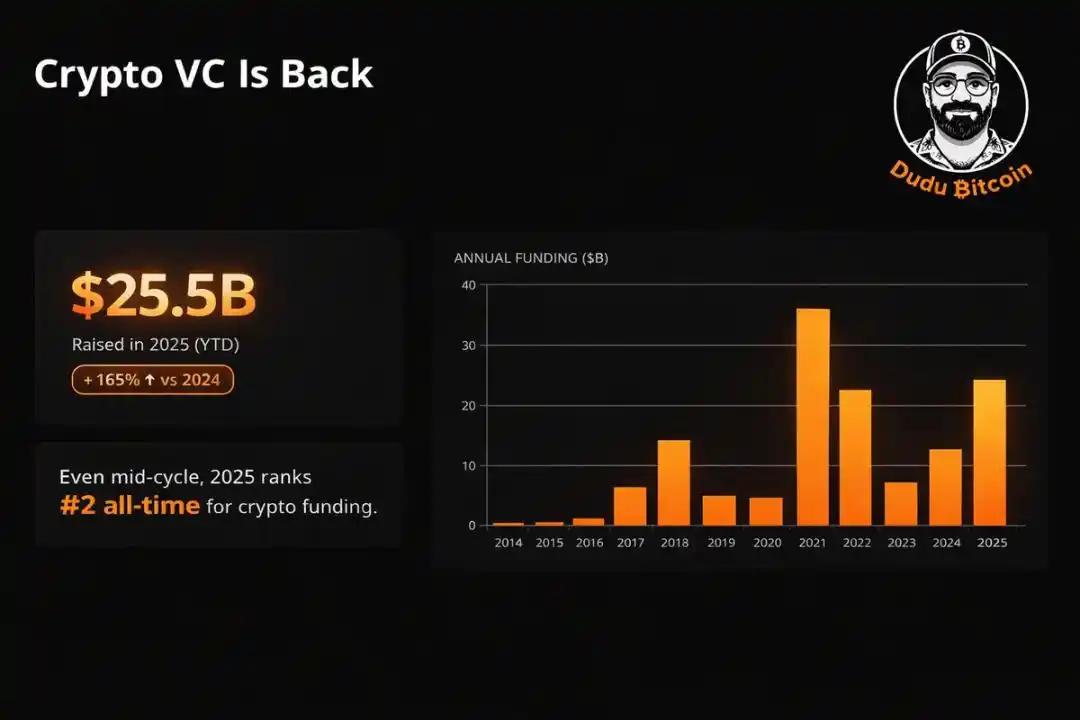
The total funding for the year reached $25 billion, marking the second-highest year on record, second only to the frenzy of 2021.
But a key difference this year: the current funding fervor is actually more sustainable. To understand where the money is flowing, I spent weeks analyzing 6,723 funding rounds.
Winning Sectors: Prediction Markets, AI Storage, and RWA
Prediction markets emerged as the biggest winners, which is not surprising.
For prediction markets, 2025 was a bountiful year—it was the only track within Web3 that successfully attracted a mainstream consumer base. Platforms like Polymarket and Kalshi found themselves in fierce competition, both striving to secure more top-tier partnerships. Today, prediction markets are embedded in Google searches and major mainstream media outlets, further integrating into the public sphere.
Real-world assets (RWA) and the cybersecurity sector have risen to the top of the funding charts, confirming a key point: cryptocurrency is gradually maturing and becoming an integral part of the financial system, with a stronger foundation.
However, for entrepreneurs focused on NFT development, this year's situation is not optimistic.
Seed Round Funding is Maturing
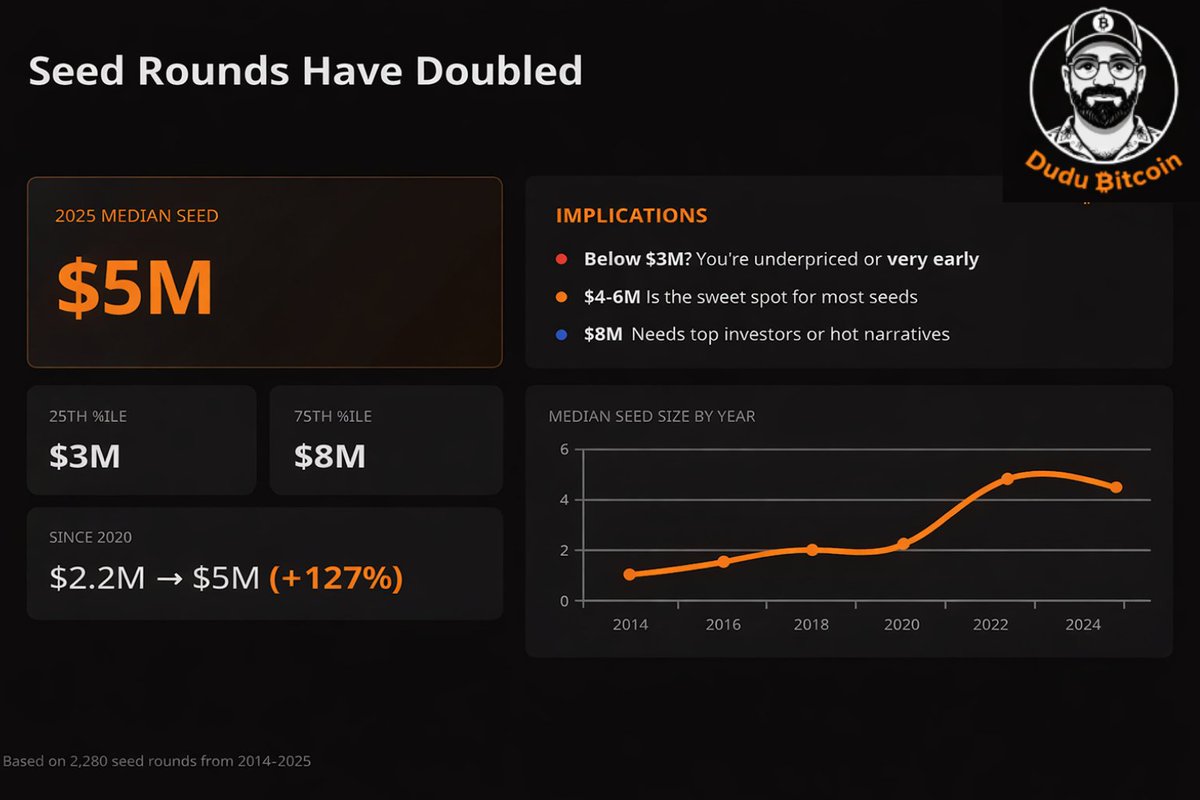
The era of launching a project with small seed funding is long gone. In the age of AI, the resources needed to develop a product used by people have significantly decreased. This means that entrepreneurs can operate "bootstrapped" for longer, only seeking funding when they have a truly tangible result to show.
Recommendation: Strive to Collaborate with Coinbase Ventures
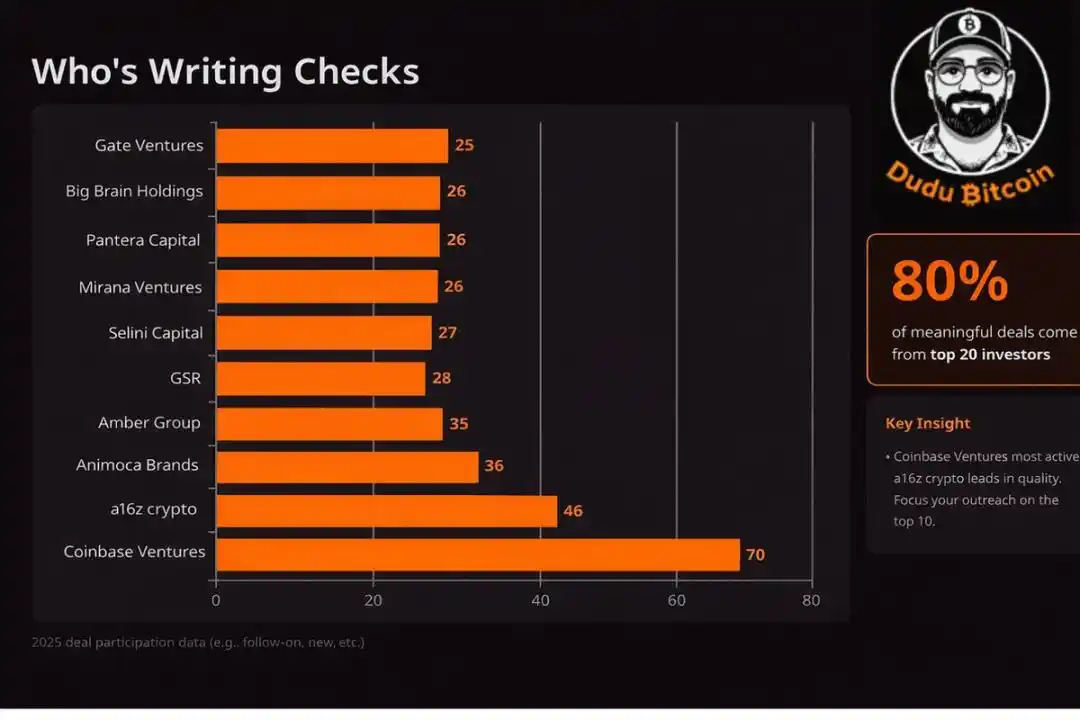
I've seen too many so-called "investment matchmakers" — they help connect entrepreneurs with investors, but take a commission for it. What's more, most of these matchmakers only know third-tier investors, so the time cost for entrepreneurs is simply not worth it. Therefore, if you're looking, find someone who can connect you with top-tier institutions like Coinbase Ventures, rather than niche organizations like the "Soulja Boy Fund" (Note: Soulja Boy is an American rapper, and the fund under his name has a small scale and limited investment influence).
Cryptocurrency Is Gradually Maturing
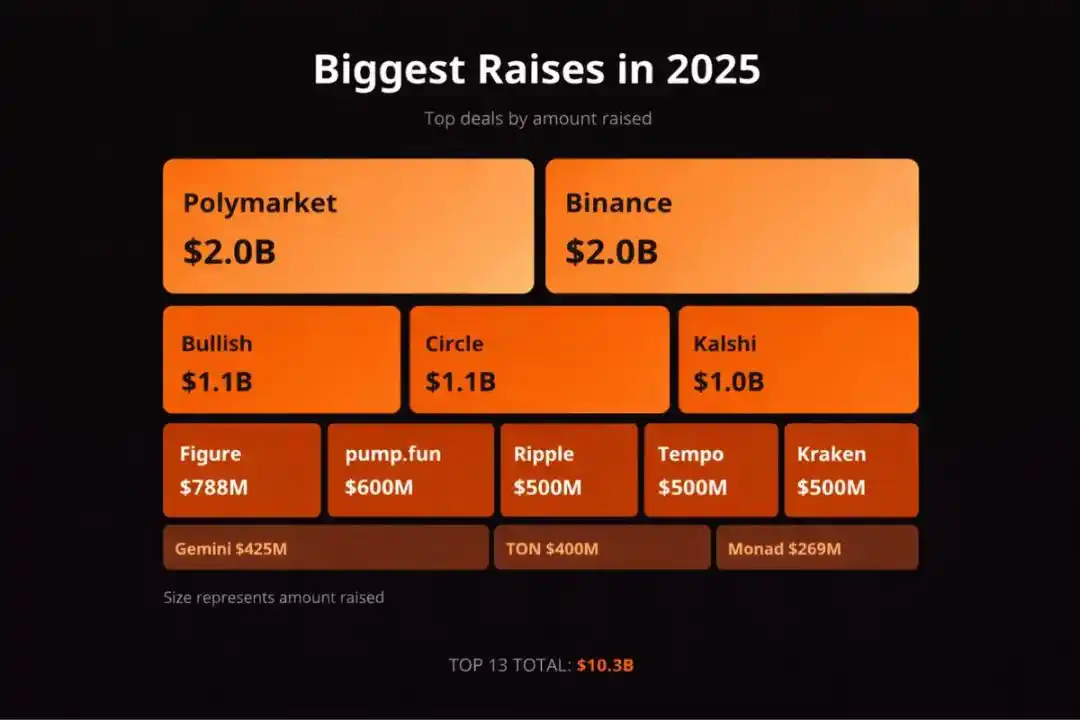
Look at the largest funded projects this year, and the trend is quite clear.
Of course, the crypto space still retains some "speculative vitality" (Note: referring to the crypto field's unique high-risk, high-speculation trend):
· Binance: Received a huge amount of funding from the UAE to build a top-tier meme coin exchange platform;
· Pump.fun: Set a record for the issuance of meme coins per second;
· TON: Leveraging Telegram's widespread popularity in the crypto space, it has gained considerable attention;
· Monad: Its L1 public chain has accumulated a large following in the community, but the subsequent TGE performance was disappointing.
Every industry cycle needs some "stimulating elements," but if you take a step back from a short-term perspective, you will clearly see the maturity trend in the crypto space.
Two of the largest funded projects this year come from the prediction market — Polymarket and Kalshi.
As mentioned earlier, 2025 is a bumper year for prediction markets, the only track in the Web3 space that truly attracts mainstream consumer groups. Polymarket and Kalshi are still in fierce competition, fully striving to secure more tier-one partners. Their services are now embedded in Google Search and major mainstream media outlets.
The stablecoin sector has also performed well in 2025:
· Bullish: Co-founded by Brendan Blumer, who previously sparked controversy with the EOS project, its IPO raised $1 billion.
· Ripple: Successfully attracted Wall Street funds and expanded into the stablecoin field;
· Circle: Raised $1 billion through an IPO, followed by a significant surge in its stock price;
· Payment giant Stripe: Launched the L1 blockchain "Tempo," proving that fintech companies are also actively entering the crypto space;
· Figure: Completed a billion-dollar IPO, also focusing on stablecoin-related business.
Finally, cryptocurrency exchanges Kraken and Gemini also completed fundraising rounds, likely the final ones before their IPOs.
The total funding for the above four "speculative" projects is approximately $3.27 billion; the predicted market area has raised a total of $3 billion; and projects in the more mature track of the Web3 space have raised a total of $3.4 billion.
Today's cryptocurrency is no longer limited to a single attribute. It is splitting into three parallel tracks of development:
· Speculation and Cultural Track (such as Meme coins, niche public chains);
· Information and Truth Market Track (with prediction markets at its core);
· Real-world Financial Infrastructure Track (such as stablecoins, RWAs).
You may also like

Galaxy Deep Research Report: How Hyperliquid's HIP-4 Upgrade Changes the Landscape of Prediction Markets?

ZachXBT: Humanity private key leak and abnormal surge in H token should be viewed separately
On June 9, according to related disclosures, on-chain investigator ZachXBT posted an update on Humanity’s roughly $31 million security incident, saying that after further analyzing fund flows, he currently tends to believe the project team was not involved in an “inside job” or a self-staged attack. According to him, the official explanation about the private key leak was broadly accurate, but before the token unlock, the price of H had been artificially pushed higher, and the hacker later took advantage of that market environment; therefore, the private key leak and the earlier abnormal price pumping should be regarded as two separate and independent events. This reframing has shifted the market’s understanding of the nature of the incident. Earlier discussion around Humanity had focused on whether the team directly participated in the attack or used the security incident to cover up internal operations. ZachXBT’s latest remarks shift the focus from “whether it was self-theft” to “whether there were pre-unlock market structure issues.” He also questioned whether the team may have.

Morning Report | OpenAI has submitted an S-1 registration statement draft to the U.S. SEC; Morpho completes $175 million financing

Morning Report | BitMine increased its holdings by 126,971 ETH last week; trader Eugene announced his exit from the crypto market

Wang Chuan: How can one not feel anxious after the neighbor Old Wang made thirty times profit by investing in storage stocks? (Seven) - A quarter-century cycle

Cryptocurrency CEXs are flocking to sell US stocks, and traditional brokerages are facing an "uninvited guest."
$75 billion in foreign capital has fled, and South Korean retail investors have absorbed it all using leverage

Japan’s Three Megabanks Plan Joint Stablecoin Issuance in Fiscal 2026
MUFG, SMBC, and Mizuho reportedly plan to jointly issue fiat-pegged stablecoins in fiscal 2026, signaling Japan’s growing push into bank-led digital payment infrastructure.

Humanity Discloses H Token Dual-Chain Attack Details, With Losses on Ethereum and BSC Exceeding $36 Million
Humanity said the H token attack across Ethereum and BSC caused more than $36 million in losses after leaked ProxyAdmin keys enabled malicious contract upgrades and token minting.
White House Discusses CLARITY Act With Law Enforcement Ahead of Senate Vote
The White House discussed the CLARITY Act with law enforcement ahead of a Senate vote, focusing on illicit finance risks and developer protections.

Bitcoin Trading Guide 2026: Strategies for Experienced Traders

What Is XAUT and PAXG? Why Tokenized Gold Is Booming in 2026

Will the SpaceX IPO Hurt Bitcoin? Here's What Traders Are Watching

Foreign selling in the South Korean stock market accelerates, with cumulative net sales reportedly reaching $75 billion this year
On June 9, The Kobeissi Letter, citing Goldman Sachs data, reported that global investors are selling South Korean stocks at an unusually rapid pace. In the latest trading session, foreign investors sold about $801 million worth of Kospi constituent stocks again; total foreign outflows last week reached about $10 billion, and the market has been in net foreign selling on nearly every trading day over the past month. According to the data cited in the report, foreign investors have sold about $75 billion worth of South Korean stocks so far this year. Meanwhile, South Korean retail and institutional investors together recorded roughly $69 billion in net buying over the same period, suggesting that the market’s main buying support has come from domestic capital rather than returning overseas funds. The information currently disclosed still mainly comes from The Kobeissi Letter’s retelling and Goldman Sachs data summaries, while public details on the statistical period and the specific definition of “selling” remain relatively limited.

Fortune Warns of Strategy’s Financing Structure Risks as Bitcoin Premium Narrows
Fortune warned that Strategy’s Bitcoin treasury model faces growing financing risks as MSTR’s net asset premium narrows and preferred stock dividend pressure increases.

Ferrari Challenge Le Mans: Carl Moon to Dominate in WEEX Livery

Sahara AI Responds to SAHARA’s Sharp Drop: No Contract or Product Security Issues Found, Internal Investigation Underway
Sahara AI responded to SAHARA’s 60% price drop, saying no token contract or product security issues have been found and an internal investigation is underway.

WEEX Deposit/Withdrawal Dynamic Island: Your Asset Status, Always in Sight
Galaxy Deep Research Report: How Hyperliquid's HIP-4 Upgrade Changes the Landscape of Prediction Markets?
ZachXBT: Humanity private key leak and abnormal surge in H token should be viewed separately
On June 9, according to related disclosures, on-chain investigator ZachXBT posted an update on Humanity’s roughly $31 million security incident, saying that after further analyzing fund flows, he currently tends to believe the project team was not involved in an “inside job” or a self-staged attack. According to him, the official explanation about the private key leak was broadly accurate, but before the token unlock, the price of H had been artificially pushed higher, and the hacker later took advantage of that market environment; therefore, the private key leak and the earlier abnormal price pumping should be regarded as two separate and independent events. This reframing has shifted the market’s understanding of the nature of the incident. Earlier discussion around Humanity had focused on whether the team directly participated in the attack or used the security incident to cover up internal operations. ZachXBT’s latest remarks shift the focus from “whether it was self-theft” to “whether there were pre-unlock market structure issues.” He also questioned whether the team may have.
Morning Report | OpenAI has submitted an S-1 registration statement draft to the U.S. SEC; Morpho completes $175 million financing
Morning Report | BitMine increased its holdings by 126,971 ETH last week; trader Eugene announced his exit from the crypto market
Wang Chuan: How can one not feel anxious after the neighbor Old Wang made thirty times profit by investing in storage stocks? (Seven) - A quarter-century cycle
Cryptocurrency CEXs are flocking to sell US stocks, and traditional brokerages are facing an "uninvited guest."


