
8 years ago a book that made Saylor go all-in on Bitcoin, gave Silver the "death sentence"

Original Title: "A Book About Bitcoin from 8 Years Ago is Now 'Predicting' the Silver Crash?"
Original Author: David, Deep Tide TechFlow
In 2020, MicroStrategy founder Michael Saylor read a book and decided to buy $425 million worth of Bitcoin.
The book is called "The Bitcoin Standard," published in 2018, translated into 39 languages, with sales over a million copies, revered by Bitcoiners as the "Bible."
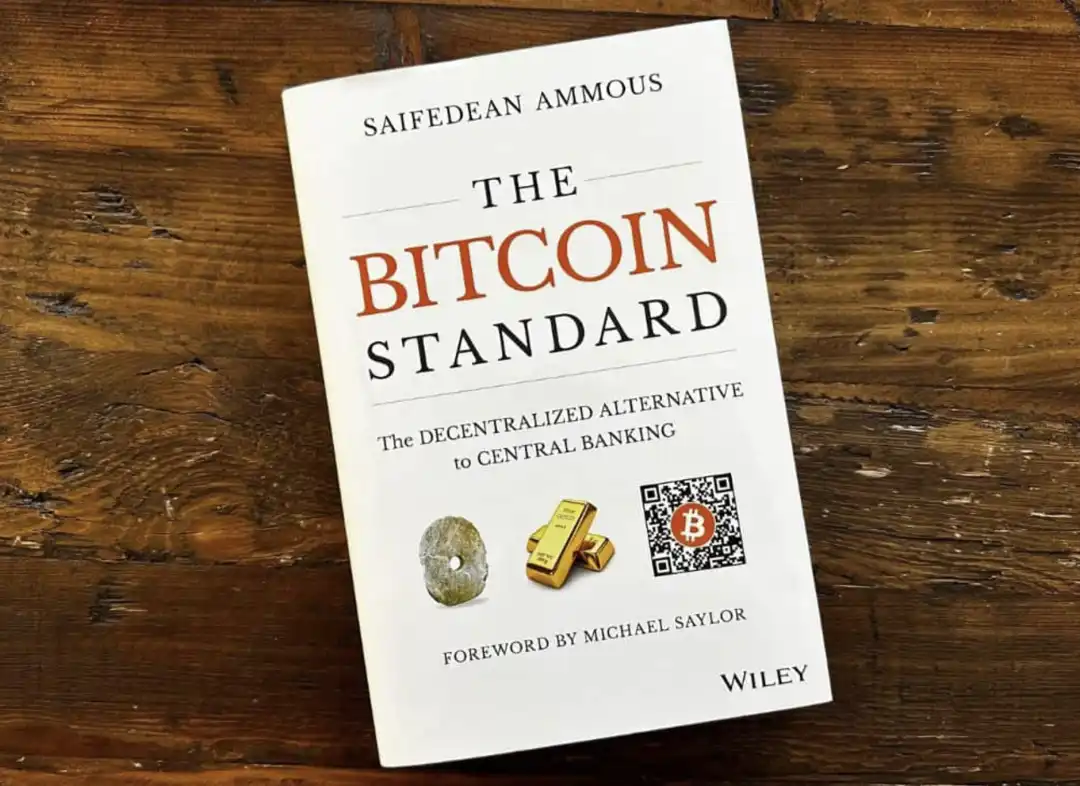
The author, Saifedean Ammous, holds a Ph.D. in Economics from Columbia University, and the core argument is simple:
Bitcoin is a harder "hard currency" than gold.
Moreover, on the book's back cover, Michael Saylor's endorsement reads:
"This book is a work of genius. After reading it, I decided to buy $425 million worth of Bitcoin. It had the most profound impact on MicroStrategy's thinking, leading us to shift our balance sheet to a Bitcoin standard."
However, there is a chapter in this book that is not about Bitcoin. It explains why silver cannot become hard money.
Today, 8 years later, silver has just surged to a historic high of $117, the precious metals investment frenzy continues, with even Hyperliquid and various CEXs starting to offer precious metals contract trading in different forms.
Usually, at such times, there are always whistleblowers and contrarians who play the role of reminding about risks, especially in an environment where everything is rising except Bitcoin.
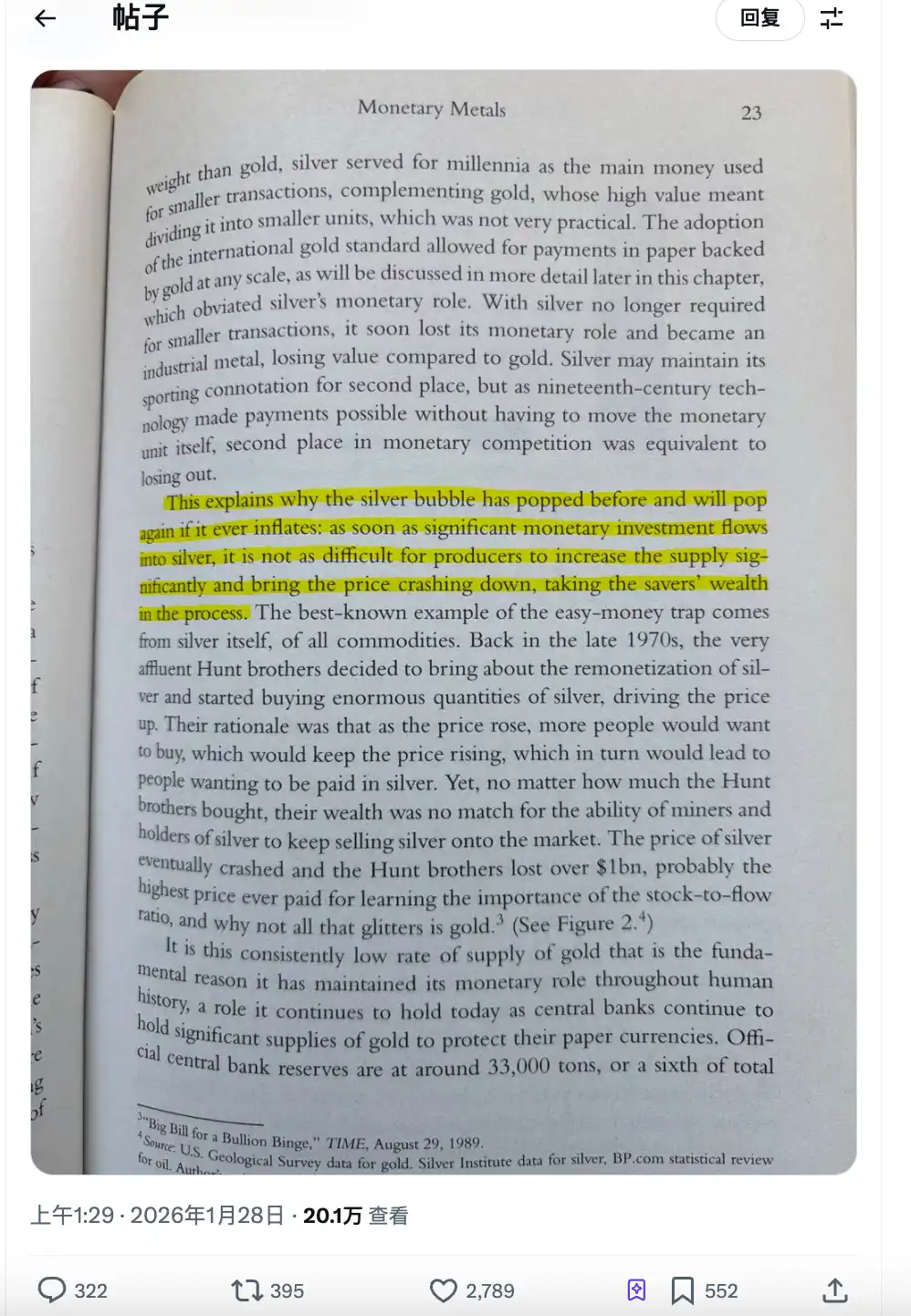
For instance, a widely circulated post on Crypto Twitter today highlighted a screenshot of page 23 from this book, with the following passage:
Every silver bubble bursts, and the next one will be no exception.
Silver Speculation History
Before rushing to criticize, let's take a look at what this core argument really means.
The core argument in this book is actually called stock-to-flow. BTC OGs should have heard of this theory to some extent.
In plain language, for something to become "hard money," the key is how difficult it is to increase its supply.
Gold is hard to mine. The global above-ground gold stock is about 200,000 tons, with an annual addition of less than 3,500 tons. Even if the gold price doubles, miners cannot suddenly double the amount of gold mined. This is called "supply rigidity."
Bitcoin is even more extreme. The total supply is capped at 21 million coins, halving every four years, and no one can change the code. This is scarcity created by algorithm.
What about silver?
The highlighted excerpt in the book roughly states: The silver bubble has burst before and will burst again in the future. This is because once a large amount of money flows into silver, miners can easily increase the supply, driving the price down and causing the wealth of savers to evaporate.
The author also gave an example: the Hunt Brothers.
In the late 1970s, Texas oil tycoons the Hunt Brothers decided to hoard silver, attempting to corner the market. They bought billions of dollars' worth of silver and futures contracts, pushing the price from $6 to $50, setting a historic high for the silver price at the time.
And then? Miners frenziedly unloaded silver, trading platforms raised margin requirements, and the silver price collapsed. The Hunt Brothers lost over $1 billion and eventually went bankrupt.

Therefore, the author's conclusion is:
Silver's supply elasticity is too high, making it impossible to become a store of value. Every time someone tries to hoard it as "hard money," the market will teach them a lesson with increased supply.
When this logic was written in 2018, silver was $15 per ounce. Few cared.
Is this round of silver different?
For the above logic about silver to hold true, there is a premise: if the silver price rises, the supply can keep up.
However, 25 years of data tell a different story.
Global silver mine production peaked in 2016 at about 900 million ounces. By 2025, this number had dropped to 835 million ounces. The price increased by 7 times, but production decreased by 7%.
Why Is the Logic of "Price Increase Leads to Production Increase" No Longer Effective?
One structural reason is that about 75% of silver is produced as a by-product of copper, zinc, and lead mining. Miners' production decisions are based on the prices of base metals, not silver. If the price of silver doubles but the price of copper remains the same, mines will not ramp up production.
Another reason could be time. From exploration to production, the cycle of a new mining project is 8 to 12 years. Even if construction were to start immediately, no additional supply would be seen before 2030.
The result is a five-year consecutive supply deficit. According to data from the Silver Institute, from 2021 to 2025, the global silver cumulative deficit is close to 820 million ounces, which is almost equivalent to the entire annual global mine production.
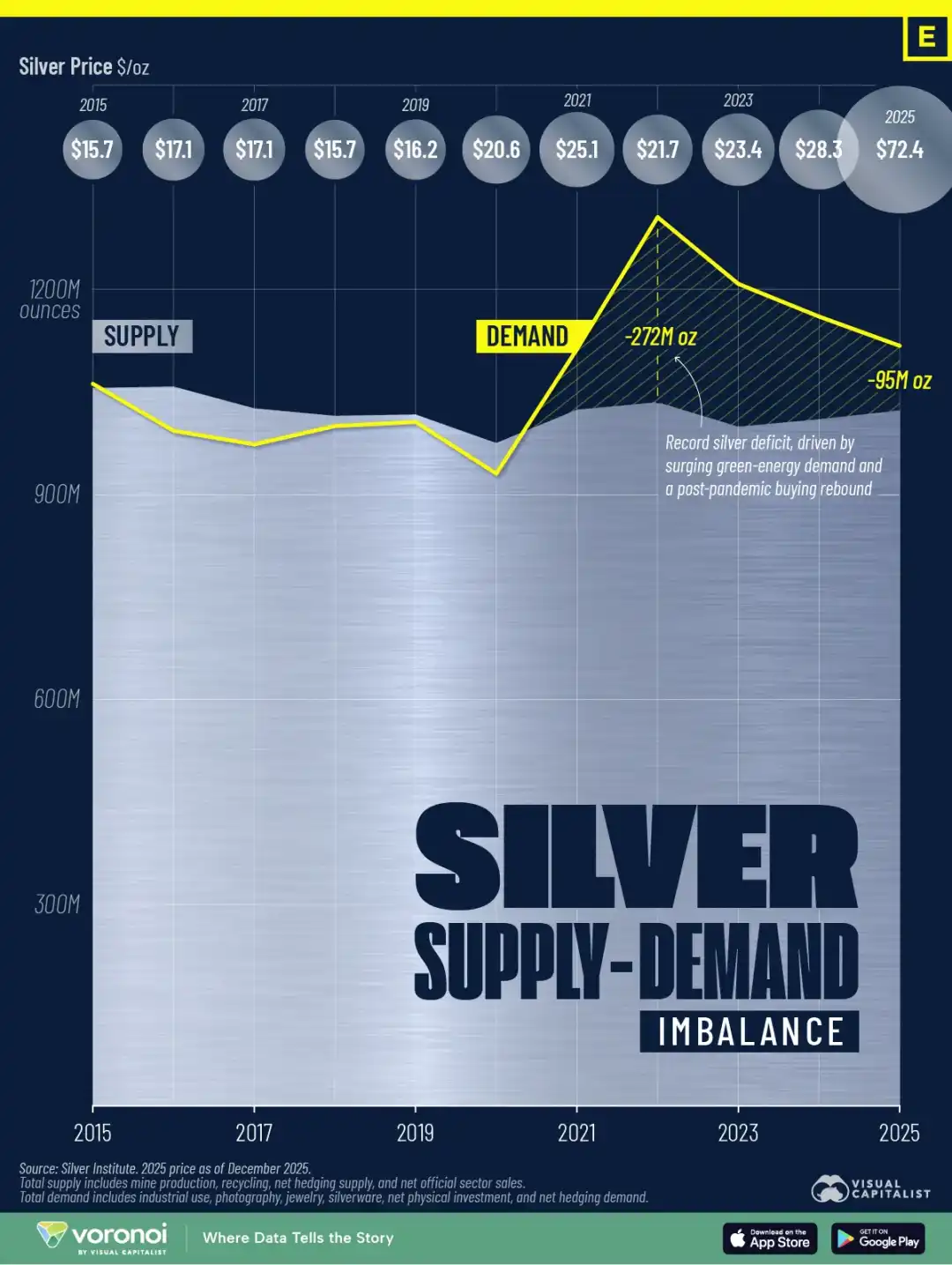
Meanwhile, silver inventories are also hitting rock bottom. The London Bullion Market Association's deliverable silver inventory has dropped to only 155 million ounces. The silver lease rate has surged from 0.3%-0.5% in normal years to 8%, meaning someone is willing to pay an 8% annualized cost just to ensure they can get physical delivery.
There is also a new variable. Starting January 1, 2026, China has implemented export restrictions on refined silver, where only state-owned large refineries with an annual capacity exceeding 80 tons can obtain export permits. Small and medium-sized exporters are directly shut out.
In the era of the Hunt Brothers, miners and holders could use increased production and selling pressure to suppress prices.
This time, the ammunition on the supply side may not be sufficient.
It's Speculation and Utility
When the Hunt Brothers hoarded silver, silver was a speculative asset. Buyers were thinking: the price will rise, so they stockpiled it to sell later.
The upward trend of silver in 2025 has a completely different driving force.
First, look at a set of data. According to the World Silver Survey 2025 report, industrial demand for silver reached 680.5 million ounces in 2024, a historical high. This figure accounts for over 60% of global total demand.
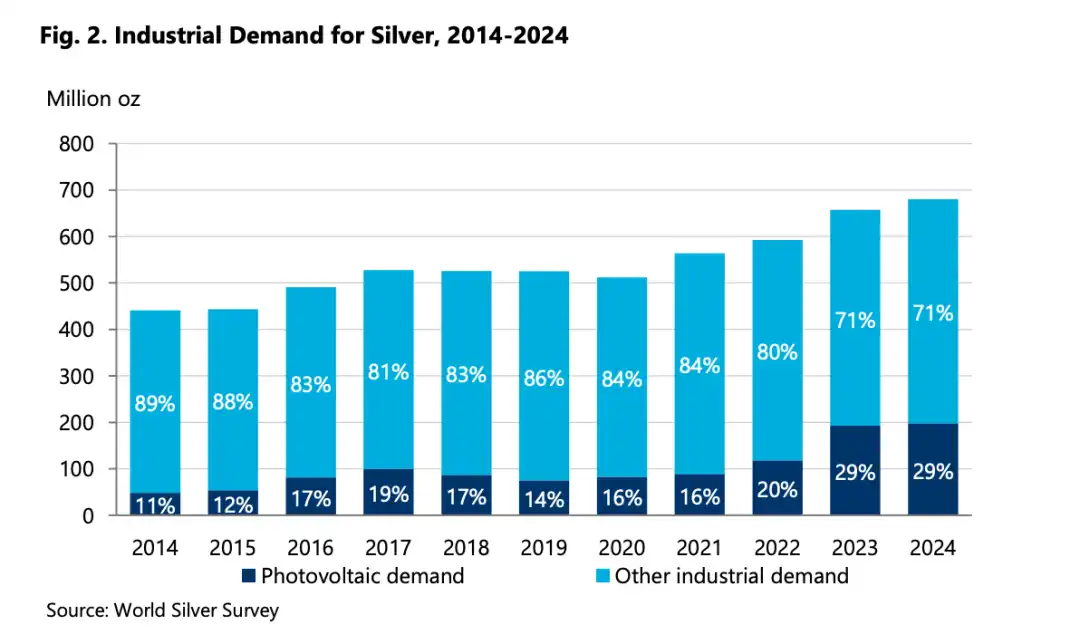
What is driving industrial demand?
Solar Photovoltaics: Every solar panel requires silver paste as a conductive layer. The International Energy Agency predicts that global solar photovoltaic capacity will double by 2030. The solar industry is already the largest single industrial buyer of silver.
Electric Vehicles. A traditional gasoline car uses about 15-28 grams of silver. An electric vehicle uses 25-50 grams, with higher-end models using more. Silver is used everywhere from the battery management system, motor controller, to the charging port.
AI and Data Centers. Servers, chip packaging, high-frequency connectors, silver's conductivity and thermal properties are irreplaceable. This demand is expected to accelerate starting in 2024, with the Silver Institute specifically listing "AI-related applications" in their report.
In 2025, the U.S. Department of the Interior included silver in the "critical minerals" list. The last time this list was updated, lithium and rare earths were added.
Of course, maintaining a high silver price will lead to a "silver-saving" effect, such as some solar panel manufacturers already reducing the amount of silver paste per panel. However, the Silver Institute's forecast is that even considering the silver-saving effect, industrial demand will remain close to record levels in the next 1-2 years.
This is actually a rigid demand, something that Saifedean may not have foreseen when he wrote "The Bitcoin Standard."
A Book Can Also Provide Psychological Massage
The narrative of Bitcoin as "digital gold" has recently been muted compared to real gold and silver.
The market has called this year the "debasement trade": the weakening of the U.S. dollar, rising inflation expectations, geopolitical tensions, and funds flowing into hard asset havens. However, this wave of safe-haven funds chose gold and silver, not Bitcoin.
For Bitcoin extremists, this requires an explanation.
So the book mentioned above has become a classic reference and a defense of a position: silver is rising now because of a bubble; wait for it to burst, and then you will know who was right.
This is more like a narrative self-rescue.
When the asset you hold underperforms the market for a whole year, you need a framework to explain "why I am still right."
Short-term prices are not important; long-term logic is crucial. The logic of silver is wrong, the logic of Bitcoin is right, so Bitcoin will inevitably outperform, it's just a matter of time.
Is this logic internally consistent? It is. Can it be falsified? It's difficult.
Because you can always say, "time has not been long enough."
The problem is, the real world doesn't play by the rules. Holding Bitcoin and altcoins in hand, brothers who stay true to the crypto circle are really anxious.
The Bitcoin theory written down 8 years ago cannot automatically cover the reality of no price increase 8 years later.
As silver continues to skyrocket, we also sincerely wish Bitcoin good luck.
You may also like

Japan’s Three Megabanks Plan Joint Stablecoin Issuance in Fiscal 2026
MUFG, SMBC, and Mizuho reportedly plan to jointly issue fiat-pegged stablecoins in fiscal 2026, signaling Japan’s growing push into bank-led digital payment infrastructure.

Humanity Discloses H Token Dual-Chain Attack Details, With Losses on Ethereum and BSC Exceeding $36 Million
Humanity said the H token attack across Ethereum and BSC caused more than $36 million in losses after leaked ProxyAdmin keys enabled malicious contract upgrades and token minting.

White House Discusses CLARITY Act With Law Enforcement Ahead of Senate Vote
The White House discussed the CLARITY Act with law enforcement ahead of a Senate vote, focusing on illicit finance risks and developer protections.

$75 billion in foreign capital has fled, and South Korean retail investors have absorbed it all using leverage

Bitcoin Trading Guide 2026: Strategies for Experienced Traders

What Is XAUT and PAXG? Why Tokenized Gold Is Booming in 2026

Cryptocurrency CEXs are flocking to sell US stocks, and traditional brokerages are facing an "uninvited guest."

Will the SpaceX IPO Hurt Bitcoin? Here's What Traders Are Watching
Foreign selling in the South Korean stock market accelerates, with cumulative net sales reportedly reaching $75 billion this year
On June 9, The Kobeissi Letter, citing Goldman Sachs data, reported that global investors are selling South Korean stocks at an unusually rapid pace. In the latest trading session, foreign investors sold about $801 million worth of Kospi constituent stocks again; total foreign outflows last week reached about $10 billion, and the market has been in net foreign selling on nearly every trading day over the past month. According to the data cited in the report, foreign investors have sold about $75 billion worth of South Korean stocks so far this year. Meanwhile, South Korean retail and institutional investors together recorded roughly $69 billion in net buying over the same period, suggesting that the market’s main buying support has come from domestic capital rather than returning overseas funds. The information currently disclosed still mainly comes from The Kobeissi Letter’s retelling and Goldman Sachs data summaries, while public details on the statistical period and the specific definition of “selling” remain relatively limited.

Fortune Warns of Strategy’s Financing Structure Risks as Bitcoin Premium Narrows
Fortune warned that Strategy’s Bitcoin treasury model faces growing financing risks as MSTR’s net asset premium narrows and preferred stock dividend pressure increases.

Ferrari Challenge Le Mans: Carl Moon to Dominate in WEEX Livery

Sahara AI Responds to SAHARA’s Sharp Drop: No Contract or Product Security Issues Found, Internal Investigation Underway
Sahara AI responded to SAHARA’s 60% price drop, saying no token contract or product security issues have been found and an internal investigation is underway.

WEEX Deposit/Withdrawal Dynamic Island: Your Asset Status, Always in Sight
Scaling Crypto Derivatives: The Digital Asset Infrastructure Behind High-Volume Trading
In the fast-moving digital asset ecosystem, derivatives platforms face an extreme architectural test. High-leverage futures markets demand more than just standard security—they require absolute operational precision, zero-latency matching engines, and ironclad structural scalability, all while navigating intense market volatility.
As global platforms scale to meet these demands, the industry is shifting away from rigid, monolithic setups toward a more agile, "decoupled" infrastructure philosophy.
The Blueprint for High-Volume Copy TradingFor elite global exchanges like WEEX (founded in 2018), this architectural choice becomes critical when scaling high-volume retail features like social copy trading. When thousands of users automatically mirror the real-time strategies of elite traders simultaneously, it triggers sudden, monumental spikes in concurrent transactional volume.
To prevent execution latency or settlement bottlenecks during these peak volatility events, a platform's primary engine must remain entirely dedicated to risk management, copy-trade synchronization, and order matching.
The Architectural Rule: New-generation platforms must separate front-end user execution engines from heavy backend infrastructural overhead to eliminate operational friction.
By separating these layers, platforms can maintain complete sovereignty over their trading environments and user experiences while strategically aligning with institutional-grade infrastructure ecosystems. This strategic framework allows modern exchanges to leverage advanced Digital Asset Custody infrastructure such as Cobo’s behind the scenes, ensuring that backend wallet management scales elastically alongside trading spikes.
Capitalizing on Market Momentum and 400× LeverageIn a derivatives arena where platforms offer up to 400× leverage on perpetual contracts, capital efficiency and market agility are core business metrics. To capture market momentum, an exchange needs the ability to rapidly expand its asset offerings, supporting everything from legacy crypto assets to sudden, trending altcoins across a massive library of trading pairs.
Adopting a flexible, scalable Wallet-as-a-Service (WaaS) solution such as Cobo’s could completely rewrite the development timeline for high-growth exchanges. Instead of spending months of engineering capital building out custom backend wallet architectures for every new blockchain network, platforms can deploy localized infrastructure in days.
This agility allows platforms to instantly scale their listings to over a thousand trading pairs without compromising security or delaying time-to-market. It mirrors the exact operational advantages seen during high-velocity market events, similar to how advanced wallet infrastructure empowers platforms during sudden asset surges; allowing exchanges to pass that speed and liquidity directly to their global user base.
A Mature Foundation for GrowthThe synergy between trusted infrastructure ecosystems and global trading platforms represents the natural evolution of a maturing crypto market. As WEEX continues to scale its global spot and derivatives offerings for over 6 million users, adopting robust backend paradigms proves that platforms no longer have to compromise between cutting-edge trading velocity and uncompromised structural security.

Morning Report | BitMine increased its holdings by 126,971 ETH last week; trader Eugene announced his exit from the crypto market

Wang Chuan: How can one not feel anxious after the neighbor Old Wang made thirty times profit by investing in storage stocks? (Seven) - A quarter-century cycle

Get Paid to Onboard? Try WEEX’s New Homepage with Rewards for Registration, Deposit & Trade
WEEX Custom Layout: Build Your Perfect Trading Workspace in Seconds
Japan’s Three Megabanks Plan Joint Stablecoin Issuance in Fiscal 2026
MUFG, SMBC, and Mizuho reportedly plan to jointly issue fiat-pegged stablecoins in fiscal 2026, signaling Japan’s growing push into bank-led digital payment infrastructure.
Humanity Discloses H Token Dual-Chain Attack Details, With Losses on Ethereum and BSC Exceeding $36 Million
Humanity said the H token attack across Ethereum and BSC caused more than $36 million in losses after leaked ProxyAdmin keys enabled malicious contract upgrades and token minting.
White House Discusses CLARITY Act With Law Enforcement Ahead of Senate Vote
The White House discussed the CLARITY Act with law enforcement ahead of a Senate vote, focusing on illicit finance risks and developer protections.
$75 billion in foreign capital has fled, and South Korean retail investors have absorbed it all using leverage
Bitcoin Trading Guide 2026: Strategies for Experienced Traders
What Is XAUT and PAXG? Why Tokenized Gold Is Booming in 2026


