
Bitcoin Enters Bond Market, Moody's Provides First-Ever Rating for Global Cryptocurrency-Backed Bond


Original Title: "Bitcoin Enters the Municipal Bond Market, Moody's Issues First-Ever Credit Rating for Crypto-Backed Bond"
Original Author: Sanqing, Foresight News
On March 31, Moody's Investors Service provided a provisional credit rating of Ba2 for a Bitcoin-backed bond issued by the New Hampshire Business Finance Authority (New Hampshire BFA) in the United States. This marks the first time a traditional rating agency has conducted a credit assessment of a Bitcoin-backed municipal bond.
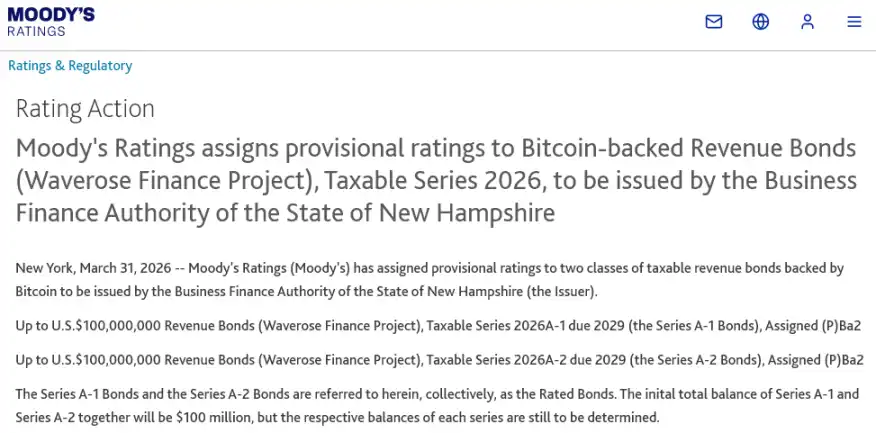
Image Source: MOODY'S Ratings & Regulatory
What Is This Bond?
This is a $100 million Bitcoin-backed taxable revenue bond linked to the Waverose Finance Project, divided into two series: 2026A-1 and 2026A-2, both maturing in 2029.
The bond was structured by Wave Digital Assets, Rosemawr Management serves as the investment manager, Orrick provides legal services, and the fees BFA receives from the transaction will be used to establish the "Bitcoin Economic Development Fund."
The core of the bond's structure does not rely on any entity's cash flow but instead directly repays using Bitcoin as collateral. The Bitcoin collateral is custody by BitGo Trust Company, Inc., held in regulated cold storage.
When the borrower needs to pay interest or repay principal, the collateral will be liquidated to cover the expenses. The bond also features a term favorable to holders. A-2 series holders have the right to receive additional BTC profit sharing if the Bitcoin price is higher than the pricing date at maturity after full principal and interest repayment.
Compared to Bitcoin lending tools on platforms like Coinbase, the significance of this bond lies in the fact that it has provided cryptocurrency with an opportunity to enter the public debt market for the first time. Borrowers no longer rely on private loans from centralized platforms but, by obtaining a traditional credit-rated public bond, can leverage institutional funds at scale and low cost within a compliant framework.
How Institutions Evaluate Bitcoin Risk
Moodys stated in a report that the provisional rating primarily reflects risks related to collateral, structure, and operations, with Bitcoin's high volatility being a key consideration.
To hedge against price volatility, the issuance structure introduced a 1.6x excess collateral requirement, with the BTC collateral value always required to be maintained above 160% of the debt exposure.
Once the collateral ratio falls to the 1.4x trigger line (i.e., LTV deteriorates to around 71%), a mandatory full redemption mechanism will be triggered, the bond will mature prematurely, and the Bitcoin will be liquidated for repayment.
In other words, to borrow $100, you must pledge at least $160 worth of Bitcoin. If the collateral value shrinks to below $140, the system will trigger a forced redemption, the bond will mature early, and the Bitcoin will be sold to repay the debt.
In the rating report, Moodys adopted a 72% advance rate and a shorter liquidation window to assess conservatism, simulating an extreme scenario where the Bitcoin price drops by around 28% from the pricing date. The test showed that the 1.6x initial excess collateral and 1.4x trigger mechanism still provide sufficient protection, supporting the Ba2 rating result.
This set of parameters is quite conservative, but for an asset with a historical drawdown of over 50%, this conservatism may also be a prerequisite for Moody's willingness to provide a rating.
Another detail worth noting separately is that, although this bond is named after the New Hampshire Business Finance Authority, it has no association with the state's public credit. Moodys clearly stated in the report that no public funds from the state can be used to repay the bond.
The issuer plays the role of a conduit issuer in the structure. It provides the issuance channel and nominal endorsement but does not take on any credit backstop responsibility.
This structure is not uncommon in the traditional municipal bond field and is typically used for special project financing in areas such as healthcare and education.
Why This Transaction is Important
To understand the historical significance of this bond, it needs to be viewed in a larger context.
Over the past few years, institutions' attitude towards Bitcoin has gone through three stages: from rejection to holding the asset (BTC reserves on the corporate balance sheet), and then to using it as collateral for financing (pledging BTC in exchange for fiat loans). This bond represents the beginning of the fourth stage: Bitcoin as the underlying collateral for a publicly rated debt instrument, entering the traditional public financial markets.
This track implies three things: opening a window for institutional investors to indirectly hold Bitcoin exposure through compliant channels; prompting Moody's to develop a rating methodology for crypto collateral, attracting more rating agencies to follow suit; demonstrating that Bitcoin can serve as an underlying logic for an "interest-bearing asset" under certain conditions, rather than just a zero-yield asset.
This bond issuance is not an isolated event. Concurrently, the US Department of Labor, under President Trump's executive order, issued a proposal to expand the range of digital assets available in retirement investment portfolios; multiple states are considering "Bitcoin Treasury Reserve" legislation; and New Hampshire became the first US state to pass a cryptocurrency reserve law.
At face value, a Ba2 rating is considered "junk bond" status, but this label itself can be misleading. In Moody's rating sequence, Ba2 is in the second tier of speculative grade, with a considerable distance from the bottom of the rating scale (C/D).
Tesla only achieved investment-grade ratings from S&P and Moody's in 2022 and 2023; Ford still maintains a speculative grade (Ba1) within the Moody's system, and barely holds the lowest investment-grade tier in the S&P system with a negative outlook. However, this does not prevent them from being key allocations for institutional investors.
Furthermore, the fact that this bond could attain a Ba2 instead of lower reflects that the 1.6x overcollateralization plus the forced liquidation mechanism passed relevant scenario simulations in Moody's stress tests. Therefore, Ba2 reflects the conservatism of the structural design, rather than a simple denial of the Bitcoin asset itself.
Looking back at historical precedents, the first MBS (mortgage-backed security) and the first green bond went through similar starting points when entering the rating system. As pricing experience accumulates and structural standards mature, ratings tend to improve. In this sense, Ba2 is merely a starting point.
You may also like

Yang Ge Gary: Agent Economics and AI Microeconomics

Founder of Baixing.com: My Experience with Claude Code in Fourteen Points

How Could the SpaceX IPO Affect Bitcoin, Altcoins season, and Crypto Liquidity?

RootData: May 2026 Cryptocurrency Exchange Transparency Research Report

Should we escape the peak? The principle of the tail-end market in the stock market

Morning News | Five major virtual asset platforms in South Korea have experienced 57 incidents of hacking and system failures in six years; Grayscale submits registration application for Canton ETF

The ambitions of Kalshi, MTS, and a16z

The AI bubble is bursting

Real withdrawal is to release water: When crypto VCs position themselves in the Agent network effect

Has the narrative of BTC as "digital gold" failed?
A Perspective on the Indian Cryptocurrency Market: Descending into Silence or Moving Towards Maturity?

It took me a year to see the painful truth about Agent payments

Morning News | Bitmine issues preferred shares to raise $300 million; Polymarket accuses Kalshi of industrial espionage
Privacy coin trust crisis! ZEC plummets over 56% in a single day
Who is leading the price discovery in the cryptocurrency market? Measured delays on platforms like Binance and Hyperliquid

Anthropic launches IPO: Business miracle or valuation bubble?

What Is SpaceX IPO and Why Is Everyone Talking About It?

Macroeconomic Analysis of the African Payment Market Landscape
Yang Ge Gary: Agent Economics and AI Microeconomics
Founder of Baixing.com: My Experience with Claude Code in Fourteen Points
How Could the SpaceX IPO Affect Bitcoin, Altcoins season, and Crypto Liquidity?
RootData: May 2026 Cryptocurrency Exchange Transparency Research Report
Should we escape the peak? The principle of the tail-end market in the stock market
Morning News | Five major virtual asset platforms in South Korea have experienced 57 incidents of hacking and system failures in six years; Grayscale submits registration application for Canton ETF


