
Built on Compliance and Security, AI Empowering Users, KuCoin is Redefining the Crypto Partner

After years of brutal growth and a crisis of trust in the crypto industry, 2025 has become a turning point for the industry. For the world's leading exchanges, the simple traffic grab is a thing of the past, and a higher-dimensional competition around "compliance depth" and "technological innovation" is unfolding.
Recently, the globally leading crypto platform KuCoin has been making frequent moves. In November, it first obtained AUSTRAC cryptocurrency exchange registration in Australia, and then received the MiCAR license issued by the Austrian authorities. MiCAR is widely regarded as one of the world's strictest, most comprehensive, and forward-looking digital asset regulatory frameworks. With the MiCAR passport mechanism, KuCoin EU will be able to provide fully compliant digital asset services in 29 countries and regions in the European Economic Area.
This is a highly challenging breakthrough in the compliance architecture, meaning that KuCoin has met the EU's unified standards in terms of capital adequacy, client asset segregation, information disclosure, and more.
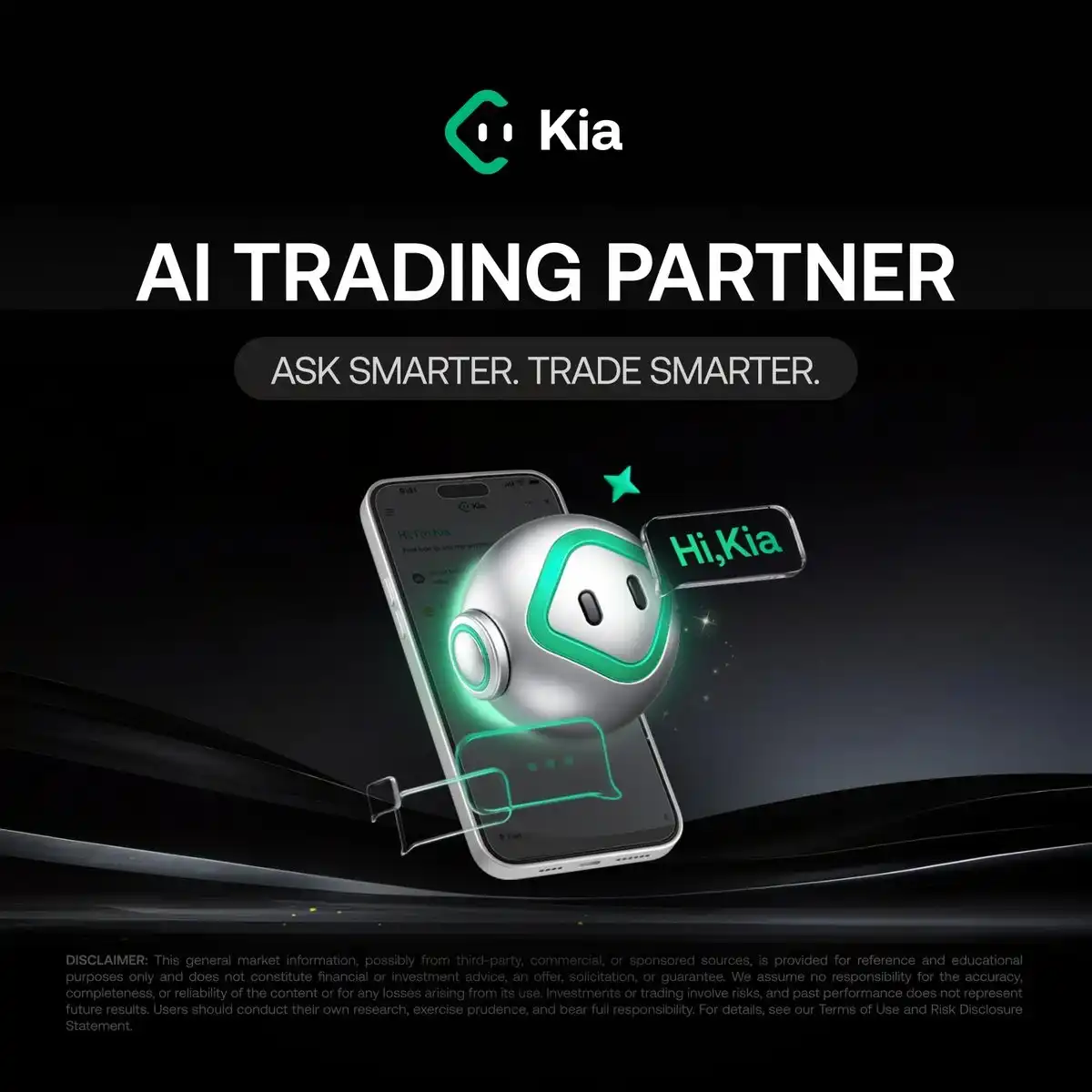
At the same time, the AI-driven KuCoin investment information assistant Kia has also been launched, initially open to all VIP users and gradually expanding to more users. KuCoin is transforming from a simple exchange platform to a trusted cryptocurrency partner for users by building a dual drive of "compliance + technology."
KuCoin's Long-termism, $20 Billion Trust Building
Over the past few years, the crypto industry has experienced volatility, reshaping, and accelerated maturity, entering a new era based on "trust" as the underlying logic. Whether it is the security and stability of trading infrastructure or the construction of a compliance system, these have become core variables for industry development. In this global trust rebuilding, KuCoin delivered a remarkable compliance report card at the end of 2025.
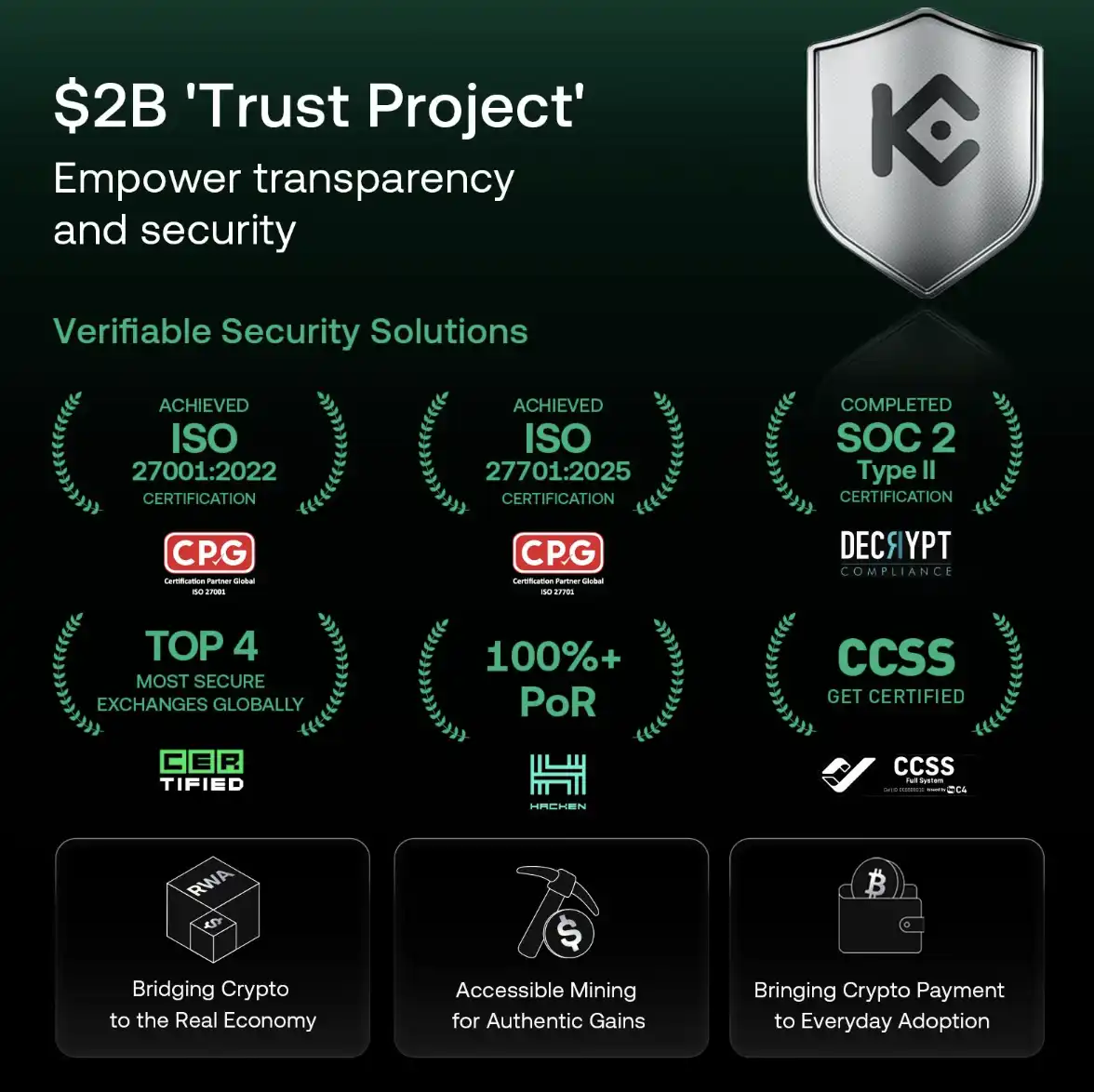
In addition to the AUSTRAC cryptocurrency exchange registration in Australia and the MiCAR license, KuCoin is also the only platform among the current leading exchanges globally to have obtained all four top-level security certifications: SOC 2 Type II, ISO 27001, ISO 27701, and CCSS. Along with CER.live's AAA-level security rating and the long-standing third-party audit proof of reserves (PoR), KuCoin has actually established a risk control and security system comparable to traditional financial institutions.
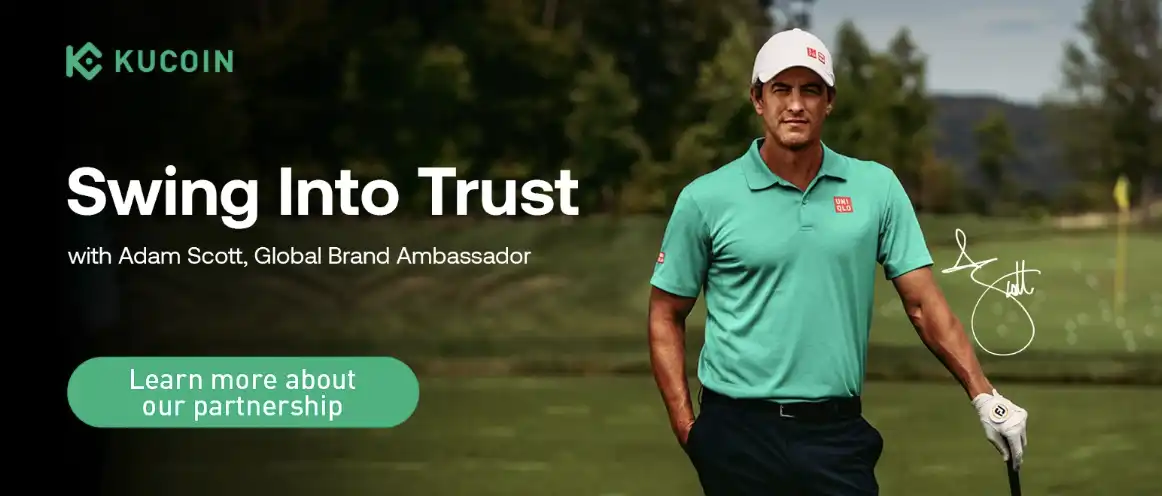
KuCoin CEO BC Wong has stated that compliance is not only an obligation but also the cornerstone of a long-term strategy. This pursuit of ultimate security and compliance, much like the qualities demonstrated by its first global brand ambassador, golfing legend Adam Scott, is precise, steady, and trustworthy.
In the minds of many, a trading platform should invest more resources in marketing campaigns or jumping on more trending memes. In contrast, allocating resources to compliance and security may not show short-term benefits prominently. It is costly, time-consuming, and users may not perceive it in the short term.
However, if we extend the time horizon, we can see that KuCoin is following a challenging yet correct long-term path. At the TOKEN2049 event in 2025, KuCoin announced a $20 billion investment in a Trust Plan and introduced the motto "Trust First. Trade Next."
The Trust Plan is not limited to just finance but extends to social responsibility. From supporting children's education in remote areas of Africa to the Bahamas' "Period Equity Project" and aiding in the relief efforts related to the Tai Po fire in Hong Kong, KuCoin is proving that the crypto industry is not just about cold code and candlestick charts; it can also become a warm force for improving the real world.
Kia: Will AI Reshape the Crypto Industry?
Compliance ensures the security of users' trading environment, and KuCoin's latest AI investment assistant, Kia, focuses on providing efficient advisory analysis to enhance user decision-making efficiency.
In today's heated competition among cryptocurrency exchanges, competing based on asset quantity or transaction speed has become somewhat weary. When market fluctuations are calculated in milliseconds, information grows exponentially, and the average investor's biggest enemy is no longer the market itself but decision paralysis caused by information overload. What the market lacks is a tool that can help ordinary users navigate through information noise, emotional swings, and a complex market.
Kia may be the disruptor that the industry has been eagerly anticipating. It is not just an embedded chatbot but a technological trump card that KuCoin has thrown to the industry after accumulating years of trading data and technical reserves—an AI native to crypto. Kia's core value lies in "noise reduction" and "empowerment."
Before Kia's emergence, crypto investors were faced with constantly moving candlestick charts on their screens and massive amounts of news, on-chain activities, and social sentiment per second. While institutional investors may capture opportunities amidst this never-ending flow of information with tools, for ordinary users, this overwhelming information is mostly just noise that interferes with decision-making.
According to the technical details released by KuCoin, Kia showcases strong data throughput and processing capabilities. Kia is not just a simple Q&A system but an intelligent hub integrated with natural language processing technology. Kia can real-time aggregate news, on-chain metrics, NFT and DeFi data, social platform sentiment, and extract trends and key factors using natural language processing technology—a task that only institutional research departments or quant teams could do in the past.
Moreover, the metrics provided by Kia are different from traditional trading signals. Traditional trading signals often resemble a black box, but Kia emphasizes interpretability, translating high-threshold financial terms into everyday conversation. When it provides risk alerts or market assessments, it synchronously displays on-chain data fluctuations, sentiment changes, or structural indicators to help users understand the underlying logic. It also informs users whether the current market is greedy or fearful and what the driving factors behind it are. Kia's emergence has made the execution of complex strategies as simple as sending a message.
In other words, Kia allows ordinary users to enjoy institutional-level data capabilities. Of course, Kia does not make decisions for users but enhances the transparency of the user's decision-making process.
In an era where phones have transitioned from keyboards to touchscreens, a change in interaction methods has brought about the explosion of the mobile internet. The emergence of Kia may lower the knowledge threshold, becoming a new gateway between users and the crypto world, allowing more people to safely enter Web3. This is a true upgrade for the crypto industry following smart contracts.
Through Kia, KuCoin has proven itself to be not just an exchange but a technology company with deep AI expertise. When AI becomes the user's investment co-pilot, mass adoption of cryptocurrency may no longer be far away.
Compliance and Security as a Shield, AI Innovation as a Spear
Looking back at the crypto industry by the end of 2025, two main threads that are reshaping the landscape can be clearly seen. One is the rebuilding of a compliant infrastructure pivoting on regulation and transparency, while the other is a technological paradigm upgrade centered on AI. In other words, compliance and security act as a shield, with AI-led innovation as the spear.
KuCoin's layout conveniently provides users with robust risk protection capabilities while empowering users to make more proactive decisions and actions through innovative tools. Whether it's the expanding global licensing system, the $2 billion Trust Plan, or the AI service capabilities represented by Kia, all present a very clear judgment. The winner in the future will not be the one who runs faster, but the one willing to invest a higher cost for longer-term security and deeper innovation.
In an industry that has experienced continuous crises, sticking to compliance and transparency is the most challenging path. The $2 billion Trust Building Plan signifies that KuCoin has built an almost industry-strong shield at a very high cost. It not only safeguards user asset security but also lays the foundation for the platform's global expansion.
Kia, on the other hand, is the sharp spear KuCoin has forged for users. This is an intelligent weapon powerful enough to change the industry experience, reshape service delivery, and lower the adoption threshold. As an AI-driven intelligent investment assistant, Kia does not merely display data but understands users, market, and strategic logic. It is like an always-on, never-tired professional analyst, capable of integrating on-chain and off-chain data, providing personalized analysis, and even assisting users in executing complex strategies, enabling the crypto industry for the first time to have a paradigm-level revolutionary product.
While the "Shield" holds the user's trust, the "Spear" is opening up KuCoin to a future of growth. In the long journey of cryptocurrency towards mainstream adoption, doing the difficult but right thing is often the most certain path to long-term success.
You may also like

WEEX Labs Lands at Dutch Blockchain Week: A Disruptive Crypto × AI Conversation Sets Sail in Amsterdam

SK Hynix Reportedly Plans U.S. ADR Listing as Early as August, With SEC Approval Possible in Late June
SK Hynix may pursue a U.S. ADR listing as early as August, with SEC approval reportedly possible in late June amid strong AI chip supply chain demand.

SpaceX vs Tesla vs xAI: Which Elon Musk Trade Has the Biggest Upside in 2026?

OpenAI Reveals It Has Confidentially Submitted an S-1 to the SEC, Keeping the Door Open for a Future IPO
On June 9, according to an OpenAI announcement, the company recently confidentially submitted a draft S-1 registration statement to the U.S. Securities and Exchange Commission (SEC), beginning the preliminary compliance process for a potential initial public offering. OpenAI said it chose to disclose this proactively because it expected the news might leak; however, the company has not yet set a specific listing timeline, and related arrangements may still take some time.

Latest research from 13 top universities including Cornell University: The current state, challenges, and misconceptions of the fusion of Crypto and AI
Deconstructing Anthropic: The Best AI Company, Possibly Also a Type of Organizational Invention
Apollo and Blackstone Reportedly Back $35 Billion Anthropic Chip Financing as Deal Details Remain Unclear
On June 9, according to currently available news alerts, Apollo and Blackstone Group participated in a $35 billion financing for an Anthropic “chip project.” Based on the original wording of the report, the funding has already been raised, but public information remains limited. The financing structure, use of proceeds, project entity, and whether Apollo and Blackstone participated through equity, debt, or project financing have not yet been disclosed.

Humanity Protocol Security Incident Escalates: More Than $31 Million Stolen From Related Addresses as Attacker Continues Selling H for ETH
On June 9, according to monitoring by Onchain Lens, more than $31 million has been stolen from addresses linked to Humanity Protocol, and the attack is still ongoing, with the hacker continuously swapping H tokens for ETH. Project founder Terence Kwok later confirmed the security incident on X, saying the issue involved a private key leak.

Bloomberg: As Bitcoin Weakens, Stablecoins and RWA Continue to Drive Expansion in Crypto Businesses
In June, Bloomberg reported that despite Bitcoin falling below $60,000 last week, wiping out about $235 billion in market value within seven days, and dropping close to 50% from last year’s peak, some core businesses in the crypto industry are still expanding, mainly in stablecoins, real-world asset tokenization (RWA), payments, and infrastructure. The report also noted that overall altcoin activity has contracted significantly: altcoin market capitalization has fallen from a peak of about $431 billion in November 2021 to around $170 billion, and among the tens of millions of tokens issued in recent years, fewer than 1,700 still maintain meaningful trading activity.

Galaxy Deep Research Report: How Hyperliquid's HIP-4 Upgrade Changes the Landscape of Prediction Markets?
Binance Research: RWA Market Expected to Expand Nearly 6x from Early 2025, with Public Equities and Onchain Payments Heating Up Together
In June, Binance Research said in its monthly market report that the real-world asset (RWA) market is expected to grow by about 589% from the beginning of 2025. Bond- and money market fund-related RWA expanded by about $6.5 billion, up 83% year over year, while publicly traded equity RWAs grew by about 422%. The report also noted that monthly crypto debit card transaction volume exceeded $747 million in May, up 48.6% year to date.

Japan to Assess a Framework for Yen Stablecoins and Crypto ETFs as Asia’s Compliant Payments Narrative Heats Up
Recently, according to the original report, Japan is considering the launch of yen stablecoins and cryptocurrency ETFs. Public information remains limited at this stage, and there is still no complete policy text, regulatory draft, or clear implementation timeline, so this is better characterized as a “policy discussion” rather than formal implementation. The original wording also noted that advancing stablecoin regulation in Asia is driving XRP usage and supporting growth in the XRPL ecosystem. However, based on currently available public information, there is not enough evidence to directly establish a clear causal relationship between this round of discussion in Japan and XRP or XRPL.

ZachXBT: Humanity private key leak and abnormal surge in H token should be viewed separately
On June 9, according to related disclosures, on-chain investigator ZachXBT posted an update on Humanity’s roughly $31 million security incident, saying that after further analyzing fund flows, he currently tends to believe the project team was not involved in an “inside job” or a self-staged attack. According to him, the official explanation about the private key leak was broadly accurate, but before the token unlock, the price of H had been artificially pushed higher, and the hacker later took advantage of that market environment; therefore, the private key leak and the earlier abnormal price pumping should be regarded as two separate and independent events. This reframing has shifted the market’s understanding of the nature of the incident. Earlier discussion around Humanity had focused on whether the team directly participated in the attack or used the security incident to cover up internal operations. ZachXBT’s latest remarks shift the focus from “whether it was self-theft” to “whether there were pre-unlock market structure issues.” He also questioned whether the team may have.

Morning Report | OpenAI has submitted an S-1 registration statement draft to the U.S. SEC; Morpho completes $175 million financing

Morning Report | BitMine increased its holdings by 126,971 ETH last week; trader Eugene announced his exit from the crypto market

Wang Chuan: How can one not feel anxious after the neighbor Old Wang made thirty times profit by investing in storage stocks? (Seven) - A quarter-century cycle
Cryptocurrency CEXs are flocking to sell US stocks, and traditional brokerages are facing an "uninvited guest."
$75 billion in foreign capital has fled, and South Korean retail investors have absorbed it all using leverage
WEEX Labs Lands at Dutch Blockchain Week: A Disruptive Crypto × AI Conversation Sets Sail in Amsterdam
SK Hynix Reportedly Plans U.S. ADR Listing as Early as August, With SEC Approval Possible in Late June
SK Hynix may pursue a U.S. ADR listing as early as August, with SEC approval reportedly possible in late June amid strong AI chip supply chain demand.
SpaceX vs Tesla vs xAI: Which Elon Musk Trade Has the Biggest Upside in 2026?
OpenAI Reveals It Has Confidentially Submitted an S-1 to the SEC, Keeping the Door Open for a Future IPO
On June 9, according to an OpenAI announcement, the company recently confidentially submitted a draft S-1 registration statement to the U.S. Securities and Exchange Commission (SEC), beginning the preliminary compliance process for a potential initial public offering. OpenAI said it chose to disclose this proactively because it expected the news might leak; however, the company has not yet set a specific listing timeline, and related arrangements may still take some time.
Latest research from 13 top universities including Cornell University: The current state, challenges, and misconceptions of the fusion of Crypto and AI
Deconstructing Anthropic: The Best AI Company, Possibly Also a Type of Organizational Invention


