
Bybit Unveils 2026 Strategic Vision: Building a 'New Finance Platform' to Construct Global Financial Infrastructure


The cryptocurrency exchange platform Bybit announced yesterday that it will begin a strategic transformation towards a "New Financial Platform" by 2026, planning to build a global comprehensive financial ecosystem to provide a more modern banking, investment, and payment infrastructure for underserved and unserved financial populations worldwide. Bybit Co-Founder and CEO Ben Zhou presented this vision during a keynote speech in the first half of the year, stating that the plan aims to drive deep integration between crypto assets, traditional finance, and the real economy, marking Bybit's transition from a platform focused on digital asset trading to a new phase of connecting the global financial system. By 2025, Bybit ranked second in monthly trading volume.
In his first live stream event in 2026, Ben stated that the core of this strategy is a long-term mission: aimed at breaking down the barriers of modern finance so that all of the world's 1.4 billion financially underserved populations can benefit and empower them to integrate into the next generation financial system.
Currently, millions of people worldwide still lack reliable banking services due to geographic, infrastructural, or financial system limitations. Bybit's platform architecture leverages blockchain technology to provide round-the-clock, geographically unrestricted financial services seamlessly integrated into regulated fiat infrastructure.
"Finance should not be limited by geographic boundaries," said Bybit Co-Founder and CEO Ben Zhou. "We are building a financial infrastructure that connects digital assets with real-world economic activities, aiming to eliminate various inconveniences of modern finance and create an always-on, efficient, and global financial system."
MyBank: A New Retail Banking Experience Breaking Geographical Barriers
One of the key focuses of the new plan is MyBank, Bybit's brand-new retail banking service set to launch in February 2026. MyBank provides exclusive accounts that enable users to easily and securely deposit, withdraw large sums of money, and make cross-border transfers, fully compliant with relevant regulations.
This service is designed to address real-world challenges for emerging market users, including slow transfers, limited financial services, high fees, and limited product choices. By combining cryptocurrency liquidity with banking channels, MyBank allows individuals and businesses to efficiently deploy funds with a banking-grade experience.
ByCustody: Institutional Asset Protection, a Cornerstone of Financial Inclusion
The foundation of financial inclusion is trust. Bybit's institutional custody architecture, ByCustody, has already enabled over 30 asset managers on the platform to oversee more than $50 billion in assets. ByCustody supports individual client asset segregation to ensure asset security, enabling institutions and high-net-worth clients to access the digital asset market while enjoying the protection of traditional financial safeguards.
Currently, over 2,000 institutions have adopted the Bybit infrastructure, with a yearly growth rate of 100%, reflecting the increasing market demand for a hybrid financial platform connecting traditional and digital assets.
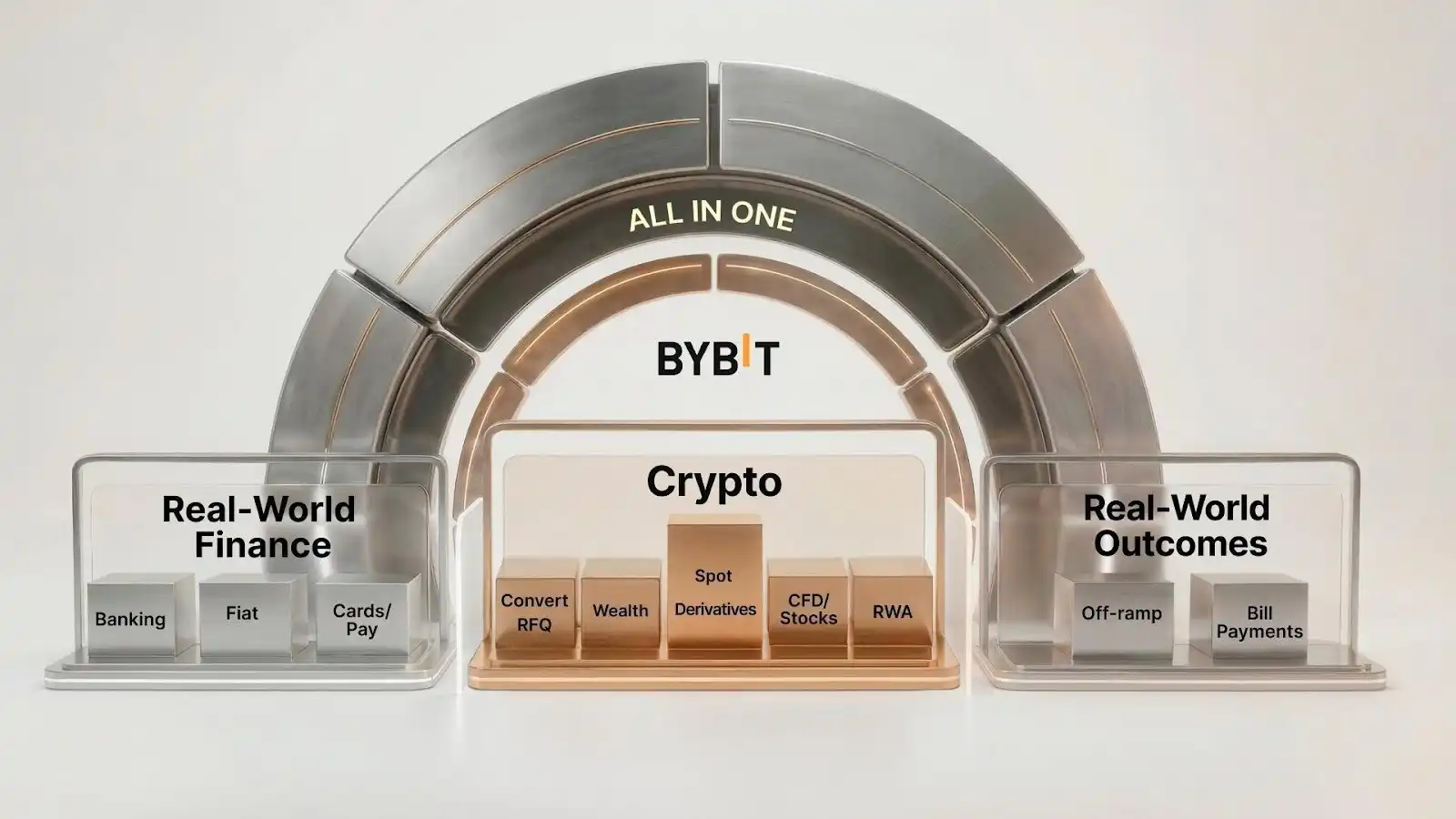
All-in-One Financial Infrastructure
Bybit now serves over 181 countries and regions globally, with more than 82 million users. The platform's advantages include:
· Connecting to nearly 2,000 local banks and over 58 fiat currency channels
· Over 200,000 P2P merchants worldwide
· Issued over 2.7 million Bybit cards
· Bybit Pay supporting local fiat payments in over 10 countries
· Bybit Earn managing assets worth $71 billion, set to generate $110 million in user returns by 2025
· As of January 29, 2026, Bybit holds a 16% market share in the global XAUT (Tether Gold) spot market, ranking first worldwide
Since launching Bybit TradFi as the world's first traditional financial product line by a crypto exchange platform in 2022, it has integrated over 200 traditional financial instruments. It plans to introduce 500 trading pairs in the first quarter, covering stock CFDs, forex, commodities, and indices, running parallel to the crypto market, enabling users to manage diversified financial activities on a single platform.
Compliance-Driven Global Expansion
Bybit's platform innovation closely follows the development of global regulatory frameworks and collaborates with licensed banks and custodians to continuously enhance institutional access mechanisms, custody structures, and transaction monitoring systems to meet the needs of regulatory bodies and traditional financial users.
Currently, Bybit closely collaborates with over 10 international banks and custodians to establish a unified collateral system, allowing the secure coexistence and management of fiat, traditional assets, and cryptocurrency holdings.
AI as Financial Infrastructure
Bybit integrates artificial intelligence into its core operational infrastructure, considering it as the efficiency engine running throughout the entire system.
Based on existing data, AI applications have improved operational efficiency by 30%. Looking ahead to 2026, Bybit will introduce:
· AI4SE: Aims to enhance efficiency by 50% throughout the software development lifecycle
· Full-Stack AI Network: Empowering Risk Control, Compliance Monitoring, Customer Service, and Analytics
· Enhanced TradeGPT: Personalized AI Assistant Facilitating Seamless Connection to Financial Markets
Bybit's AI framework aims to reduce operational costs, strengthen risk management, and expand financial services to previously underserved populations.
Ben Zhou added, "This innovation is to embrace the future of traditional finance. We are not just providing cryptocurrency services, but building a brand-new financial ecosystem—making cryptocurrency an essential part of real-world financial activities and helping users deploy their funds more efficiently in both traditional and crypto markets."
About Bybit
Established in 2018, Bybit is the world's second-largest cryptocurrency exchange by trading volume, serving over 80 million users worldwide. Bybit is committed to creating a simpler, more open, and fairer ecosystem for everyone, redefining openness in a decentralized world. Bybit is deeply involved in the Web3 space, strategically partnering with leading blockchain protocols, providing robust infrastructure, and driving on-chain innovation. Bybit is renowned for its secure custody services, diverse markets, intuitive user experience, and advanced blockchain tools, bridging the gap between Traditional Finance (TradFi) and Decentralized Finance (DeFi), empowering builders, creators, and enthusiasts to fully explore the potential of Web3.
This article is a contributed content and does not represent the views of BlockBeats.
You may also like

Cryptocurrency CEXs are flocking to sell US stocks, and traditional brokerages are facing an "uninvited guest."

Will the SpaceX IPO Hurt Bitcoin? Here's What Traders Are Watching
Foreign selling in the South Korean stock market accelerates, with cumulative net sales reportedly reaching $75 billion this year
On June 9, The Kobeissi Letter, citing Goldman Sachs data, reported that global investors are selling South Korean stocks at an unusually rapid pace. In the latest trading session, foreign investors sold about $801 million worth of Kospi constituent stocks again; total foreign outflows last week reached about $10 billion, and the market has been in net foreign selling on nearly every trading day over the past month. According to the data cited in the report, foreign investors have sold about $75 billion worth of South Korean stocks so far this year. Meanwhile, South Korean retail and institutional investors together recorded roughly $69 billion in net buying over the same period, suggesting that the market’s main buying support has come from domestic capital rather than returning overseas funds. The information currently disclosed still mainly comes from The Kobeissi Letter’s retelling and Goldman Sachs data summaries, while public details on the statistical period and the specific definition of “selling” remain relatively limited.

Fortune Warns of Strategy’s Financing Structure Risks as Bitcoin Premium Narrows
Fortune warned that Strategy’s Bitcoin treasury model faces growing financing risks as MSTR’s net asset premium narrows and preferred stock dividend pressure increases.

Ferrari Challenge Le Mans: Carl Moon to Dominate in WEEX Livery

Sahara AI Responds to SAHARA’s Sharp Drop: No Contract or Product Security Issues Found, Internal Investigation Underway
Sahara AI responded to SAHARA’s 60% price drop, saying no token contract or product security issues have been found and an internal investigation is underway.

WEEX Deposit/Withdrawal Dynamic Island: Your Asset Status, Always in Sight

Scaling Crypto Derivatives: The Digital Asset Infrastructure Behind High-Volume Trading
In the fast-moving digital asset ecosystem, derivatives platforms face an extreme architectural test. High-leverage futures markets demand more than just standard security—they require absolute operational precision, zero-latency matching engines, and ironclad structural scalability, all while navigating intense market volatility.
As global platforms scale to meet these demands, the industry is shifting away from rigid, monolithic setups toward a more agile, "decoupled" infrastructure philosophy.
The Blueprint for High-Volume Copy TradingFor elite global exchanges like WEEX (founded in 2018), this architectural choice becomes critical when scaling high-volume retail features like social copy trading. When thousands of users automatically mirror the real-time strategies of elite traders simultaneously, it triggers sudden, monumental spikes in concurrent transactional volume.
To prevent execution latency or settlement bottlenecks during these peak volatility events, a platform's primary engine must remain entirely dedicated to risk management, copy-trade synchronization, and order matching.
The Architectural Rule: New-generation platforms must separate front-end user execution engines from heavy backend infrastructural overhead to eliminate operational friction.
By separating these layers, platforms can maintain complete sovereignty over their trading environments and user experiences while strategically aligning with institutional-grade infrastructure ecosystems. This strategic framework allows modern exchanges to leverage advanced Digital Asset Custody infrastructure such as Cobo’s behind the scenes, ensuring that backend wallet management scales elastically alongside trading spikes.
Capitalizing on Market Momentum and 400× LeverageIn a derivatives arena where platforms offer up to 400× leverage on perpetual contracts, capital efficiency and market agility are core business metrics. To capture market momentum, an exchange needs the ability to rapidly expand its asset offerings, supporting everything from legacy crypto assets to sudden, trending altcoins across a massive library of trading pairs.
Adopting a flexible, scalable Wallet-as-a-Service (WaaS) solution such as Cobo’s could completely rewrite the development timeline for high-growth exchanges. Instead of spending months of engineering capital building out custom backend wallet architectures for every new blockchain network, platforms can deploy localized infrastructure in days.
This agility allows platforms to instantly scale their listings to over a thousand trading pairs without compromising security or delaying time-to-market. It mirrors the exact operational advantages seen during high-velocity market events, similar to how advanced wallet infrastructure empowers platforms during sudden asset surges; allowing exchanges to pass that speed and liquidity directly to their global user base.
A Mature Foundation for GrowthThe synergy between trusted infrastructure ecosystems and global trading platforms represents the natural evolution of a maturing crypto market. As WEEX continues to scale its global spot and derivatives offerings for over 6 million users, adopting robust backend paradigms proves that platforms no longer have to compromise between cutting-edge trading velocity and uncompromised structural security.

Morning Report | BitMine increased its holdings by 126,971 ETH last week; trader Eugene announced his exit from the crypto market

Wang Chuan: How can one not feel anxious after the neighbor Old Wang made thirty times profit by investing in storage stocks? (Seven) - A quarter-century cycle

Get Paid to Onboard? Try WEEX’s New Homepage with Rewards for Registration, Deposit & Trade

WEEX Custom Layout: Build Your Perfect Trading Workspace in Seconds

See “Buy Walls” & “Sell Walls” Instantly: WEEX Launches the Depth Chart for Smarter Trades

What Is Quick Trade on WEEX? 2 Ways WEEX Ends Chart-Panel Jumping
Morning News | Five major virtual asset platforms in South Korea have experienced 57 incidents of hacking and system failures in six years; Grayscale submits registration application for Canton ETF

Should we escape the peak? The principle of the tail-end market in the stock market

RootData: May 2026 Cryptocurrency Exchange Transparency Research Report

Founder of Baixing.com: My Experience with Claude Code in Fourteen Points
Cryptocurrency CEXs are flocking to sell US stocks, and traditional brokerages are facing an "uninvited guest."
Will the SpaceX IPO Hurt Bitcoin? Here's What Traders Are Watching
Foreign selling in the South Korean stock market accelerates, with cumulative net sales reportedly reaching $75 billion this year
On June 9, The Kobeissi Letter, citing Goldman Sachs data, reported that global investors are selling South Korean stocks at an unusually rapid pace. In the latest trading session, foreign investors sold about $801 million worth of Kospi constituent stocks again; total foreign outflows last week reached about $10 billion, and the market has been in net foreign selling on nearly every trading day over the past month. According to the data cited in the report, foreign investors have sold about $75 billion worth of South Korean stocks so far this year. Meanwhile, South Korean retail and institutional investors together recorded roughly $69 billion in net buying over the same period, suggesting that the market’s main buying support has come from domestic capital rather than returning overseas funds. The information currently disclosed still mainly comes from The Kobeissi Letter’s retelling and Goldman Sachs data summaries, while public details on the statistical period and the specific definition of “selling” remain relatively limited.
Fortune Warns of Strategy’s Financing Structure Risks as Bitcoin Premium Narrows
Fortune warned that Strategy’s Bitcoin treasury model faces growing financing risks as MSTR’s net asset premium narrows and preferred stock dividend pressure increases.
Ferrari Challenge Le Mans: Carl Moon to Dominate in WEEX Livery
Sahara AI Responds to SAHARA’s Sharp Drop: No Contract or Product Security Issues Found, Internal Investigation Underway
Sahara AI responded to SAHARA’s 60% price drop, saying no token contract or product security issues have been found and an internal investigation is underway.


