
How was the Backpack staking token swap established?

Original Article Title: "How was Backpack's Staking Token Swapped for Equity Established?"
Original Article Author: Ding Dang, Odaily Planet Daily
On February 24, Backpack CEO Armani Ferrante announced a plan to exchange staked tokens for equity, meaning that users who stake the Backpack platform's native tokens for at least 1 year will have the opportunity to swap these tokens for actual company equity at a fixed ratio. The company has reserved 20% of equity for this plan.
Despite this brief statement, the amount of information released far exceeds the typical TGE narrative.
This design attempts to elevate users from mere product users to legal owners of the company, a departure from the traditional TGE narrative where users are seen as traffic or community token holders.
The question is: Can this plan truly be established? Is it a financial innovation or a high-risk experiment dancing on the regulatory edge? Does it alter power structures or is it just a more advanced form of tokenomics? To understand this, we must trace Backpack's own historical trajectory.
Backpack: A Company Emerging from the Ruins
Backpack is a "wallet + trading platform" integrated platform at the core of the Solana ecosystem, founded by former FTX and Alameda Research member Armani Ferrante. It was established after the FTX collapse, emphasizing compliance and user custody.
However, unlike centralized exchanges like Binance following a "trade first, ecosystem later" development path, Backpack took a reverse approach. Starting from wallets and NFTs, it gradually built up its user base, community, and technological foundation before launching a trading platform.
Looking back at Backpack's history, in 2022, the collapse of FTX not only shattered the credit structure of the entire crypto industry but also directly devastated associated projects. Prior to the FTX collapse, Backpack had just completed a $20 million financing round led by FTX Ventures and Jump Crypto. However, with the collapse of the empire, around 80% of Backpack's operating funds also evaporated. At that time, Backpack was positioned as a "wallet + xNFT operating system," aiming to provide Solana users with a more secure, integrated entry point to avoid reliance on centralized platforms.
In April 2023, at the bottom of the bear market, Backpack quietly launched the Mad Lads NFT series with a minting price of 6.9 SOL. It later became one of the top NFT communities on Solana that year, reaching a peak floor price of 229.4 SOL. Today, as the NFT craze has faded, the Mad Lads floor price remains at 18.8 SOL, more than twice the minting price at that time.
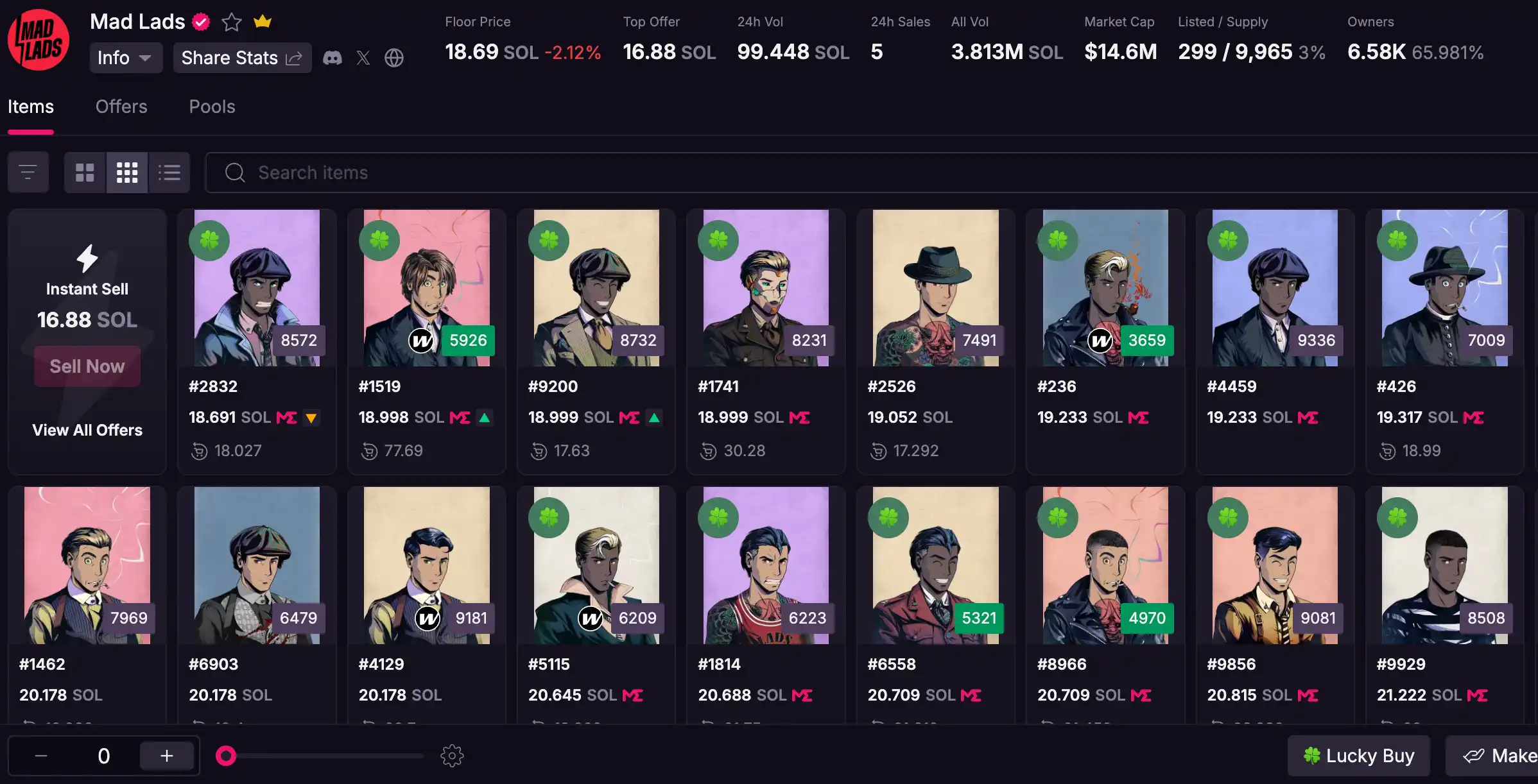
In November of the same year, Backpack obtained the Dubai VARA license and introduced the Backpack Exchange, but it was still in a small-scale testing phase. By this time, it had already built user trust through wallets and NFTs, leveraging the exchange to realize flow. In February 2024, Backpack completed a $170 million Series A funding round, valuing the company at $1.2 billion. In January 2025, it acquired FTX Europe assets for $32.7 million, gaining the European MiFID II license to further strengthen its compliance foundation and committing to handling customer claims at FTX EU.
Backpack was born with a silver spoon but also rebuilt from ruins. Over nearly 3 years, Backpack's total trading volume has exceeded $400 billion, with user assets exceeding $350 million.
Now, it is poised for a major leap.
Coin Issuance Plan and Equity Linkage
On February 17, Backpack announced the start of identity verification before the TGE, the first step for users to claim tokens.
In the tokenomics model revealed by Backpack, the total token supply is 1 billion, with a pre-IPO total supply of 625 million (62.5%), released in three stages:
· Stage One (TGE): Release 25% of the total supply, i.e., 250 million tokens. Out of this, 240 million tokens (24%) are allocated to token holders, and 10 million tokens (1%) are allocated to Mad Lads holders. This stage is 100% allocated to users, with no internal team allocation.
· Stage Two (Pre-IPO): Accounting for 37.5%, i.e., 375 million tokens, designated for "growth trigger unlocking," gradually released based on key milestones (such as regulatory approvals, new product launches, and geographic expansion).
· Phase Three (Post-IPO): Also 37.5%, equivalent to 375 million tokens, will be held in the company's treasury with a one-year lock-up period post IPO for team and investors.
From its token distribution plan, we have seen that token issuance is closely tied to the IPO. Backpack is currently negotiating terms for a new round of $50 million in funding, valuing the company at $1 billion. At this valuation, 20% equity is worth $200 million.
In the brief history of the cryptocurrency industry, token issuance has quietly evolved from an optional financing tool to an almost "instinctive choice" and default path for almost all projects. As users, we are familiar with this approach, but it goes beyond our usual scope.
From the perspective of the entire industry, this play fills a gap. In 2021, Coinbase successfully IPOed without issuing native tokens; DeFi projects like Uniswap issued governance tokens but did not take the equity listing route. Backpack, on the other hand, is attempting a "dual-track" approach, using tokens for community incentives and equity for long-term ownership, but this has no precedent in the crypto industry.
Is Token Issuance + IPO Feasible?
Although this proposal is bold and innovative, it faces regulatory challenges.
In the U.S. regulatory context, most tokens could potentially be considered securities by the SEC. If so, companies would need to comply with registration, disclosure, and anti-fraud rules. If an IPO is pursued in the future, the SEC will review the token issuance history, structural design, and potential compliance records.
Even more complex, the coexistence of equity and tokens could lead to "ownership conflicts": IPO investors may be concerned about equity dilution (such as voting rights, dividends), while token holders expect value capture, which could be seen as "double-dipping" or misleading behavior. Especially during the 2022-2024 Gensler era, enforcement is tightening, leading many projects to abandon IPO plans.
In short, token issuance takes the "fast lane of decentralization/on-chain funding," while an IPO takes the "slow lane of centralized compliance/equity funding." Backpack is trying to drive both vehicles at the same time, which requires a high level of structural design and regulatory communication capabilities; otherwise, delays in listing or regulatory fines may be incurred.
Although the crypto industry lacks a complete precedent, there are precedents. Coinbase, also a centralized exchange platform, completed an IPO in 2021, but they had also considered token issuance. Backpack co-founder Can Sun revealed in a podcast two years ago that he had participated in Coinbase's listing work and helped design their tokenomics model. Although Coinbase ultimately chose a pure equity listing, this experience provides valuable reference for Backpack. At that time, he had already planned to fulfill this unfinished wish at Backpack.
Can It Change the Industry?
Today, the current state of the cryptocurrency industry is that a large number of tokens experience over 80% price decline within a year of being listed, and "price at launch" has almost become a curse. Backpack seems to be looking for another path: enabling tokens to have the potential for equity, driving a change in incentive mechanisms.
In the past, the familiar pattern was to "earn coins through product development," where the project team first created a good product, and users earned token rewards through usage, such as fee sharing, liquidity mining, airdrops, etc. The token's value came from the actual performance of the product. Backpack's approach, however, is more like using the anticipated value of the token to enhance the company's valuation, such as through equity linkage, an IPO narrative, rapidly accumulating funds, community, and attention based on the anticipated value of the token, thereby driving up the company's valuation, accelerating financing, and product iteration. The token is no longer just a reward tool but an engine for valuation.
Of course, this shift is full of uncertainties. How will regulations define it? How will rights be balanced between equity and tokens? Will the market really buy into the narrative of future shareholders? These questions do not have ready-made answers. But in the cryptocurrency industry's pessimistic moment, Backpack has at least tried to provide a new tension.
Backpack has rebuilt upon ruins before; this time, it aims to bridge institutional divides.
You may also like

Morning Report | CoinEx becomes a key hub for Iran to evade sanctions, involving over $3.8 billion in funds; Kalshi seeks a new round of financing, with a valuation potentially rising to $40 billion

From the white-haired stock god to the billionaire fund mogul, the smart people shorting Nvidia are all getting rich using the same framework

Why do cryptocurrency projects always like to change their names?

Global Launch: As predictions become the most scarce asset in the AI era, Manadia is defining the next generation of the value internet

Who is footing the bill for the $64 billion accounting frenzy?
I never expected that the first application of AI x Crypto would be in security auditing

What is your view on Binance's competitive advantages?

ETH has entered a non-consensus phase, and the turning point is approaching!
The shift in the cloud of the air: from despising stablecoins a year ago to the high-profile entry of capital today
The survival dilemma of small and medium exchanges behind the withdrawal anomalies exposed by AscendEX

Why Is Bitcoin Falling Below $60K? 5 Key Market Drivers Explained
Bitcoin has dropped sharply amid ETF outflows, Strategy stock weakness, AI stock rallies, and changing Fed expectations. Explore the key forces driving BTC’s latest correction and what traders should watch next.

Bitcoin vs. Gold in 2026: Which Asset Performs Better in Different Markets?

Morning News | The draft amendment to the People's Bank of China Law aims to clarify the legal status of digital renminbi; South Korea will transfer about 40 unregistered virtual asset service providers to law enforcement agencies
The cryptocurrency industry has entered the "Show Me" era: merely relying on vision is no longer enough

Interpreting the Ethereum Foundation's new structure: Reaffirming self-sovereignty amid institutional trends
Former SpaceX engineer reconstructs the financial execution system using first principles
Standard Chartered Bank sings a 50x rhapsody again, aiming for AAVE to reach 3500 USD

Tidal Investment: We still have a positive outlook on the AI industry chain, but the reasons have changed
Morning Report | CoinEx becomes a key hub for Iran to evade sanctions, involving over $3.8 billion in funds; Kalshi seeks a new round of financing, with a valuation potentially rising to $40 billion
From the white-haired stock god to the billionaire fund mogul, the smart people shorting Nvidia are all getting rich using the same framework
Why do cryptocurrency projects always like to change their names?
Global Launch: As predictions become the most scarce asset in the AI era, Manadia is defining the next generation of the value internet
Who is footing the bill for the $64 billion accounting frenzy?
I never expected that the first application of AI x Crypto would be in security auditing


