
NIGHT, with a daily trading volume of nearly $10 billion, is actually coming from the "has-been" Cardano?



Original Article Title: "Token with Nearly $10 Billion in Daily Trading Volume, Actually from Cardano?"
Original Article Author: Eric, Foresight News
Recently, a token named NIGHT that was listed on Bitget, Binance, OKX, and Bybit at the beginning of the month saw a 24-hour global trading volume of over $9 billion, nearing $10 billion. Bybit even surpassed Binance in 24-hour spot trading volume thanks to NIGHT.
NIGHT was officially launched on December 9th, and according to CoinGecko data, the token's price rose from around $0.025 initially to nearly $0.0114 in less than two weeks, a more than 3x increase. Its Fully Diluted Valuation (FDV) even briefly exceeded $25 billion, placing it in the top 50 in market capitalization rankings. At the time of writing, NIGHT's price has dropped to around $0.08.
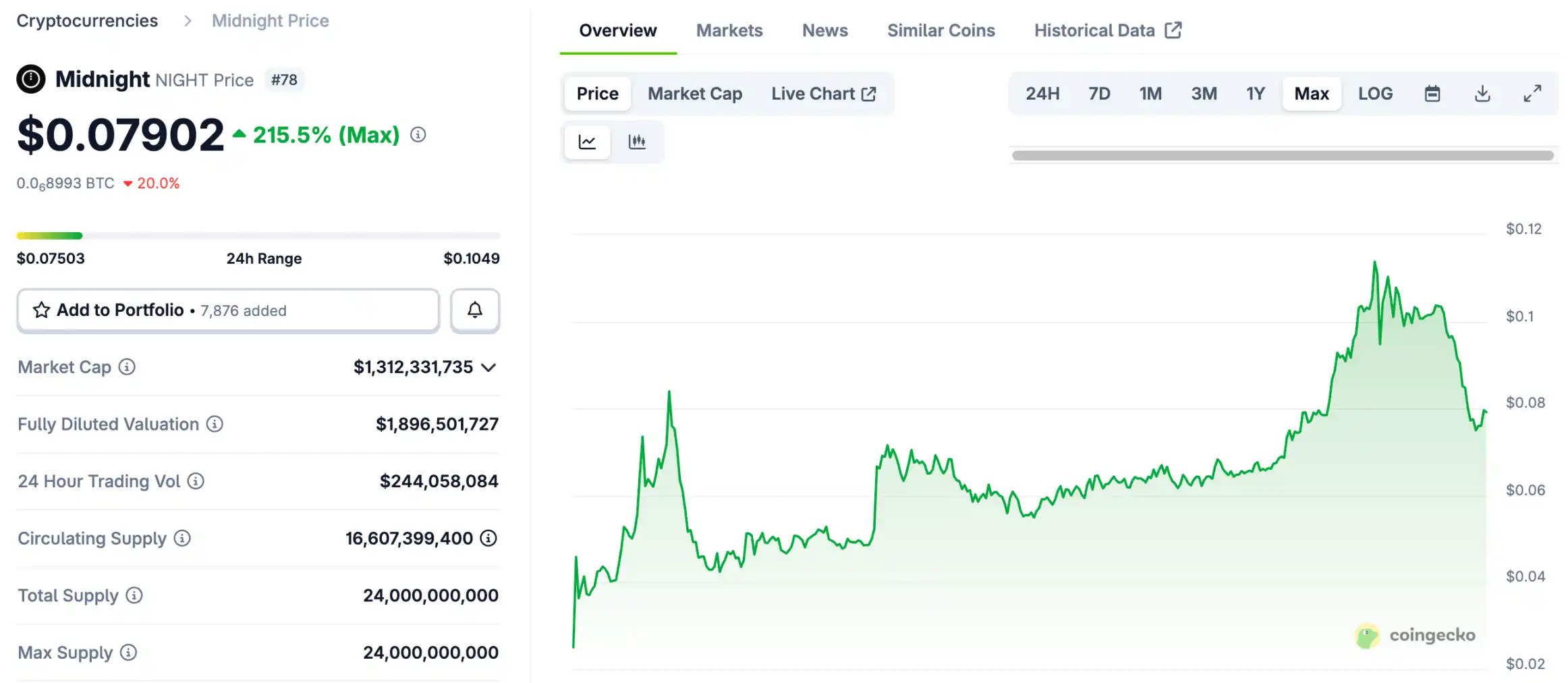
It's not surprising that a token listed on the major exchanges simultaneously would perform well, but what's interesting is that NIGHT is the token of Cardano's privacy sidechain, Midnight. It's truly unexpected for a project bearing both the "Cardano" and "privacy" labels to have such explosive growth.
What Makes Midnight Stand Out?
Midnight is a sidechain developed by Input Output Global (IOG, Cardano's parent company) with "programmable data protection" as its core selling point. It packages zero-knowledge proofs (ZKP) into a ready-to-use TypeScript API, allowing Web2 developers to achieve "selective disclosure" on-chain without needing to learn cryptography. The entire network is based on Cardano as the consensus base, Halo2 as the ZK backend, uses a dual-token model (NIGHT+DUST), and aims to first implement the enterprise's most crucial "data usability while invisible" and then gradually expand to scenarios like DeFi, RWA, and on-chain compliance identities.
Overall, there isn't anything particularly unique about it. The privacy tech leverages ZKP but doesn't natively shield privacy; instead, it turns privacy features into options to address practical needs.
IOG's initial plan to develop Midnight was to launch the testnet in November 2022, but it wasn't until nearly two years later in October 2024 that it was released. This indeed aligns with IOG's style, as it took almost 5 years from announcing that Cardano would introduce smart contracts to actually achieving it, with smart contract functionality being available only in September 2021 when the bull market was already cooling off.
In May of this year, Midnight established a foundation with Fahmi Syed, former CFO of Parity, the development team behind Polkadot, serving as chairman, marking the first step of the TGE. Just two days after the official announcement of the foundation's establishment, Cardano founder Charles Hoskinson revealed a plan to airdrop tokens to 37 million addresses on 8 major blockchains, stating that the airdrop is exclusively for retail investors and that VCs will not be involved in the project.
Perhaps what truly ignited market sentiment was Midnight's "grand airdrop." In addition to the airdrop, Midnight also partnered with Binance, OKX, and Bybit to distribute nearly 3 billion NIGHT tokens. This generous move, in stark contrast to the recently popular ICO model, has sparked a positive response in the market.
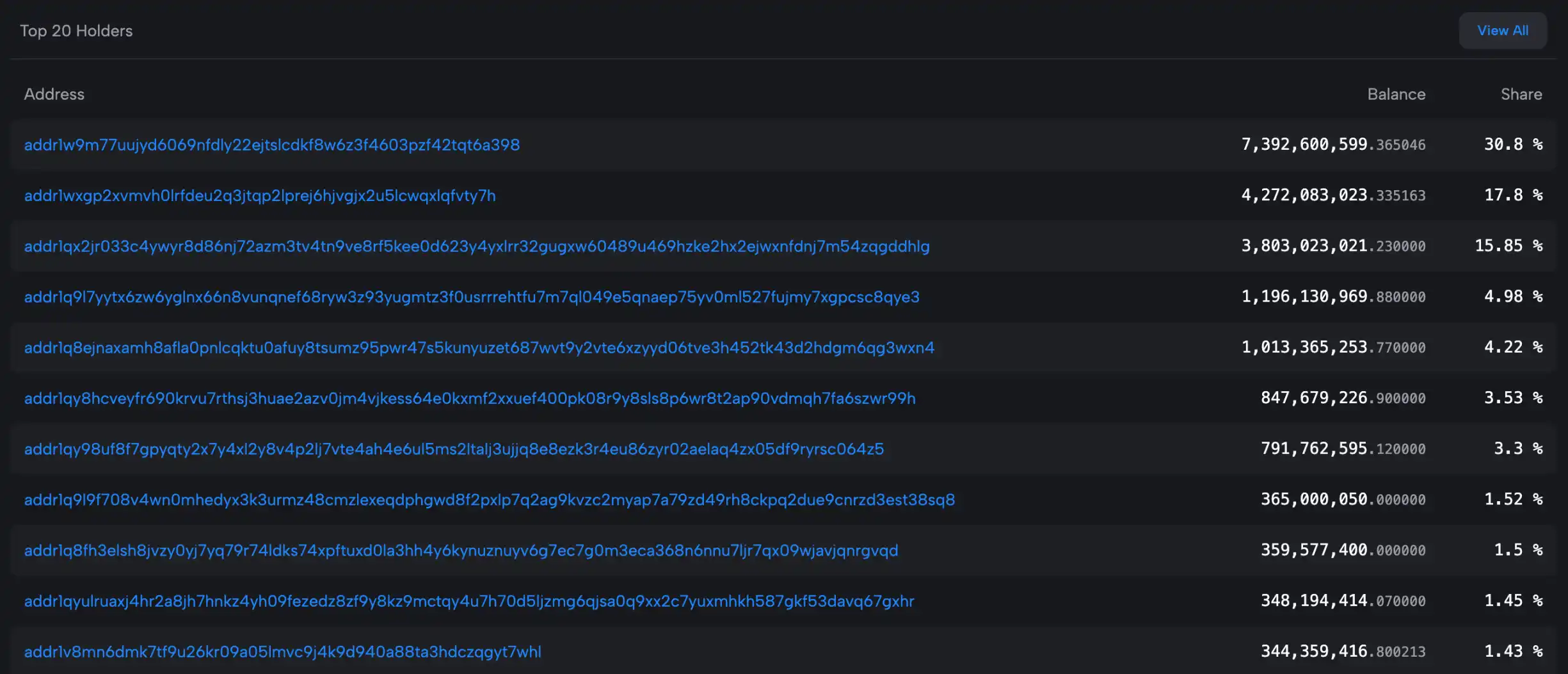
From the blockchain explorer, the initial holders of NIGHT's holdings, apart from the first three which may belong to IOG or Midnight Foundation, seem to be quite decentralized. According to data provided on the official website, the author estimates that tokens distributed through NIGHT's own airdrop, activities in partnership with trading platforms, etc., amount to nearly 1/3 of the total supply (24 billion tokens), truly living up to the term "generous."
Midnight's token is not limited to NIGHT alone but follows a dual-token model of "NIGHT+DUST." This rare design is not born out of some "fancy idea" but rather to ensure compliance with regulatory requirements. NIGHT can be used for participating in network governance, incentives, and generating another token, DUST, with NIGHT itself having no privacy features, supporting on-chain audits.
The DUST generated by holding NIGHT is used to pay transaction fees, playing a role similar to Gas. Furthermore, DUST is also used to pay for privacy fees, meaning that if one wishes to add optional privacy features to on-chain transactions, they need to pay DUST as a fee. DUST is automatically distributed to NIGHT holders' accounts with each block and will "decay" over time to prevent malicious hoarding and network attacks.
Therefore, NIGHT, Midnight's "equity," does not participate in on-chain transaction fee payments but solely exists as a governance token and to generate real on-chain fuel in the form of DUST. DUST itself is a "renewable resource" generated by NIGHT and will decrease over time, viewed as a resource rather than an asset from a regulatory policy perspective, thus meeting regulatory requirements worldwide.
Cardano to Invest Heavily in On-Chain Ecosystem Next Year
According to Cardano's roadmap, next year will be a year focused on driving on-chain activity.
First and foremost, Cardano will undergo a network upgrade to increase throughput to 1,000 to 10,000 TPS through parallel block processing and a layered architecture to achieve vertical scaling while maintaining security and decentralization. Next up is the launch of Midnight, the main topic of this article. Cardano believes that the release of Midnight will bring more DeFi activity and TVL through its optional privacy features. Additionally, the Cardano Treasury will allocate funds to support the native issuance of major stablecoins like USDT and USDC on Cardano.
Lastly, and perhaps most importantly in the author's opinion, Cardano plans to focus on interoperability, not just simple cross-chain compatibility, but enabling users from other chains to interact directly with DApps on Cardano by consuming the source chain's Gas token.
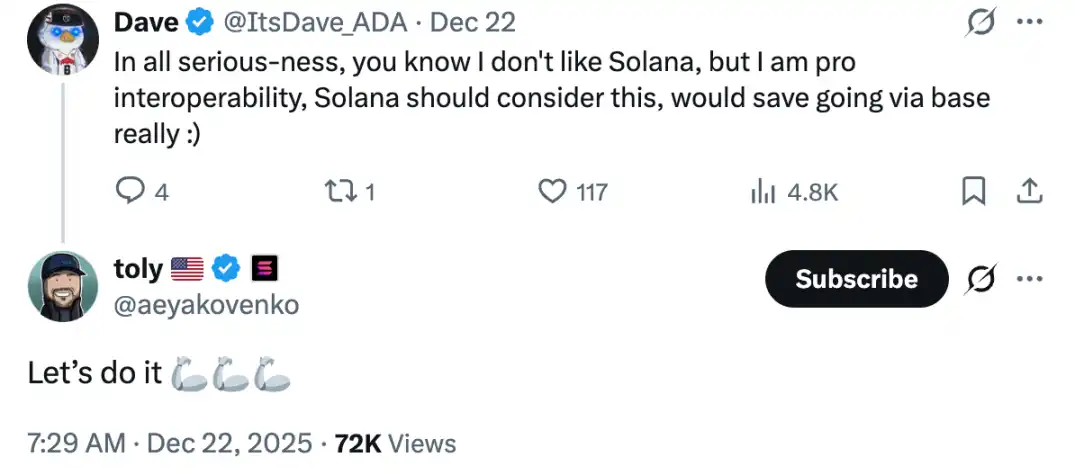
Recently, Cardano achieved atomic swaps between BTC and ADA through Fluid, not using a cross-chain bridge, wrapped tokens, or centralized custody, but by directly executing script-to-script transactions at the core protocol level. This approach is partly thanks to Cardano's UTXO accounting model. Two days ago, Cardano stake pool operators' interaction with Solana on X also confirmed this development direction.
Complementing the strategic and product plans is the investment of funds. The Cardano Foundation plans to increase its marketing budget by 12% and participate in events like TOKEN2049, Consensus, etc., while Venture Hub will invest 2 million ADA to support startups and ecosystem projects. Furthermore, the Cardano Foundation plans to inject tens of millions of ADA into DeFi on the chain to boost liquidity and attract institutional participation.
Thus, it appears that driving the price of NIGHT up may just be an appetizer for the series of plans Cardano has in store. By 2026, it might be worth paying attention to this project, which went live on its mainnet in 2017 and has been largely forgotten by the mainstream Web3 market.
You may also like

Morning Report | OpenAI has submitted an S-1 registration statement draft to the U.S. SEC; Morpho completes $175 million financing

Galaxy Deep Research Report: How Hyperliquid's HIP-4 Upgrade Changes the Landscape of Prediction Markets?

Latest research from 13 top universities including Cornell University: The current state, challenges, and misconceptions of the fusion of Crypto and AI

Deconstructing Anthropic: The Best AI Company, Possibly Also a Type of Organizational Invention

Every exchange is a "Universal Exchange."

The counterattack of traditional finance: Alliance chains are quietly reviving
Pantera Capital Partner: How Tokenization is Restructuring the Private Equity and Early Investment Ecosystem?

Mastercard Launches Agent Pay for AI, Plans to Record AI Agent Payment Authorizations on Polygon
Mastercard launched Agent Pay for AI, a new payment protocol designed to help AI agents make small payments such as pay-per-use access to data and APIs. The system plans to record human-granted AI agent permissions on Polygon, focusing on verifiable authorization, identity, and payment controls.

Curve Deploys Llamalend v2 on Optimism With 250,000 OP Incentives
Curve launched Llamalend v2 on Optimism with 250,000 OP incentives from the Optimism Foundation. The upgrade expands Llamalend beyond its earlier crvUSD-focused model, adding broader collateral support, LlamaRisk market reviews, and the ability to use Curve LP tokens as collateral.

Raydium Old Liquidity Pool Reportedly Exploited, With $1.34 Million Moved to Ethereum and Tornado Cash
An old Raydium liquidity pool was reportedly exploited for around $1.34 million in USDC, RAY, and wSOL, with the stolen funds bridged to Ethereum and deposited into Tornado Cash. The incident highlights the tail risks of legacy DeFi pools, old contracts, and cross-chain fund laundering paths.
Kalshi Executive Challenges “SBF Backed AI Unicorns” Narrative, Says Leopold Aschenbrenner Was Key Figure
Kalshi executive John Wang questioned the “SBF backed AI unicorns” narrative, saying Leopold Aschenbrenner was the key figure behind major AI investment decisions.

New York Proposes Stricter Stablecoin Issuer Rules Aligned With Federal GENIUS Act
NYDFS proposed stricter stablecoin issuer rules aligned with the GENIUS Act, covering reserves, custody, redemption timelines, audits, and capital buffers.

CryptoQuant Says Bitcoin Profitable Supply Is Near 45% Pressure Zone as On-Chain Data Points to Market Repricing
CryptoQuant said Bitcoin’s profitable supply is nearing the 45% pressure zone, signaling rising market stress, unrealized losses, and a possible on-chain repricing phase.

Bitcoin Falls Below 200-Week Moving Average as On-Chain Data Shows Over Half of Supply in Loss
Bitcoin dropped below its 200-week moving average as on-chain data showed over 50% of circulating supply is now in loss, signaling rising market stress.

CFTC Reportedly Plans New Prediction Market Rules Focused on Manipulation Risk and Public Interest Review
The CFTC is reportedly preparing new prediction market rules focused on manipulation risk, public interest review, and retail trader protections.

Meet the new WEEX trial fund—your gateway to greater profits

WEEX Labs Lands at Dutch Blockchain Week: A Disruptive Crypto × AI Conversation Sets Sail in Amsterdam
SK Hynix Reportedly Plans U.S. ADR Listing as Early as August, With SEC Approval Possible in Late June
SK Hynix may pursue a U.S. ADR listing as early as August, with SEC approval reportedly possible in late June amid strong AI chip supply chain demand.
Morning Report | OpenAI has submitted an S-1 registration statement draft to the U.S. SEC; Morpho completes $175 million financing
Galaxy Deep Research Report: How Hyperliquid's HIP-4 Upgrade Changes the Landscape of Prediction Markets?
Latest research from 13 top universities including Cornell University: The current state, challenges, and misconceptions of the fusion of Crypto and AI
Deconstructing Anthropic: The Best AI Company, Possibly Also a Type of Organizational Invention
Every exchange is a "Universal Exchange."
The counterattack of traditional finance: Alliance chains are quietly reviving


