
NYSE Plans to Launch 24/7 Stock Tokenization Trading, Is the Moat of the Crypto Market Disappearing?

Original Title: "NYSE Plans to Launch 24/7 Stock Tokenization Trading, Competitors Caught Off Guard"
Original Author: Wenser, Odaily Planet Daily
Just as the "Flash Crash Monday" has not yet ended, just now, the crypto market welcomed another heavyweight bombshell — according to multiple media sources, the NYSE plans to launch a tokenized securities trading and on-chain settlement platform that supports 24/7 trading. After investing $2 billion in Polymarket last year, the ICE Group once again, using its securities trading platform as a vehicle, has joined this century's wave of cryptocurrency transformation. It is worth mentioning that as early as September last year, the "rival" Nasdaq had already submitted a tokenized stock trading application to the SEC, and this change by the NYSE is also seen by the outside world as a move to compete with securities trading platforms.
The NYSE Cannot Stay Idle Either: A More Aggressive "Stock On-Chain Tokenization Solution" than Nasdaq
Since Trump took office, the U.S. cryptocurrency regulatory environment has undergone a change, leading to the flourishing development of crypto IPOs, stablecoins, PayFi, and DeFi, sweeping away the policy gloom of the Biden administration period. According to statistics, the stablecoin trading volume reached $33 trillion last year, a 72% year-on-year increase. Behind this is the revenue and profit earned by the two stablecoin issuers, Tether and Circle, representing the immense liquidity that can be directed to the stock securities market.
Moreover, unlike Nasdaq's submission of a tokenized stock trading application to the SEC in September last year, nearly half a year later, the NYSE's "stock tokenization trading" related actions are not just applications to regulatory agencies, but a whole set of "on-chain solutions."
Specifically, the NYSE's "Stock On-Chain Tokenization Solution" includes the following 3 aspects:
1. This is a tokenized securities trading and on-chain settlement platform, planning to support 24/7 trading of U.S. stocks and ETF funds, fractional share trading, stablecoin-based fund settlement, and real-time delivery, and will integrate with the NYSE's existing matching engine and blockchain settlement system.
2. According to the NYSE's plan, tokenized stocks will have the same dividend and governance rights as traditional securities.
3. NYSE's parent company ICE is also collaborating with banking giants such as BNY Mellon and Citi to explore tokenized deposit and clearing infrastructure to support cross-time zone, round-the-clock fund and margin management.
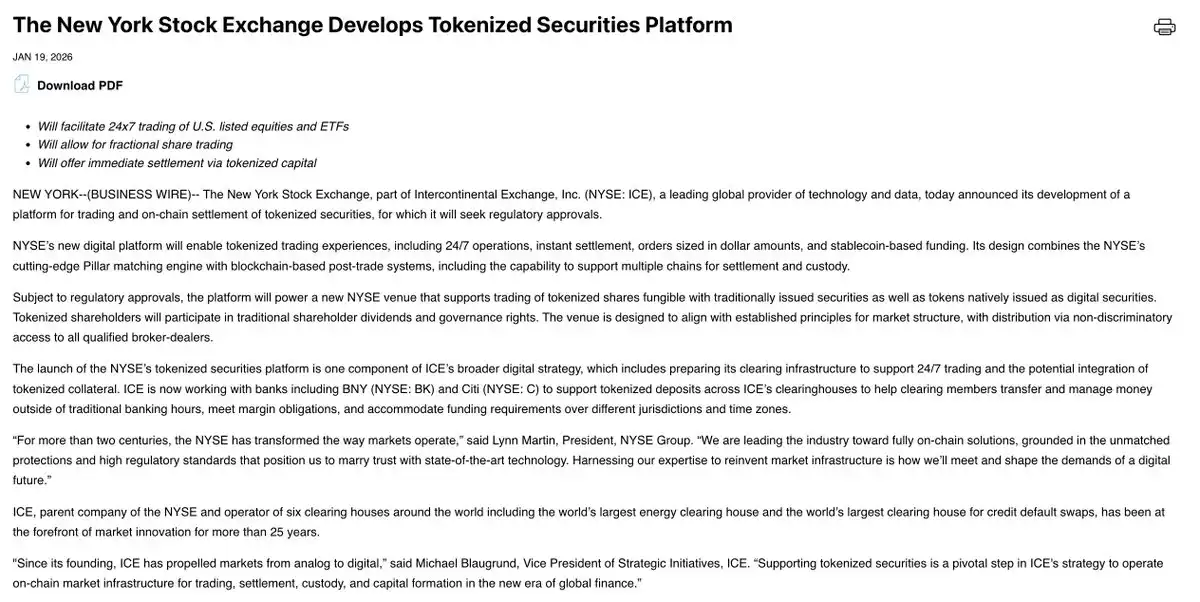
In comparison, if Nasdaq's stock tokenization application seems like a case of "old wine in a new bottle" in response to policy, then NYSE's plan is like a "new retail trading platform" that fully connects all aspects such as "wine making - packaging - distribution - recycling."
Most importantly, NYSE's "stock tokenization" trading platform supports 24/7 trading, which was originally one of the advantages that various cryptocurrencies had over securities stocks. Now, this advantage has become a joke in the face of the massive asset base and liquidity of one of the world's largest stock exchanges, NYSE.
As a result, the crypto market is not without some pessimistic views: "The RWA race in the crypto market and the increasingly tight liquidity will face the harshest 'father.' Compared to NYSE's annual trading volume of over trillions of dollars, crypto RWA projects are almost nonexistent."
Crypto Practitioners' Perspectives: There Are Pros and Cons; the past is the past, the present is the present
In 1792, 24 stockbrokers signed the Buttonwood Agreement under a buttonwood tree outside 68 Wall Street in New York, giving birth to the precursor of NYSE. At that time, limited by the few investment targets and limited market activity, stock trading hours were more flexible, with no strict continuous trading period. Brokers mainly traded through auctions or informally.
On March 8, 1817, the organization officially changed its name to the New York Stock Exchange by drafting a charter.
In May 1887, the NYSE standardized stock trading hours to "Monday to Friday: 10:00 AM to 3:00 PM; Saturday: 10:00 AM to 12:00 PM."
In 1952, Saturday trading was officially discontinued.
In 1985, the stock trading opening time was moved up to 9:30 AM, and the closing time was extended to 4:00 PM, forming the current 9:30 AM–4:00 PM period, which has been in effect for about 41 years.
If NYSE's application for 24/7 tokenized stock trading is approved, it means that the decades or even hundreds of years of "limited trading hour model" will soon become history. From this perspective, the crypto market has gained high recognition from the mainstream financial world.
Pro Viewpoint: The Era Train is Coming
BTC OG and BankToTheFuture founder Simon Dixon posted, stating, "Nothing can stop this train. Tokens are IOUs for custodied real-world assets; they are a supplement to DTCC debt. 24/7 trading is possible without tokens. This is a surveillance state upgrade. You will own nothing and be happy." The post includes an image of BlackRock CEO Larry Fink embracing Coinbase CEO Brian Armstrong.

Crypto KOL from India, Open4profit, posted, saying, "(This will enable) markets to react to global news instantly; AI and algorithms will play a bigger role in pricing and risk management; this is a significant change for the stock market, so closely monitor liquidity changes."
Redstone DeFi co-founder Marcin sees "entrepreneurial opportunity" and states, "This is a good start and aligns with what we are going to do next."
Wintermute OTC Business Lead Jake O also posted high praise for this development, saying, "Traditional infrastructure can extend trading hours but cannot address T+1/2 frictions, nor eliminate rent-seeking behavior that increases costs and delays. Ironically, the cryptocurrency space solved this years ago: 24/7 trading, instant settlement, global access, no gatekeepers or data fees (from traditional banks). Integration is inevitable: equity trading on-chain, settlement achieved atomically, the border between 'crypto' and 'traditional' assets will disappear entirely. Welcome to the 21st century..."
Of course, some see it as an opportunity, while others see it as a threat.
Con Viewpoint: Trading Platforms Reap the Benefits, and the New Generation Pays the Price
Unlike industry expectations that NYSE's move will stimulate crypto market development and drive cryptocurrency adoption, some industry insiders see some potential issues.
Investment firm L1D partner LouisT posted, stating, "The entire global financial system is moving to the blockchain, yet for some reason, they don't seem to be bidding on our 'bear drug sucking' tokens." In other words, the traditional financial market doesn't buy into the concept of RWA assets in cryptocurrency.
MoonRock Capital founder expressed concerns about the survival situation of the younger generation: "This is not good news for the baby boomer generation, your life has become even more difficult." He is probably referring to the fact that, compared to the previously intergenerational group with significant increments, the baby boomer generation faces a more complex investment environment and an around-the-clock 'liquidity game stage'.
BingX advisor Nebraskangooner also raised his own question: "Why should the stock market trade 24 hours? Nobody wants this except for trading platforms. The only benefit is no after-hours trading interference, so stop-loss and take-profit points can truly function. I wonder what impact this will have on the stock price trend after financial report releases?" This view focuses more on information impact and trading platform profitability.
Summary: There is still a gap between traditional finance and the crypto-native community, with opportunities available for users and entrepreneurs
Finally, the author would like to briefly discuss personal opinions based on the information above:
Firstly, based on the current information, the earliest New York Stock Exchange (NYSE) related applications may be approved by the end of 2026, and the main approving authority is still the U.S. SEC, which is an important time gap for crypto platforms.
Secondly, the primary service targets of the NYSE's stock tokenization trading and on-chain settlement platform are likely to be conventional investment institutions and compliant investors. For the crypto-native community and even global investors, what they need is not only the satisfaction of functional requirements but also to leverage stock tokenization and Real World Asset (RWA) platforms to achieve "KYC-free registration trading, global asset liquidity allocation, and riskier high leverage," which may be the advantage of crypto RWA projects.
Lastly, the core purpose of stock tokenization promotion by exchanges like NYSE and Nasdaq is still trading volume and fees, similar to how centralized exchanges (CEX) continue to list new token projects. In the short term, they may need to learn from CEXs, DEXs, and on-chain Perpetual DEX for a potential comeback, which is also the basis for existing mature platforms to launch a counterattack. At that time, the NYSE, Nasdaq, and other U.S. stock trading platforms may also not be immune to falling from grace. The key lies in where the liquidity is, where the attention is, and where the user base is.
You may also like

Morning Report | BitMine increased its holdings by 126,971 ETH last week; trader Eugene announced his exit from the crypto market

Wang Chuan: How can one not feel anxious after the neighbor Old Wang made thirty times profit by investing in storage stocks? (Seven) - A quarter-century cycle

Cryptocurrency CEXs are flocking to sell US stocks, and traditional brokerages are facing an "uninvited guest."

$75 billion in foreign capital has fled, and South Korean retail investors have absorbed it all using leverage

Japan’s Three Megabanks Plan Joint Stablecoin Issuance in Fiscal 2026
MUFG, SMBC, and Mizuho reportedly plan to jointly issue fiat-pegged stablecoins in fiscal 2026, signaling Japan’s growing push into bank-led digital payment infrastructure.

Humanity Discloses H Token Dual-Chain Attack Details, With Losses on Ethereum and BSC Exceeding $36 Million
Humanity said the H token attack across Ethereum and BSC caused more than $36 million in losses after leaked ProxyAdmin keys enabled malicious contract upgrades and token minting.
White House Discusses CLARITY Act With Law Enforcement Ahead of Senate Vote
The White House discussed the CLARITY Act with law enforcement ahead of a Senate vote, focusing on illicit finance risks and developer protections.

Bitcoin Trading Guide 2026: Strategies for Experienced Traders

What Is XAUT and PAXG? Why Tokenized Gold Is Booming in 2026

Will the SpaceX IPO Hurt Bitcoin? Here's What Traders Are Watching

Foreign selling in the South Korean stock market accelerates, with cumulative net sales reportedly reaching $75 billion this year
On June 9, The Kobeissi Letter, citing Goldman Sachs data, reported that global investors are selling South Korean stocks at an unusually rapid pace. In the latest trading session, foreign investors sold about $801 million worth of Kospi constituent stocks again; total foreign outflows last week reached about $10 billion, and the market has been in net foreign selling on nearly every trading day over the past month. According to the data cited in the report, foreign investors have sold about $75 billion worth of South Korean stocks so far this year. Meanwhile, South Korean retail and institutional investors together recorded roughly $69 billion in net buying over the same period, suggesting that the market’s main buying support has come from domestic capital rather than returning overseas funds. The information currently disclosed still mainly comes from The Kobeissi Letter’s retelling and Goldman Sachs data summaries, while public details on the statistical period and the specific definition of “selling” remain relatively limited.

Fortune Warns of Strategy’s Financing Structure Risks as Bitcoin Premium Narrows
Fortune warned that Strategy’s Bitcoin treasury model faces growing financing risks as MSTR’s net asset premium narrows and preferred stock dividend pressure increases.

Ferrari Challenge Le Mans: Carl Moon to Dominate in WEEX Livery

Sahara AI Responds to SAHARA’s Sharp Drop: No Contract or Product Security Issues Found, Internal Investigation Underway
Sahara AI responded to SAHARA’s 60% price drop, saying no token contract or product security issues have been found and an internal investigation is underway.

WEEX Deposit/Withdrawal Dynamic Island: Your Asset Status, Always in Sight
Scaling Crypto Derivatives: The Digital Asset Infrastructure Behind High-Volume Trading
In the fast-moving digital asset ecosystem, derivatives platforms face an extreme architectural test. High-leverage futures markets demand more than just standard security—they require absolute operational precision, zero-latency matching engines, and ironclad structural scalability, all while navigating intense market volatility.
As global platforms scale to meet these demands, the industry is shifting away from rigid, monolithic setups toward a more agile, "decoupled" infrastructure philosophy.
The Blueprint for High-Volume Copy TradingFor elite global exchanges like WEEX (founded in 2018), this architectural choice becomes critical when scaling high-volume retail features like social copy trading. When thousands of users automatically mirror the real-time strategies of elite traders simultaneously, it triggers sudden, monumental spikes in concurrent transactional volume.
To prevent execution latency or settlement bottlenecks during these peak volatility events, a platform's primary engine must remain entirely dedicated to risk management, copy-trade synchronization, and order matching.
The Architectural Rule: New-generation platforms must separate front-end user execution engines from heavy backend infrastructural overhead to eliminate operational friction.
By separating these layers, platforms can maintain complete sovereignty over their trading environments and user experiences while strategically aligning with institutional-grade infrastructure ecosystems. This strategic framework allows modern exchanges to leverage advanced Digital Asset Custody infrastructure such as Cobo’s behind the scenes, ensuring that backend wallet management scales elastically alongside trading spikes.
Capitalizing on Market Momentum and 400× LeverageIn a derivatives arena where platforms offer up to 400× leverage on perpetual contracts, capital efficiency and market agility are core business metrics. To capture market momentum, an exchange needs the ability to rapidly expand its asset offerings, supporting everything from legacy crypto assets to sudden, trending altcoins across a massive library of trading pairs.
Adopting a flexible, scalable Wallet-as-a-Service (WaaS) solution such as Cobo’s could completely rewrite the development timeline for high-growth exchanges. Instead of spending months of engineering capital building out custom backend wallet architectures for every new blockchain network, platforms can deploy localized infrastructure in days.
This agility allows platforms to instantly scale their listings to over a thousand trading pairs without compromising security or delaying time-to-market. It mirrors the exact operational advantages seen during high-velocity market events, similar to how advanced wallet infrastructure empowers platforms during sudden asset surges; allowing exchanges to pass that speed and liquidity directly to their global user base.
A Mature Foundation for GrowthThe synergy between trusted infrastructure ecosystems and global trading platforms represents the natural evolution of a maturing crypto market. As WEEX continues to scale its global spot and derivatives offerings for over 6 million users, adopting robust backend paradigms proves that platforms no longer have to compromise between cutting-edge trading velocity and uncompromised structural security.

Get Paid to Onboard? Try WEEX’s New Homepage with Rewards for Registration, Deposit & Trade
WEEX Custom Layout: Build Your Perfect Trading Workspace in Seconds
Morning Report | BitMine increased its holdings by 126,971 ETH last week; trader Eugene announced his exit from the crypto market
Wang Chuan: How can one not feel anxious after the neighbor Old Wang made thirty times profit by investing in storage stocks? (Seven) - A quarter-century cycle
Cryptocurrency CEXs are flocking to sell US stocks, and traditional brokerages are facing an "uninvited guest."
$75 billion in foreign capital has fled, and South Korean retail investors have absorbed it all using leverage
Japan’s Three Megabanks Plan Joint Stablecoin Issuance in Fiscal 2026
MUFG, SMBC, and Mizuho reportedly plan to jointly issue fiat-pegged stablecoins in fiscal 2026, signaling Japan’s growing push into bank-led digital payment infrastructure.
Humanity Discloses H Token Dual-Chain Attack Details, With Losses on Ethereum and BSC Exceeding $36 Million
Humanity said the H token attack across Ethereum and BSC caused more than $36 million in losses after leaked ProxyAdmin keys enabled malicious contract upgrades and token minting.


