
Predicting Contrarian Buy Pressure in the Market: Who is Taking the Other Side of Your Trade?





Original Title: "Who is Betting Against Market Common Sense?"
Original Author: Golem, Odaily Planet Daily
Lately, I couldn't help but wonder, who is it that goes against "common sense" and offers the market "free money"?
Betting against the smart ones like us is not entirely impossible. Surely, there are some who firmly believe in their judgment (just like some still believe the Earth is flat). But the prediction market is not a "gambling market." I believe that when players use real money to predict the outcome of something, they will strive to think like a "rational person," meaning their decision is the most economical and advantageous. Therefore, from this perspective, those who bet Yes on seemingly improbable event contracts must also have some sort of money-making strategy, not fools offering us a "high certainty" financial opportunity for nothing.
After thinking and discussing, I believe that those who provide liquidity on the other side of these absurd event markets fall into the following three categories (this article is a starting point for discussion, welcome feedback and corrections, X@web3_golem):
Lottery Players
The logic of lottery players is simple: they only look at the odds and focus on risking little to win big.
Sometimes, real life is far more magical than we imagine, and even events that seem far-fetched can actually happen. Moreover, while prediction markets are based on real-world outcomes, settlement conditions, system failures, and other factors can sometimes distort the contract settlement result from reality. Polymarket has experienced more than one settlement dispute due to issues with the UMA dispute resolution mechanism; a recent example is Polymarket determining that the US military action in Venezuela did not constitute an "invasion."
Thus, long-tail odds deviations occur, and even events with a very low probability on the Yes side can still have a price of 1%-3%. As long as the odds are high enough, "lottery players" will buy in, becoming one of the steadfast bottom buyers.
But in reality, the psychology of "lottery players" is also rational. For example, in the event contract "Will Putin step down by the end of 2026," driven by common sense, most people would bet "No," and the probability already reflects people's attitudes. However, there is still a 10% probability on the Yes side, which means that if you bet $10, and Putin does step down by the end of 2026, you will receive a $100 return, a 10x gain. So, why not take the bet.
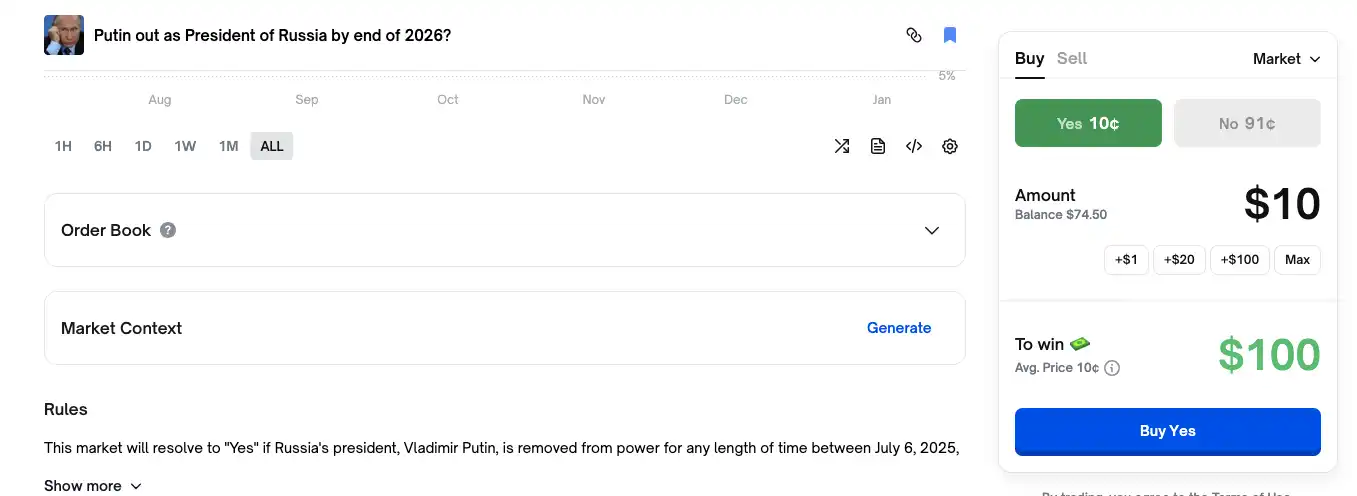
In addition, lottery players may not necessarily only bet heavily on a single outcome. Since the prediction market is full of such high odds events, as long as they cast a wide net, participate in multiple lotteries, there is still a chance to recoup costs or even profit.
They are more eager for the occurrence of a Black Swan than normal people. Therefore, they are willing to provide buy orders on the Yes side in the "Counterintuitive" market. (In some markets, Polymarket provides order book rewards and position rewards, but this is not the primary driver for lottery players).
Robot
If an event contract itself is highly deterministic, the intervention of sweepers' funds will make the probability of one side reach 99%-100% before settlement. The existence of "lottery players" can partially explain why these "Counterintuitive" markets still have players taking Yes sell orders (because Polymarket uses a shared order book, meaning when a 0.99 USD buy order appears on the No side, a corresponding 0.01 USD sell order will appear on the Yes side), but they are always a minority group, and cannot explain why these markets still have large trading volumes and good depth.
So, who else is injecting a large amount of liquidity into these markets? The answer is robots.
The development of market-making robots on Polymarket has been quite rapid, and robots that automatically trade through the Polymarket API will actively monitor all newly created markets and often be among the first participants. These robots can profit by actively trading in these markets.
In these "Counterintuitive" markets, when the No side price is $0.99, due to the shared order book, there will be a $0.01 sell order on the Yes side, and market-making robots, like lottery players, will take these $0.01 sell orders. However, shortly after, they will place $0.02, $0.03, or even higher sell orders on the Yes side, waiting for "lottery players" or other robots to trade. The No side will also have $0.98, $0.97, or even lower buy orders (Odaily note: still due to the shared order book), thus, the order book will have significant depth.
However, after communicating with the crypto VC Jsquare team (who invested in the prediction market aggregator Rocket), they believe that there are not many robots in the market executing this strategy, and in this "Counterintuitive" market, the speculative psychology of "lottery players" or players is enough to support most of the betting orders.
The presence of some wash trading robots also provides market liquidity and trading volume for these "Counterintuitive" and somewhat niche markets (compared to events like the U.S. presidential election). One wash trading robot will place a $0.02 buy order on the Yes side, and another wash trading robot will place a $0.98 buy order on the No side to execute the trade.
This behavior is mainly to participate in future prediction market airdrops. In a high-frequency market, orders may be matched by other players, so these "counterintuitive" event contracts are the ideal tool for volume boosting.
Prediction Platforms
In addition to the above "lottery players" and bots, prediction platforms themselves have also made significant contributions to the liquidity of these markets.
Polymarket has liquidity incentives in its mechanism design, including Orderbook Rewards and Holding Rewards. Orderbook Rewards mean that in certain markets, as long as players place orders within the maximum specified spread, they can receive rewards; Holding Rewards mean that in certain markets, as long as players hold Yes or No shares, they can receive a 4% annualized holding reward.
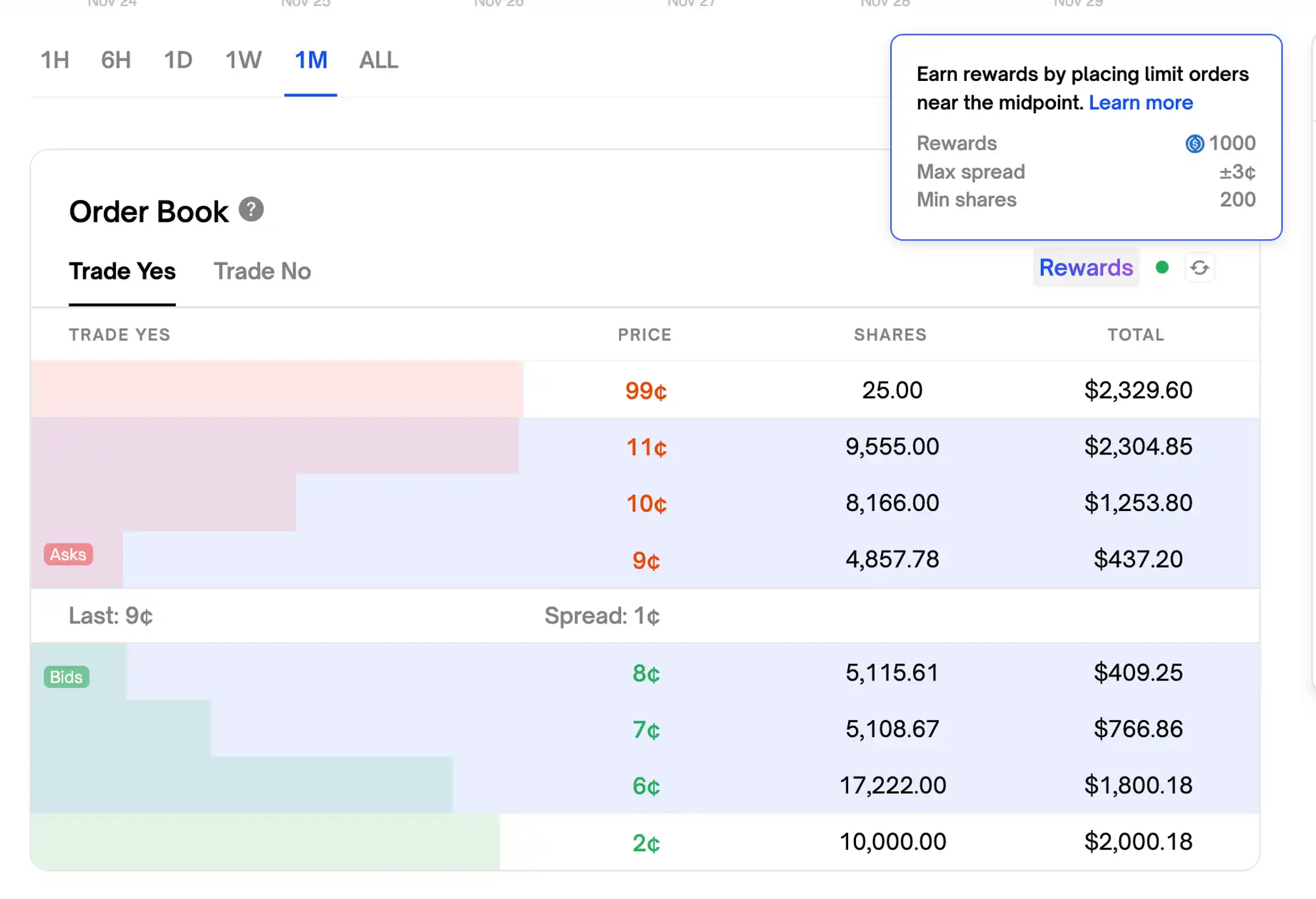
The highlighted part represents the maximum spread range for Orderbook Rewards
According to statistics, Polymarket has invested about $10 million in market maker incentives, with peak daily payments exceeding $50,000 to maintain order book liquidity. These incentives have now decreased to $0.025 for every $100 traded.
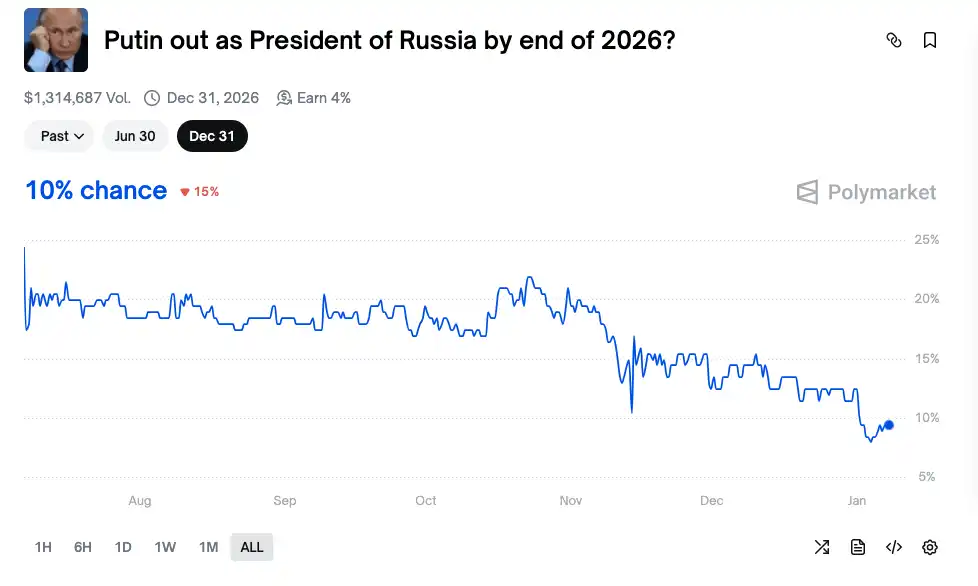
These investments have indeed been effective, driving trading in many "counterintuitive" markets. For example, the event contract "Will Putin step down by the end of 2026" has a trading volume of over $1.3 million. Holding a share of this contract will receive a 4% annualized return. For players holding Yes shares, this is equivalent to a final annualized return of 14% (10% end-of-term return + 4% platform reward), making it very attractive. For players holding No shares, the Orderbook Rewards and Holding Rewards also hedge against some risk.
There is also speculation that, in addition to providing liquidity incentives on the surface, prediction markets themselves act as market makers for these "counterintuitive" and niche markets to facilitate advertising and marketing effects. However, this is purely speculation and open to discussion.
You may also like

Galaxy Deep Research Report: How Hyperliquid's HIP-4 Upgrade Changes the Landscape of Prediction Markets?

ZachXBT: Humanity private key leak and abnormal surge in H token should be viewed separately
On June 9, according to related disclosures, on-chain investigator ZachXBT posted an update on Humanity’s roughly $31 million security incident, saying that after further analyzing fund flows, he currently tends to believe the project team was not involved in an “inside job” or a self-staged attack. According to him, the official explanation about the private key leak was broadly accurate, but before the token unlock, the price of H had been artificially pushed higher, and the hacker later took advantage of that market environment; therefore, the private key leak and the earlier abnormal price pumping should be regarded as two separate and independent events. This reframing has shifted the market’s understanding of the nature of the incident. Earlier discussion around Humanity had focused on whether the team directly participated in the attack or used the security incident to cover up internal operations. ZachXBT’s latest remarks shift the focus from “whether it was self-theft” to “whether there were pre-unlock market structure issues.” He also questioned whether the team may have.

Morning Report | OpenAI has submitted an S-1 registration statement draft to the U.S. SEC; Morpho completes $175 million financing

Morning Report | BitMine increased its holdings by 126,971 ETH last week; trader Eugene announced his exit from the crypto market

Wang Chuan: How can one not feel anxious after the neighbor Old Wang made thirty times profit by investing in storage stocks? (Seven) - A quarter-century cycle

Cryptocurrency CEXs are flocking to sell US stocks, and traditional brokerages are facing an "uninvited guest."
$75 billion in foreign capital has fled, and South Korean retail investors have absorbed it all using leverage

Japan’s Three Megabanks Plan Joint Stablecoin Issuance in Fiscal 2026
MUFG, SMBC, and Mizuho reportedly plan to jointly issue fiat-pegged stablecoins in fiscal 2026, signaling Japan’s growing push into bank-led digital payment infrastructure.

Humanity Discloses H Token Dual-Chain Attack Details, With Losses on Ethereum and BSC Exceeding $36 Million
Humanity said the H token attack across Ethereum and BSC caused more than $36 million in losses after leaked ProxyAdmin keys enabled malicious contract upgrades and token minting.
White House Discusses CLARITY Act With Law Enforcement Ahead of Senate Vote
The White House discussed the CLARITY Act with law enforcement ahead of a Senate vote, focusing on illicit finance risks and developer protections.

Bitcoin Trading Guide 2026: Strategies for Experienced Traders

What Is XAUT and PAXG? Why Tokenized Gold Is Booming in 2026

Will the SpaceX IPO Hurt Bitcoin? Here's What Traders Are Watching

Foreign selling in the South Korean stock market accelerates, with cumulative net sales reportedly reaching $75 billion this year
On June 9, The Kobeissi Letter, citing Goldman Sachs data, reported that global investors are selling South Korean stocks at an unusually rapid pace. In the latest trading session, foreign investors sold about $801 million worth of Kospi constituent stocks again; total foreign outflows last week reached about $10 billion, and the market has been in net foreign selling on nearly every trading day over the past month. According to the data cited in the report, foreign investors have sold about $75 billion worth of South Korean stocks so far this year. Meanwhile, South Korean retail and institutional investors together recorded roughly $69 billion in net buying over the same period, suggesting that the market’s main buying support has come from domestic capital rather than returning overseas funds. The information currently disclosed still mainly comes from The Kobeissi Letter’s retelling and Goldman Sachs data summaries, while public details on the statistical period and the specific definition of “selling” remain relatively limited.

Fortune Warns of Strategy’s Financing Structure Risks as Bitcoin Premium Narrows
Fortune warned that Strategy’s Bitcoin treasury model faces growing financing risks as MSTR’s net asset premium narrows and preferred stock dividend pressure increases.

Ferrari Challenge Le Mans: Carl Moon to Dominate in WEEX Livery

Sahara AI Responds to SAHARA’s Sharp Drop: No Contract or Product Security Issues Found, Internal Investigation Underway
Sahara AI responded to SAHARA’s 60% price drop, saying no token contract or product security issues have been found and an internal investigation is underway.

WEEX Deposit/Withdrawal Dynamic Island: Your Asset Status, Always in Sight
Galaxy Deep Research Report: How Hyperliquid's HIP-4 Upgrade Changes the Landscape of Prediction Markets?
ZachXBT: Humanity private key leak and abnormal surge in H token should be viewed separately
On June 9, according to related disclosures, on-chain investigator ZachXBT posted an update on Humanity’s roughly $31 million security incident, saying that after further analyzing fund flows, he currently tends to believe the project team was not involved in an “inside job” or a self-staged attack. According to him, the official explanation about the private key leak was broadly accurate, but before the token unlock, the price of H had been artificially pushed higher, and the hacker later took advantage of that market environment; therefore, the private key leak and the earlier abnormal price pumping should be regarded as two separate and independent events. This reframing has shifted the market’s understanding of the nature of the incident. Earlier discussion around Humanity had focused on whether the team directly participated in the attack or used the security incident to cover up internal operations. ZachXBT’s latest remarks shift the focus from “whether it was self-theft” to “whether there were pre-unlock market structure issues.” He also questioned whether the team may have.
Morning Report | OpenAI has submitted an S-1 registration statement draft to the U.S. SEC; Morpho completes $175 million financing
Morning Report | BitMine increased its holdings by 126,971 ETH last week; trader Eugene announced his exit from the crypto market
Wang Chuan: How can one not feel anxious after the neighbor Old Wang made thirty times profit by investing in storage stocks? (Seven) - A quarter-century cycle
Cryptocurrency CEXs are flocking to sell US stocks, and traditional brokerages are facing an "uninvited guest."


