
「Prediction Market Leader Stock」 Kalshi Surges Over 20% in Pre-market Trading, Is it Still a Buy?


Original Title: "Kalshi Pre-Market Stock Price Surges, Is It Still a Good Time to Buy?"
Original Author: Wenser, Odaily Planet Daily
The size and trading volume of the prediction market continue to grow rapidly. IPO pre-market of top platforms such as Kalshi and Polymarket has also attracted certain market attention and liquidity. According to PreStocks platform data, Kalshi's pre-market stock price has surged by 21.7% in the past 30 days, far exceeding the one-month increase of mainstream coins such as BTC and ETH.
Before the IPO cake is served, the Pre-IPO sector may be a battleground suitable for more people to participate early. In this article, Odaily Planet Daily will analyze from the perspectives of industry track, platform data, and capital valuation whether it is worth doubling down on the prediction market stock pre-market.
"Prediction Market Still Has 100x Upside Potential" Behind the Judgment: Total Trading Volume to Exceed $50 Billion by 2025
In August last year, 1confirmation founder Nick Tomaino boldly stated that "the prediction market's trading volume will increase by 100 times."
At that time, the "prediction market giants" Polymarket and Kalshi had not yet received financing of over $1 billion, and the valuation was far from the tens of billions of dollars scale. The overall trading volume of the prediction market in July was less than $2 billion, nearly halving compared to the historical peak in October 2024, which exceeded $4 billion. The judgment of 100x growth potential seemed like a baseless talk.
However, in October 2025, Polymarket announced a $2 billion investment from the NYSE parent company ICE Group, with a valuation soaring to $9 billion, and then sought a new round of financing in the range of $12 billion to $15 billion; Kalshi completed two rounds of financing between October and December, with the latest round reaching $1 billion, a valuation skyrocketing to $11 billion, led by Paradigm, with participation from Sequoia, a16z, Meritech Capital, IVP, ARK Invest, Anthos Capital, CapitalG, and Y Combinator, among others.
Behind the frenzy of capital lies the rapid development of the booming prediction market.
According to data related to our previously published "2025 Prediction Market Review: Total Trading Volume Exceeds $50 Billion, Duopoly Market Share Exceeds 97.5%" article:
1. In September 2025, the total trading volume of Kalshi and Polymarket reached $1.44 billion;
2. In October 2025, the prediction market trading volume reached $8.7 billion, with Kalshi leading and Polymarket following;
3. In November 2025, the total trading volume of Kalshi and Polymarket approached $10 billion, with Kalshi's trading volume reaching $5.8 billion, a month-on-month growth of 32%; Polymarket's trading volume reached $3.74 billion, a month-on-month growth of 23.8%.
4. In December 2025, analyst Patrick Scott wrote that in November 2025, the trading volume of the prediction market exceeded $13 billion, more than three times the trading volume during the peak of the 2024 election.
So far, in just a few months, the overall monthly trading volume of the prediction market has increased by about 6 times. Looking at this, a 100-fold increase is not out of reach.
After all, a 100-fold increase from $2 billion is only $200 billion. Compared to the total trading volume of over $50 billion in the 2025 prediction market, it only needs a 4-fold increase. Behind this rapid growth is the surge of Kalshi, a U.S.-based compliant prediction market platform.
Kalshi Poised to Become the "Leading Stock of the Prediction Market": 2025 Trading Volume Nearly $24 Billion, January Trading Volume Expected to Reach $9 Billion
The reason for emphasizing Kalshi's "compliant identity in the U.S. market" is that based on its various licenses and compliance readiness, the IPO door is easier for Kalshi to open. In addition, as a pioneer prediction market platform founded in 2018 (Note by Odaily: the platform was officially launched in July 2021, slightly later than Polymarket), Kalshi's business growth in recent years has also been remarkable.
Kalshi 2025 Performance Report: Annual Trading Volume of $23.8 Billion, 97 Million Trades
KalshiData previously stated that in 2025, all Kalshi metrics saw record growth.
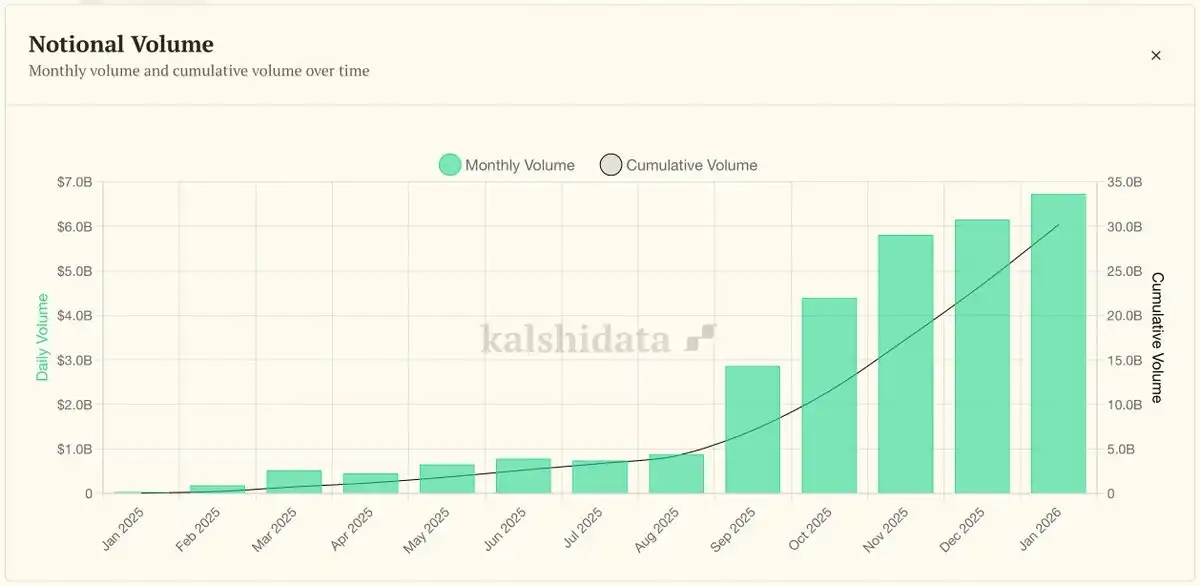
· In terms of nominal trading volume, the total for the year reached $23.8 billion, a year-over-year increase of 1108%, approximately 12.1 times. In December, a monthly all-time high of $6.38 billion was reached, a weekly all-time high of $1.7 billion in the fourth week of December, and a daily all-time high of $381.7 million on December 21st.
· In terms of number of trades, the total for the year reached 97 million trades, a year-over-year increase of 1680%, approximately 17.8 times. In December, there were 27.67 million trades, 7.6 million trades in the fourth week of December, and 1.5 million trades on December 21st, all reaching all-time highs.
As we entered 2026, Kalshi's business data growth can be described as nothing short of staggering.
Kalshi Business Surge: January 2026 Nominal Trading Volume Expected to Exceed $9 Billion
On December 16, 2025, Kalshi CEO Tarek Mansour announced that with the launch of the Combo feature, the platform reached a historic daily trading volume of $340 million;
On January 12, 2026, the prediction market's daily trading volume surged to around $702 million, setting a new record; of which, Kalshi accounted for approximately $465 million, about two-thirds of the total volume, while Polymarket and Opinion collectively contributed about $100 million in trading volume.
On January 26, KalshiData announced that as of January 23, Kalshi's monthly nominal trading volume was around $6.7 billion, with a daily average trading volume of about $293 million. If this pace is maintained, Kalshi's January nominal trading volume is expected to reach around $9.1 billion.
It is worth mentioning that in October of last year, the overall prediction market trading volume was $8.7 billion, with Kalshi's market share ranging from 45%-55%; now, the monthly trading volume of just the Kalshi platform alone exceeds the total market size at that time. This not only reflects the overall boom of the prediction market but also demonstrates the frightening pace of Kalshi's business growth.
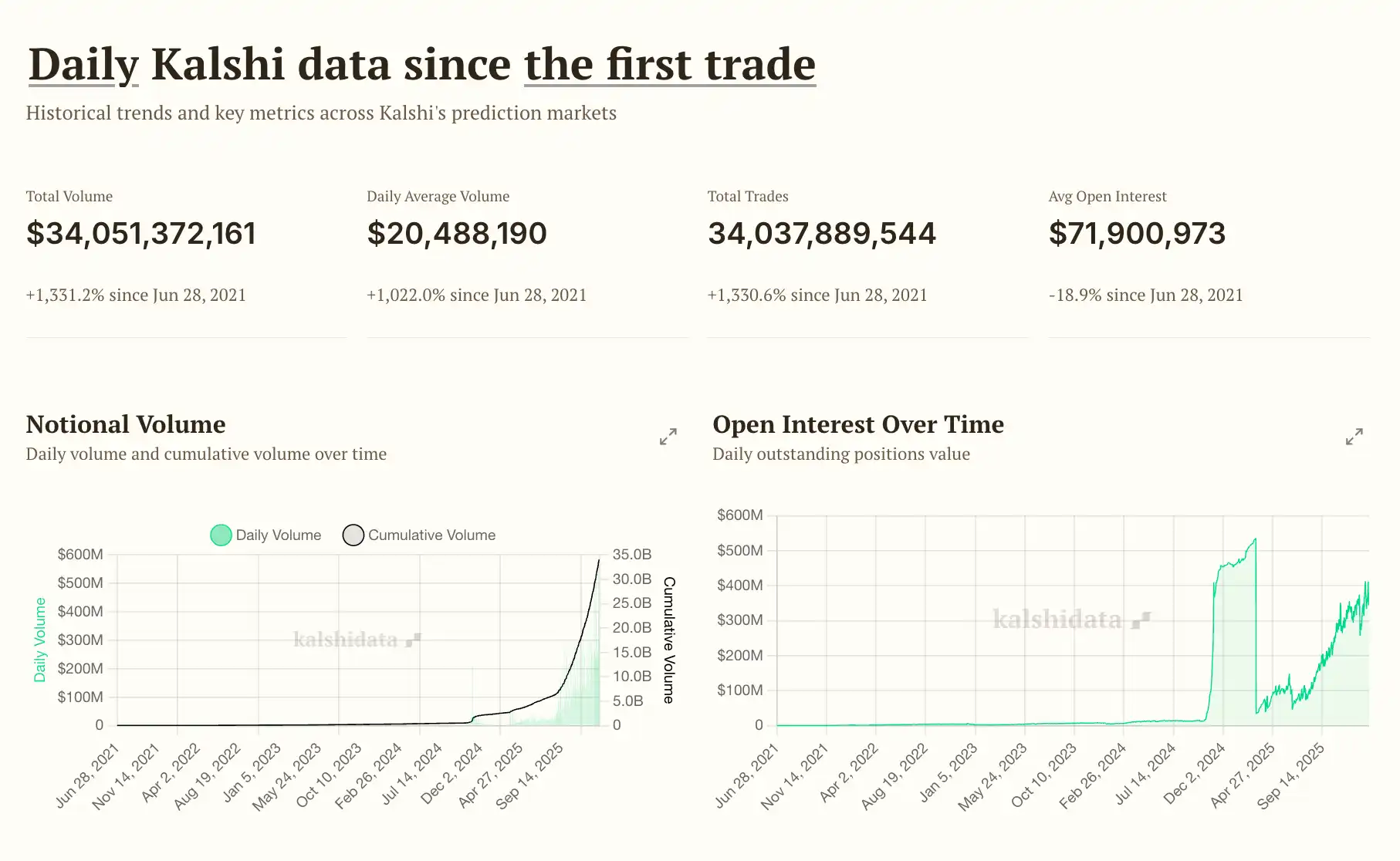
According to data from the KalshiData website, as of January 29, Kalshi's total historical trading volume has exceeded $34.05 billion, with a daily average trading volume of over $20.48 million; and looking at the nominal trading volume's candlestick chart, since September 2025, it has shown almost exponential growth.
Capital Market Pricing Range: Kalshi's Single Stock Price is $300-$450
Finally, as the current market leader in the prediction market space, although the specific timing and number of shares for the Kalshi IPO have not been determined, considering its previous funding news and public statements, an IPO is a sure thing. Currently, there are many differences between the pre-market stock valuations of the two in both the traditional financial markets and the cryptocurrency markets:
The pre-market valuation of Kalshi's stock in the traditional financial markets is relatively low—
· On the Nasdaq Private Market, the price per share of Kalshi is around $307;
· On Hiive, the price per share of Kalshi is around $357.
The pre-market valuation of Kalshi's stock in the cryptocurrency markets, on the other hand, is relatively high—
· On PreStocks, the implied market cap of Kalshi is around $14 billion, with a price per share of around $407;
· On Jarsy, Kalshi's market value is $11 billion, with a price per share of $450.
You may also like

Bitcoin Trading Guide 2026: Strategies for Experienced Traders

What Is XAUT and PAXG? Why Tokenized Gold Is Booming in 2026

Cryptocurrency CEXs are flocking to sell US stocks, and traditional brokerages are facing an "uninvited guest."

Will the SpaceX IPO Hurt Bitcoin? Here's What Traders Are Watching
Foreign selling in the South Korean stock market accelerates, with cumulative net sales reportedly reaching $75 billion this year
On June 9, The Kobeissi Letter, citing Goldman Sachs data, reported that global investors are selling South Korean stocks at an unusually rapid pace. In the latest trading session, foreign investors sold about $801 million worth of Kospi constituent stocks again; total foreign outflows last week reached about $10 billion, and the market has been in net foreign selling on nearly every trading day over the past month. According to the data cited in the report, foreign investors have sold about $75 billion worth of South Korean stocks so far this year. Meanwhile, South Korean retail and institutional investors together recorded roughly $69 billion in net buying over the same period, suggesting that the market’s main buying support has come from domestic capital rather than returning overseas funds. The information currently disclosed still mainly comes from The Kobeissi Letter’s retelling and Goldman Sachs data summaries, while public details on the statistical period and the specific definition of “selling” remain relatively limited.

Fortune Warns of Strategy’s Financing Structure Risks as Bitcoin Premium Narrows
Fortune warned that Strategy’s Bitcoin treasury model faces growing financing risks as MSTR’s net asset premium narrows and preferred stock dividend pressure increases.

Ferrari Challenge Le Mans: Carl Moon to Dominate in WEEX Livery

Sahara AI Responds to SAHARA’s Sharp Drop: No Contract or Product Security Issues Found, Internal Investigation Underway
Sahara AI responded to SAHARA’s 60% price drop, saying no token contract or product security issues have been found and an internal investigation is underway.

WEEX Deposit/Withdrawal Dynamic Island: Your Asset Status, Always in Sight

Scaling Crypto Derivatives: The Digital Asset Infrastructure Behind High-Volume Trading
In the fast-moving digital asset ecosystem, derivatives platforms face an extreme architectural test. High-leverage futures markets demand more than just standard security—they require absolute operational precision, zero-latency matching engines, and ironclad structural scalability, all while navigating intense market volatility.
As global platforms scale to meet these demands, the industry is shifting away from rigid, monolithic setups toward a more agile, "decoupled" infrastructure philosophy.
The Blueprint for High-Volume Copy TradingFor elite global exchanges like WEEX (founded in 2018), this architectural choice becomes critical when scaling high-volume retail features like social copy trading. When thousands of users automatically mirror the real-time strategies of elite traders simultaneously, it triggers sudden, monumental spikes in concurrent transactional volume.
To prevent execution latency or settlement bottlenecks during these peak volatility events, a platform's primary engine must remain entirely dedicated to risk management, copy-trade synchronization, and order matching.
The Architectural Rule: New-generation platforms must separate front-end user execution engines from heavy backend infrastructural overhead to eliminate operational friction.
By separating these layers, platforms can maintain complete sovereignty over their trading environments and user experiences while strategically aligning with institutional-grade infrastructure ecosystems. This strategic framework allows modern exchanges to leverage advanced Digital Asset Custody infrastructure such as Cobo’s behind the scenes, ensuring that backend wallet management scales elastically alongside trading spikes.
Capitalizing on Market Momentum and 400× LeverageIn a derivatives arena where platforms offer up to 400× leverage on perpetual contracts, capital efficiency and market agility are core business metrics. To capture market momentum, an exchange needs the ability to rapidly expand its asset offerings, supporting everything from legacy crypto assets to sudden, trending altcoins across a massive library of trading pairs.
Adopting a flexible, scalable Wallet-as-a-Service (WaaS) solution such as Cobo’s could completely rewrite the development timeline for high-growth exchanges. Instead of spending months of engineering capital building out custom backend wallet architectures for every new blockchain network, platforms can deploy localized infrastructure in days.
This agility allows platforms to instantly scale their listings to over a thousand trading pairs without compromising security or delaying time-to-market. It mirrors the exact operational advantages seen during high-velocity market events, similar to how advanced wallet infrastructure empowers platforms during sudden asset surges; allowing exchanges to pass that speed and liquidity directly to their global user base.
A Mature Foundation for GrowthThe synergy between trusted infrastructure ecosystems and global trading platforms represents the natural evolution of a maturing crypto market. As WEEX continues to scale its global spot and derivatives offerings for over 6 million users, adopting robust backend paradigms proves that platforms no longer have to compromise between cutting-edge trading velocity and uncompromised structural security.

Morning Report | BitMine increased its holdings by 126,971 ETH last week; trader Eugene announced his exit from the crypto market

Wang Chuan: How can one not feel anxious after the neighbor Old Wang made thirty times profit by investing in storage stocks? (Seven) - A quarter-century cycle

Get Paid to Onboard? Try WEEX’s New Homepage with Rewards for Registration, Deposit & Trade

WEEX Custom Layout: Build Your Perfect Trading Workspace in Seconds

See “Buy Walls” & “Sell Walls” Instantly: WEEX Launches the Depth Chart for Smarter Trades

What Is Quick Trade on WEEX? 2 Ways WEEX Ends Chart-Panel Jumping
Morning News | Five major virtual asset platforms in South Korea have experienced 57 incidents of hacking and system failures in six years; Grayscale submits registration application for Canton ETF
Should we escape the peak? The principle of the tail-end market in the stock market
Bitcoin Trading Guide 2026: Strategies for Experienced Traders
What Is XAUT and PAXG? Why Tokenized Gold Is Booming in 2026
Cryptocurrency CEXs are flocking to sell US stocks, and traditional brokerages are facing an "uninvited guest."
Will the SpaceX IPO Hurt Bitcoin? Here's What Traders Are Watching
Foreign selling in the South Korean stock market accelerates, with cumulative net sales reportedly reaching $75 billion this year
On June 9, The Kobeissi Letter, citing Goldman Sachs data, reported that global investors are selling South Korean stocks at an unusually rapid pace. In the latest trading session, foreign investors sold about $801 million worth of Kospi constituent stocks again; total foreign outflows last week reached about $10 billion, and the market has been in net foreign selling on nearly every trading day over the past month. According to the data cited in the report, foreign investors have sold about $75 billion worth of South Korean stocks so far this year. Meanwhile, South Korean retail and institutional investors together recorded roughly $69 billion in net buying over the same period, suggesting that the market’s main buying support has come from domestic capital rather than returning overseas funds. The information currently disclosed still mainly comes from The Kobeissi Letter’s retelling and Goldman Sachs data summaries, while public details on the statistical period and the specific definition of “selling” remain relatively limited.
Fortune Warns of Strategy’s Financing Structure Risks as Bitcoin Premium Narrows
Fortune warned that Strategy’s Bitcoin treasury model faces growing financing risks as MSTR’s net asset premium narrows and preferred stock dividend pressure increases.


