
The Fed Keeps Interest Rates Unchanged, Sending Markets into a "Two-Speed" World

Original Title: "After the Fed Hits the Brakes, the Market Experiences a Drastic Change"
Original Author: seed.eth, Bitpush News
After three consecutive rate cuts, the Fed finally pressed the "pause button" at its first monetary policy meeting of 2026.
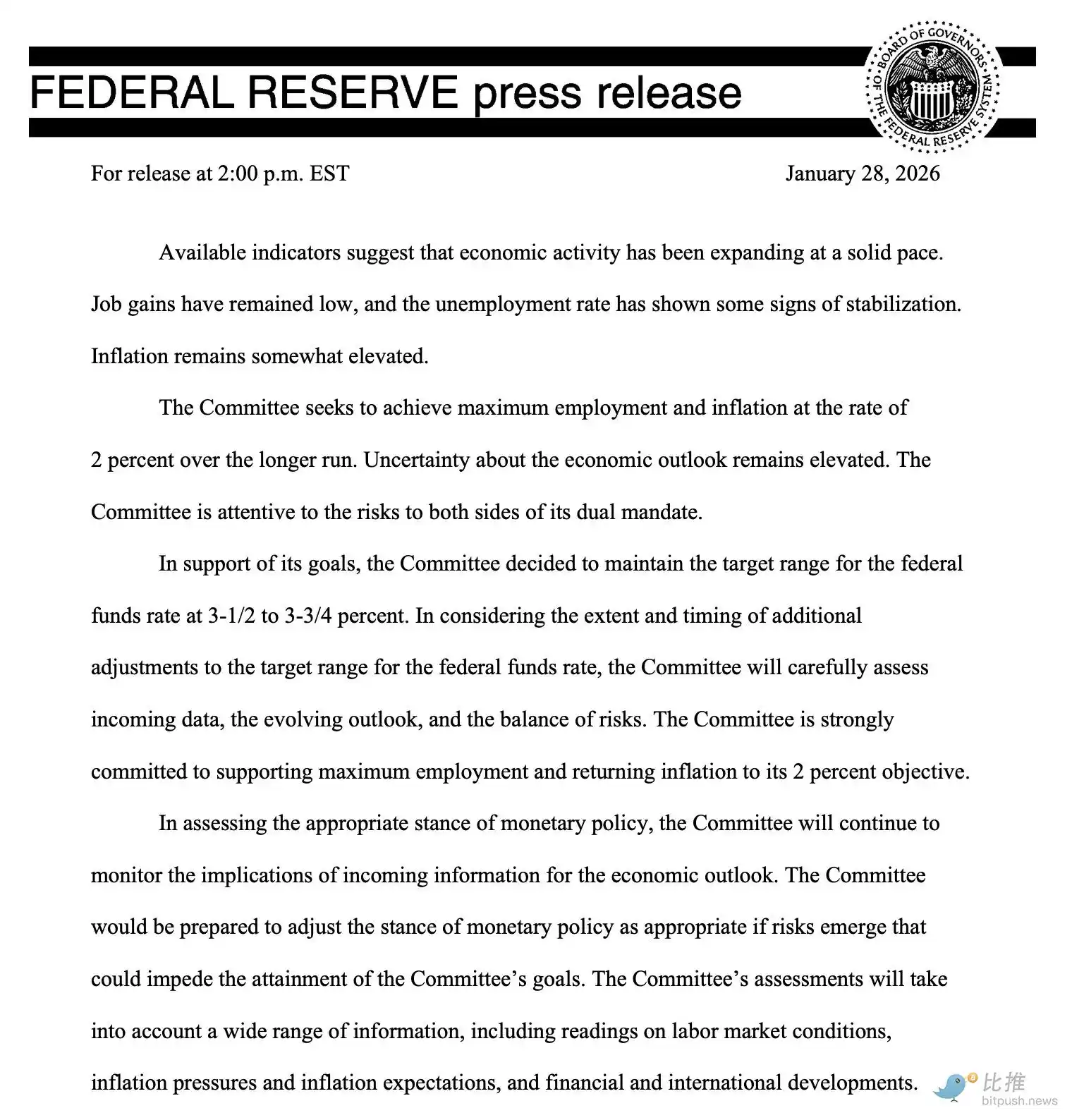
In the early hours of Thursday Beijing time, the Fed announced that it would maintain the target range for the federal funds rate at 3.5% to 3.75%. This somewhat "flat" decision was in line with expectations of over 97% of the market. However, it also revealed subtle divisions within the policy: two Fed officials dissented and voted to continue cutting rates by 25 basis points.
The Shoe Drops, but the Direction Remains Uncertain
In its policy statement, the Fed continued its relatively cautious language: the economy is still in a "solid expansion," inflation "has moderated but is still above target," there are signs of cooling in the labor market, but it has not yet posed a systemic risk. The core message is clear—the monetary policy has transitioned from an "active adjustment" phase to an "observation validation" phase.
It is worth noting that there is not complete consensus within the Federal Open Market Committee. Two members voted to continue cutting rates, indicating a divergence in policy direction between moderating inflation and economic slowdown. However, overall, the Fed clearly showed its reluctance to make new policy commitments in the current environment and chose to defer the decision-making to future data.
This stance has set the tone for the market: there will be no clear directional guidance in the short term, and asset pricing will revolve more around "expected changes" rather than "policy changes."
Current federal funds rate market pricing shows that investors generally expect rates to remain unchanged this quarter, with the first rate cut now pointing to June of this year, and the market further anticipates a possible pause in the rate-cutting cycle until 2027.
However, there are still significant differences among institutions regarding the interest rate path after this quarter: Morgan Stanley, Citigroup, and Goldman Sachs predict rate cuts in June and September, Barclays believes there may be cuts in June and December, while JPMorgan maintains its expectation of no rate changes throughout the year.
Macro Markets: Gold Shines Alone, While Other Assets Remain Calm
If the Fed's decision itself did not cause much turbulence, then the divergence in asset performance is the signal that deserves real attention.
After the rate decision was announced, the spot gold price surged all the way, breaking through the $5500 per ounce mark for the first time. In just four trading days, the gold price rose from slightly below $5000 all the way up, breaking through multiple hundred-dollar levels, with a total increase of over $500 and a weekly gain of 10%. This speed and magnitude have made gold the undisputed star of the current global market.
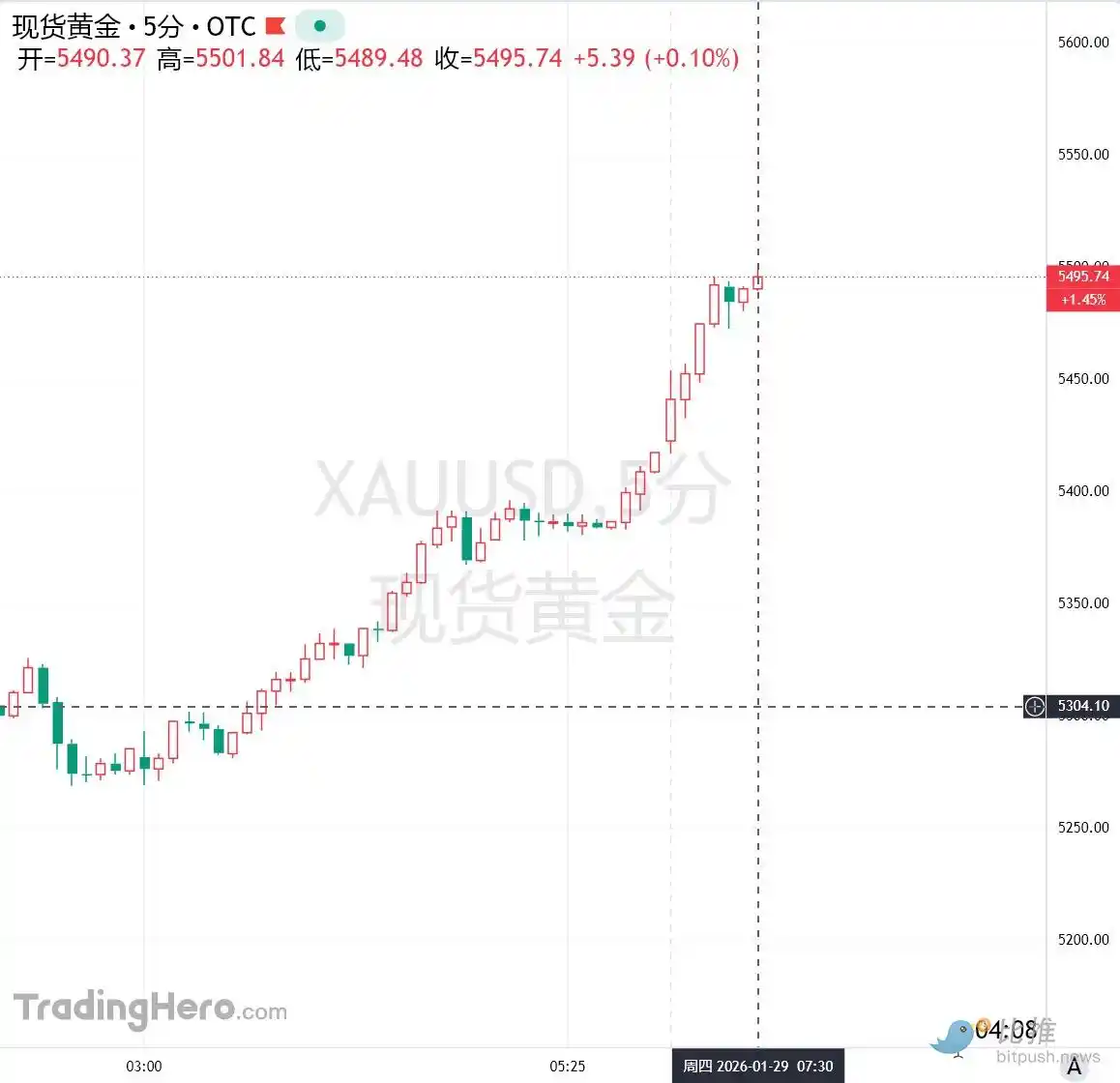
The strengthening of gold is not simply driven by interest rate trading logic. Despite the Federal Reserve pausing its rate cuts, after a period of continuous easing, monetary policy is now approaching a neutral range, easing the marginal constraint of real interest rates. Meanwhile, a mix of inflation resilience, trade frictions, political uncertainty, and global policy games have continued to amplify risk aversion. Amidst multiple layers of uncertainty, funds have chosen the most traditional and widely accepted safe-haven asset.
In stark contrast to gold, other assets have shown a lackluster performance. U.S. stocks have maintained narrow fluctuations post-decision, without showing any trending breakthroughs; the U.S. dollar index has seen limited volatility; U.S. bond yields have made slight adjustments but have not evolved into a systemic risk-off trend.
The same is true for crypto assets. Following the news announcement, the price of Bitcoin briefly dipped from $89,600 to the $89,000 level, then quickly rebounded to around $89,300. The price fluctuation was less than 1%. Ethereum (ETH) lingered around the $3,000 mark, while mainstream altcoins like Solana and XRP also remained within their previous ranges of consolidation.
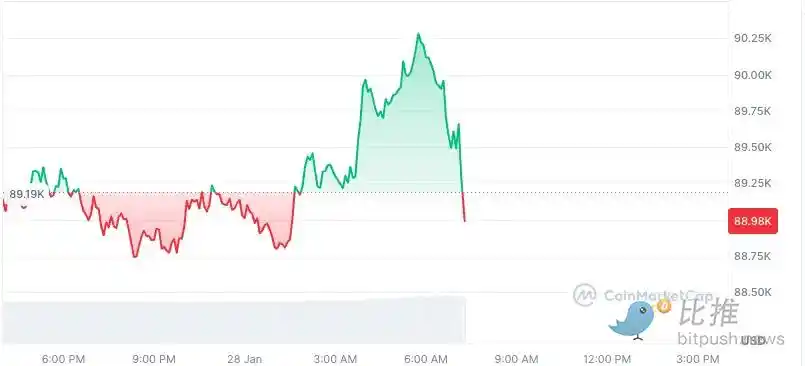
The market has given the answer in the most straightforward manner: when the direction is unclear, gold is pushed back to the center stage, while other assets enter a wait-and-see mode.
A More Important Question than Rate Cuts: Who Will Shape the Next Phase of the Federal Reserve?
After the rate decision has been made, the market's focus quickly shifted. Rather than "when will the rates be cut," investors began to concentrate on another question: who will lead the next phase of the Federal Reserve?
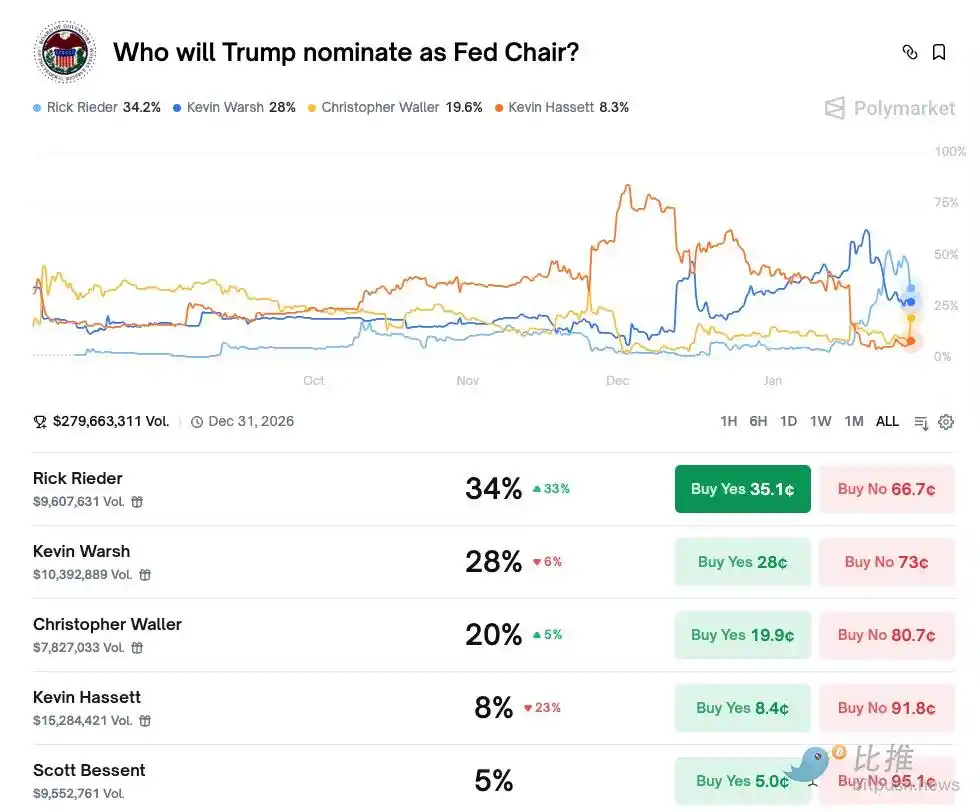
According to the latest data from Polymarket, in the "Who will Trump nominate for Fed chair" betting market, several candidates have pulled ahead in terms of odds:
Rick Rieder: The Market's Favorite "Pragmatist" (about 34%)
Currently, the highest betting probability is for Rick Rieder, with a support rate of about 34%, showing a recent significant increase.
Rieder currently serves as the Global Chief Investment Officer for Fixed Income at BlackRock, with a long history of deep involvement in the bond market and macro asset allocation decisions, seen as one of the very few individuals truly spanning "policy-market-funding structure." His public views often emphasize financial market stability, policy transmission efficiency, and the avoidance of unnecessary systemic shocks.
In the market's view, if Rieder were to become the Fed chair, it would mean that central bank decisions would pay more attention to financial conditions and asset price signals, maintaining policy flexibility within the bounds of inflation. This expectation explains why he is gaining more and more financial support in the prediction market—a bet on "predictability" and "market-friendliness."
Kevin Warsh: Advocate of Discipline and Credibility (Approx. 28%)
In second place is former Fed Governor Kevin Warsh, currently with betting odds of around 28%.
Warsh has been known for his clear stance and tough approach, emphasizing central bank credibility and long-term discipline regarding inflation. He has repeatedly expressed concerns about overly accommodative policies and is seen as a key representative of the traditional hawkish view.
If Warsh ultimately wins, the market generally expects the Fed to be more cautious in its rate-cutting pace, asset price tolerance, and policy communication. This style is usually favorable for curbing inflation expectations but also implies that risk assets will need to adapt to a stricter financial environment.
Christopher Waller: Academic Fed Governor (Approx. 20%)
Current Fed Governor Christopher Waller has betting odds of approximately 20%, placing him third.
Waller has a strong academic background, clear policy logic, and has long been seen as the most influential "hawk" within the Fed (advocating higher interest rates to curb inflation). However, in this FOMC meeting, he cast a dissenting vote in support of continuing rate cuts, indicating that he believes inflation is no longer a primary threat or that he is under significant political/economic pressure.
If Waller takes over, the Fed may give more weight to employment and growth targets, with a relatively flexible policy pace. However, whether he can maintain central bank independence in a highly politicized environment remains a focal point of market attention.
Will Bitcoin Continue Its Bearish Trend?
Amid increasing macro uncertainty, on-chain data is beginning to reveal concerning signals.
CryptoQuant's latest analysis shows that the Bitcoin "Supply in Loss" (Supply in Loss) 365-day moving average is trending upwards. This indicator is used to measure the percentage of Bitcoin currently priced below its last on-chain movement, serving as a crucial tool to observe market structure changes.
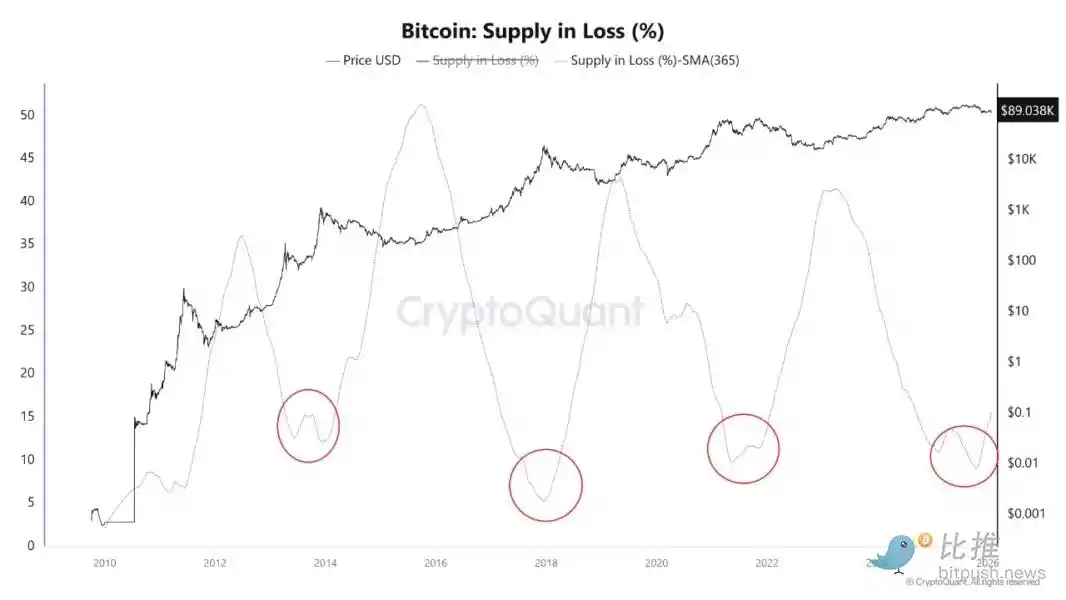
When Bitcoin hit its all-time high of $126,000 in October last year, this indicator plummeted to the lowest of the cycle, reflecting a highly profitable market state. However, as the price retreated, Supply in Loss began to rise steadily, indicating that losses are gradually spreading from short-term traders to longer-term holders.
From a historical perspective, such a directional shift often occurs in the early stages of a bull-bear transition. However, it is important to emphasize that the indicator has not yet entered the typical "surrender range," appearing more like a risk signal rather than a trend confirmation.
This means that the current state of Bitcoin is more akin to high-level digestion and structural reorganization rather than having already entered a clear bear market decline phase. Whether it will evolve into a deeper correction still heavily depends on macro liquidity and subsequent fund flows. Gabe Selby, Head of Research at CF Benchmarks, stated: "Bitcoin's short-term bullish catalysts still exist but are increasingly leaning towards political factors rather than monetary factors."
Summary: Macro uncertainty, structural changes, the market awaits answers
Overall, this round of market change is not primarily driven by a single event but rather the result of multiple factors working together; funds embrace gold in uncertainty, pushing risk-off sentiment to the forefront. Bitcoin's next steps still await further convergence of macro and cyclical signals.
You may also like

White House Discusses CLARITY Act With Law Enforcement Ahead of Senate Vote
The White House discussed the CLARITY Act with law enforcement ahead of a Senate vote, focusing on illicit finance risks and developer protections.

$75 billion in foreign capital has fled, and South Korean retail investors have absorbed it all using leverage

Bitcoin Trading Guide 2026: Strategies for Experienced Traders

What Is XAUT and PAXG? Why Tokenized Gold Is Booming in 2026

Cryptocurrency CEXs are flocking to sell US stocks, and traditional brokerages are facing an "uninvited guest."

Will the SpaceX IPO Hurt Bitcoin? Here's What Traders Are Watching
Foreign selling in the South Korean stock market accelerates, with cumulative net sales reportedly reaching $75 billion this year
On June 9, The Kobeissi Letter, citing Goldman Sachs data, reported that global investors are selling South Korean stocks at an unusually rapid pace. In the latest trading session, foreign investors sold about $801 million worth of Kospi constituent stocks again; total foreign outflows last week reached about $10 billion, and the market has been in net foreign selling on nearly every trading day over the past month. According to the data cited in the report, foreign investors have sold about $75 billion worth of South Korean stocks so far this year. Meanwhile, South Korean retail and institutional investors together recorded roughly $69 billion in net buying over the same period, suggesting that the market’s main buying support has come from domestic capital rather than returning overseas funds. The information currently disclosed still mainly comes from The Kobeissi Letter’s retelling and Goldman Sachs data summaries, while public details on the statistical period and the specific definition of “selling” remain relatively limited.

Fortune Warns of Strategy’s Financing Structure Risks as Bitcoin Premium Narrows
Fortune warned that Strategy’s Bitcoin treasury model faces growing financing risks as MSTR’s net asset premium narrows and preferred stock dividend pressure increases.

Ferrari Challenge Le Mans: Carl Moon to Dominate in WEEX Livery

Sahara AI Responds to SAHARA’s Sharp Drop: No Contract or Product Security Issues Found, Internal Investigation Underway
Sahara AI responded to SAHARA’s 60% price drop, saying no token contract or product security issues have been found and an internal investigation is underway.

WEEX Deposit/Withdrawal Dynamic Island: Your Asset Status, Always in Sight
Scaling Crypto Derivatives: The Digital Asset Infrastructure Behind High-Volume Trading
In the fast-moving digital asset ecosystem, derivatives platforms face an extreme architectural test. High-leverage futures markets demand more than just standard security—they require absolute operational precision, zero-latency matching engines, and ironclad structural scalability, all while navigating intense market volatility.
As global platforms scale to meet these demands, the industry is shifting away from rigid, monolithic setups toward a more agile, "decoupled" infrastructure philosophy.
The Blueprint for High-Volume Copy TradingFor elite global exchanges like WEEX (founded in 2018), this architectural choice becomes critical when scaling high-volume retail features like social copy trading. When thousands of users automatically mirror the real-time strategies of elite traders simultaneously, it triggers sudden, monumental spikes in concurrent transactional volume.
To prevent execution latency or settlement bottlenecks during these peak volatility events, a platform's primary engine must remain entirely dedicated to risk management, copy-trade synchronization, and order matching.
The Architectural Rule: New-generation platforms must separate front-end user execution engines from heavy backend infrastructural overhead to eliminate operational friction.
By separating these layers, platforms can maintain complete sovereignty over their trading environments and user experiences while strategically aligning with institutional-grade infrastructure ecosystems. This strategic framework allows modern exchanges to leverage advanced Digital Asset Custody infrastructure such as Cobo’s behind the scenes, ensuring that backend wallet management scales elastically alongside trading spikes.
Capitalizing on Market Momentum and 400× LeverageIn a derivatives arena where platforms offer up to 400× leverage on perpetual contracts, capital efficiency and market agility are core business metrics. To capture market momentum, an exchange needs the ability to rapidly expand its asset offerings, supporting everything from legacy crypto assets to sudden, trending altcoins across a massive library of trading pairs.
Adopting a flexible, scalable Wallet-as-a-Service (WaaS) solution such as Cobo’s could completely rewrite the development timeline for high-growth exchanges. Instead of spending months of engineering capital building out custom backend wallet architectures for every new blockchain network, platforms can deploy localized infrastructure in days.
This agility allows platforms to instantly scale their listings to over a thousand trading pairs without compromising security or delaying time-to-market. It mirrors the exact operational advantages seen during high-velocity market events, similar to how advanced wallet infrastructure empowers platforms during sudden asset surges; allowing exchanges to pass that speed and liquidity directly to their global user base.
A Mature Foundation for GrowthThe synergy between trusted infrastructure ecosystems and global trading platforms represents the natural evolution of a maturing crypto market. As WEEX continues to scale its global spot and derivatives offerings for over 6 million users, adopting robust backend paradigms proves that platforms no longer have to compromise between cutting-edge trading velocity and uncompromised structural security.

Morning Report | BitMine increased its holdings by 126,971 ETH last week; trader Eugene announced his exit from the crypto market

Wang Chuan: How can one not feel anxious after the neighbor Old Wang made thirty times profit by investing in storage stocks? (Seven) - A quarter-century cycle

Get Paid to Onboard? Try WEEX’s New Homepage with Rewards for Registration, Deposit & Trade

WEEX Custom Layout: Build Your Perfect Trading Workspace in Seconds

See “Buy Walls” & “Sell Walls” Instantly: WEEX Launches the Depth Chart for Smarter Trades

What Is Quick Trade on WEEX? 2 Ways WEEX Ends Chart-Panel Jumping
White House Discusses CLARITY Act With Law Enforcement Ahead of Senate Vote
The White House discussed the CLARITY Act with law enforcement ahead of a Senate vote, focusing on illicit finance risks and developer protections.
$75 billion in foreign capital has fled, and South Korean retail investors have absorbed it all using leverage
Bitcoin Trading Guide 2026: Strategies for Experienced Traders
What Is XAUT and PAXG? Why Tokenized Gold Is Booming in 2026
Cryptocurrency CEXs are flocking to sell US stocks, and traditional brokerages are facing an "uninvited guest."
Will the SpaceX IPO Hurt Bitcoin? Here's What Traders Are Watching


