
The LINK Price Has Dropped by More Than Half from Its Peak, But Someone Quietly Accumulated 100 Million Coins During the "10/11 Crash"

Original Article Title: Somebody Bought 10% of the LINK Supply—and Nobody Knows Who
Original Article Author: @LinkBoi777, Crypto Trader
Original Article Translation: AididiaoJP, Foresight News
Based on in-depth on-chain data analysis, when researching the wallets holding the top 100 LINK amounts, I discovered an unusual pattern.
Multiple wallets hold nearly identical amounts of LINK, each around 2 million tokens, and do not hold any other assets. Initially identifying 8 to 9 similar wallets, further investigation revealed that these were just the tip of the iceberg.
Eventually, I found a total of 48 wallets with almost the same LINK balance, exhibiting highly consistent transaction patterns. Based on this consistency, I believe they belong to the same entity.
In other words, during the period from August 2025 to January 2026, an entity accumulated approximately 100 million LINK, representing 10% of its total supply.
Clearly, this entity has made significant efforts to remain obscure. Its accumulation strategy has been carefully crafted to avoid drawing attention or impacting the market price.
Why do I believe these wallets belong to the same entity?
There are several key pieces of evidence supporting this:
· Each wallet holds around 2 million LINK.
· All wallets were created between August and November 2025.
· All purchases originated from the same Coinbase hot wallet address: 0xA9D1e08C7793af67e9d92fe308d5697FB81d3E43.
The most compelling evidence is the comparison of transaction heatmaps. These wallets' heatmaps are remarkably similar, executing similar amounts of LINK transactions on the same dates, following the same accumulation rhythm.
There are slight timing differences: wallets created later had larger initial buy-ins, while those created earlier were more gradual. However, after the initial phase, all wallets began to make consistent monthly purchases on the same date each month.
For example, observing wallets 54, 55, 56, August data may vary slightly, but their transaction behaviors from September to January are nearly synchronized. This pattern repeats across all 48 wallets, as if following the same schedule.
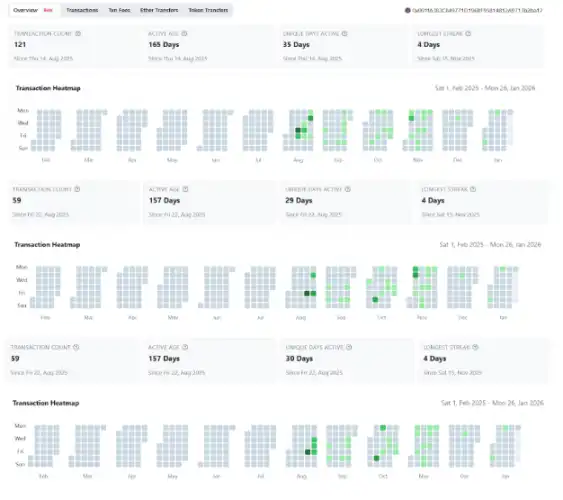
The link showcases these 48 wallets and their transaction heatmaps for readers to verify themselves
Why Did the Market Show No Reaction to the Accumulation of 10% of the Supply?
The answer is simple: the entity made a concerted effort to avoid disrupting the market.
They used anonymous wallets not associated with any public entity and structured their purchases in batches to avoid sudden spikes in demand. The goal was clear: discreetly accumulate LINK without triggering market FOMO or speculation.
To achieve this, they took advantage of a rare market event.
The Market Crash on October 10th
According to Raoul Pal, at that time, market makers could not access the API, leading to a severe imbalance in the crypto market. Simultaneously, tariff concerns sparked panic selling, flooding the order book with sell orders. Due to a lack of buyers stepping in, the market saw a freefall drop.
To prevent a total collapse, exchanges were forced to intervene, placing a large number of buy orders to absorb the selling pressure, thus accumulating a significant amount of crypto assets in inventory.
In the weeks following the crash, these assets were gradually released back into the market in October and November, creating sustained selling pressure and unusually high liquidity.
This presented an excellent opportunity for discreet accumulation.
The entities behind these wallets leveraged the liquidity window to acquire a large amount of LINK while avoiding driving up the price. It is noteworthy that 39 of the 48 wallets were created in the peak liquidity months of October and November.
Two Possible Motivations
One is opportunistic accelerated accumulation. The entity saw the market crash as a rare opportunity to speed up the accumulation process, which otherwise might have taken several more months.
Second is emergency strategic reserves. The entity may have urgently needed to acquire LINK and used the liquidity from the crash to quietly build its position to avoid price fluctuations. Whether this urgency stems from strategic demand or external pressure is currently unclear.
Impact on Exchange Balances
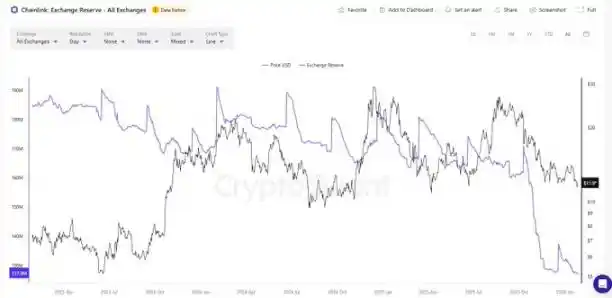
The influx of new wallets coincides precisely with the sharp decline in exchange LINK balances from October to November, as indicated by CryptoQuant data.
This drop aligns perfectly with the creation of the 39 new wallets, each accumulating around 2 million LINK during this period.
Who Could the Mastermind Be?
Having accumulated 10% of the LINK token supply, the potential suspects have been significantly narrowed down.
Chainlink Labs
Likelihood is low. Chainlink's official non-circulating supply of around 300 million LINK is publicly disclosed and accounted for in their roadmap. Additionally, Chainlink has publicly announced a weekly buyback of $1 million worth of LINK, making it contradictory to secretly hoard nearly $1 billion worth of LINK.
However, the timing is worth noting: the accumulation started on August 11, 2025, just 4 days after the Chainlink reserve mechanism was revealed, which could signal long-term confidence to the public.
BlackRock
This is one of the more reasonable speculations. With assets under management totaling $14 trillion, BlackRock has repeatedly stated that tokenization is the future of the financial market. Their $3+ billion BUIDL Fund heavily relies on Chainlink's CCIP, reserve proof, and data services.
Owning 100 million LINK would help them strategically position themselves in the tokenization infrastructure. This allocation is significant given their size. A secret accumulation would also make sense, as a large public purchase would inevitably drive up the price significantly.
JPMorgan
Equally plausible. This trillion-dollar asset bank is rapidly expanding its blockchain division (Kinexys, formerly Onyx) and has become one of the most active traditional institutions in tokenized assets and cross-chain finance.
Their tokenized currency markets, fund flow projects, and multiple public chain settlements in 2025 all rely on Chainlink's CCIP, runtime environments, and oracle data feeds. Holding 100 million LINK would help them establish a strategic position in their interoperable and oracle infrastructure between their permissioned and public chains, ensuring priority access, staking rewards, and reducing reliance risks.
Interestingly, JPMorgan's actions around the significant drop on October 10th are intriguing. Just days before the drop, the bank released a bearish report highlighting the vulnerability of crypto-related stocks to geopolitical risks. Although the drop was primarily triggered by external factors, the bearish report followed by a liquidity vacuum raises speculation that large institutions may have opportunistically accumulated positions quietly.
Financial Infrastructure Institutions (such as DTCC, SWIFT)
Unlikely. These types of institutions typically do not hold strategic token reserves. More importantly, if Chainlink were to become part of their future core infrastructure, DTCC or SWIFT would be unlikely to tolerate an unknown entity controlling 10% of the LINK supply — this would introduce unacceptable systemic risk.
One more detail worth noting:
All 48 wallets were created between August and November 2025, with the final one being established on November 20 — just two days after SWIFT activated the new ISO 20022 standard, with Chainlink being a participant in that project.
While the timing coincidence does not constitute causal evidence, it is hard to ignore. If LINK is to play a significant role in future financial communication, settlement, or interoperability facilities, establishing a strategic reserve ahead of time is undoubtedly a reasonable long-term strategy.
For institutions aiming for long-term integration rather than short-term speculation, locking in the token supply in advance can reduce execution risk, mitigate price impact, and lessen reliance on post-market liquidity.
High Net Worth Individuals
Highly unlikely. 100 million LINK worth over $1 billion would require a rare individual with that level of funds, and concentrating them into a single cryptocurrency asset without a clear strategic purpose is even more rare.
My Take
I believe this is almost certainly the work of a large institution. Without deep market awareness and institutional-level execution capabilities, it is impossible to accumulate 10% of the supply without significantly impacting the price.
The increased buying during the liquidity surplus period after the October 10th crash, especially, points to institutional behavior. They understand that high liquidity allows for frequent buying without spiking the price. This level of coordination far exceeds the capabilities of the average individual investor.
Also worth noting is that the accumulated amount happens to be exactly 100 million LINK, precisely one-tenth of the total supply. This indicates that its scale is purposefully set, not randomly accumulated, reflecting a long-term strategic intent for the project.
Accumulating 100 million LINK is unlikely to be solely for speculative purposes. This suggests that the token may have practical use cases in the future. This entity seems to be preparing to support the future of Chainlink in underpinning critical financial infrastructure and is building reserves accordingly.
Uncertainty remains until the identity is revealed. However, a single entity may have accumulated 10% of the LINK supply for future use, a fact that is significantly bullish in itself.
What's Next?
If the buyer is a large institution, the subsequent impact could be very positive. Other asset management companies and infrastructure providers may rush to build their own LINK reserves, but replicating this slow, secretive accumulation process is nearly impossible. Latecomers may be forced to buy at a high price, thus significantly driving up the price.
At the same time, concentration risk cannot be ignored. Controlling 10% of the supply implies enormous influence, and in the absence of clarity on this entity's intent, its future moves remain a key variable.
The following points are clear:
· This accumulation is indeed real.
· Its strategy is highly sophisticated.
· It involves an unusually large scale.
Whether this is an early move by a large institution or another scenario, this is one of the most noteworthy on-chain patterns in LINK's history.
You may also like

Japan’s Three Megabanks Plan Joint Stablecoin Issuance in Fiscal 2026
MUFG, SMBC, and Mizuho reportedly plan to jointly issue fiat-pegged stablecoins in fiscal 2026, signaling Japan’s growing push into bank-led digital payment infrastructure.

Humanity Discloses H Token Dual-Chain Attack Details, With Losses on Ethereum and BSC Exceeding $36 Million
Humanity said the H token attack across Ethereum and BSC caused more than $36 million in losses after leaked ProxyAdmin keys enabled malicious contract upgrades and token minting.

White House Discusses CLARITY Act With Law Enforcement Ahead of Senate Vote
The White House discussed the CLARITY Act with law enforcement ahead of a Senate vote, focusing on illicit finance risks and developer protections.

$75 billion in foreign capital has fled, and South Korean retail investors have absorbed it all using leverage

Bitcoin Trading Guide 2026: Strategies for Experienced Traders

What Is XAUT and PAXG? Why Tokenized Gold Is Booming in 2026

Cryptocurrency CEXs are flocking to sell US stocks, and traditional brokerages are facing an "uninvited guest."

Will the SpaceX IPO Hurt Bitcoin? Here's What Traders Are Watching
Foreign selling in the South Korean stock market accelerates, with cumulative net sales reportedly reaching $75 billion this year
On June 9, The Kobeissi Letter, citing Goldman Sachs data, reported that global investors are selling South Korean stocks at an unusually rapid pace. In the latest trading session, foreign investors sold about $801 million worth of Kospi constituent stocks again; total foreign outflows last week reached about $10 billion, and the market has been in net foreign selling on nearly every trading day over the past month. According to the data cited in the report, foreign investors have sold about $75 billion worth of South Korean stocks so far this year. Meanwhile, South Korean retail and institutional investors together recorded roughly $69 billion in net buying over the same period, suggesting that the market’s main buying support has come from domestic capital rather than returning overseas funds. The information currently disclosed still mainly comes from The Kobeissi Letter’s retelling and Goldman Sachs data summaries, while public details on the statistical period and the specific definition of “selling” remain relatively limited.

Fortune Warns of Strategy’s Financing Structure Risks as Bitcoin Premium Narrows
Fortune warned that Strategy’s Bitcoin treasury model faces growing financing risks as MSTR’s net asset premium narrows and preferred stock dividend pressure increases.

Ferrari Challenge Le Mans: Carl Moon to Dominate in WEEX Livery

Sahara AI Responds to SAHARA’s Sharp Drop: No Contract or Product Security Issues Found, Internal Investigation Underway
Sahara AI responded to SAHARA’s 60% price drop, saying no token contract or product security issues have been found and an internal investigation is underway.

WEEX Deposit/Withdrawal Dynamic Island: Your Asset Status, Always in Sight
Scaling Crypto Derivatives: The Digital Asset Infrastructure Behind High-Volume Trading
In the fast-moving digital asset ecosystem, derivatives platforms face an extreme architectural test. High-leverage futures markets demand more than just standard security—they require absolute operational precision, zero-latency matching engines, and ironclad structural scalability, all while navigating intense market volatility.
As global platforms scale to meet these demands, the industry is shifting away from rigid, monolithic setups toward a more agile, "decoupled" infrastructure philosophy.
The Blueprint for High-Volume Copy TradingFor elite global exchanges like WEEX (founded in 2018), this architectural choice becomes critical when scaling high-volume retail features like social copy trading. When thousands of users automatically mirror the real-time strategies of elite traders simultaneously, it triggers sudden, monumental spikes in concurrent transactional volume.
To prevent execution latency or settlement bottlenecks during these peak volatility events, a platform's primary engine must remain entirely dedicated to risk management, copy-trade synchronization, and order matching.
The Architectural Rule: New-generation platforms must separate front-end user execution engines from heavy backend infrastructural overhead to eliminate operational friction.
By separating these layers, platforms can maintain complete sovereignty over their trading environments and user experiences while strategically aligning with institutional-grade infrastructure ecosystems. This strategic framework allows modern exchanges to leverage advanced Digital Asset Custody infrastructure such as Cobo’s behind the scenes, ensuring that backend wallet management scales elastically alongside trading spikes.
Capitalizing on Market Momentum and 400× LeverageIn a derivatives arena where platforms offer up to 400× leverage on perpetual contracts, capital efficiency and market agility are core business metrics. To capture market momentum, an exchange needs the ability to rapidly expand its asset offerings, supporting everything from legacy crypto assets to sudden, trending altcoins across a massive library of trading pairs.
Adopting a flexible, scalable Wallet-as-a-Service (WaaS) solution such as Cobo’s could completely rewrite the development timeline for high-growth exchanges. Instead of spending months of engineering capital building out custom backend wallet architectures for every new blockchain network, platforms can deploy localized infrastructure in days.
This agility allows platforms to instantly scale their listings to over a thousand trading pairs without compromising security or delaying time-to-market. It mirrors the exact operational advantages seen during high-velocity market events, similar to how advanced wallet infrastructure empowers platforms during sudden asset surges; allowing exchanges to pass that speed and liquidity directly to their global user base.
A Mature Foundation for GrowthThe synergy between trusted infrastructure ecosystems and global trading platforms represents the natural evolution of a maturing crypto market. As WEEX continues to scale its global spot and derivatives offerings for over 6 million users, adopting robust backend paradigms proves that platforms no longer have to compromise between cutting-edge trading velocity and uncompromised structural security.

Morning Report | BitMine increased its holdings by 126,971 ETH last week; trader Eugene announced his exit from the crypto market

Wang Chuan: How can one not feel anxious after the neighbor Old Wang made thirty times profit by investing in storage stocks? (Seven) - A quarter-century cycle

Get Paid to Onboard? Try WEEX’s New Homepage with Rewards for Registration, Deposit & Trade
WEEX Custom Layout: Build Your Perfect Trading Workspace in Seconds
Japan’s Three Megabanks Plan Joint Stablecoin Issuance in Fiscal 2026
MUFG, SMBC, and Mizuho reportedly plan to jointly issue fiat-pegged stablecoins in fiscal 2026, signaling Japan’s growing push into bank-led digital payment infrastructure.
Humanity Discloses H Token Dual-Chain Attack Details, With Losses on Ethereum and BSC Exceeding $36 Million
Humanity said the H token attack across Ethereum and BSC caused more than $36 million in losses after leaked ProxyAdmin keys enabled malicious contract upgrades and token minting.
White House Discusses CLARITY Act With Law Enforcement Ahead of Senate Vote
The White House discussed the CLARITY Act with law enforcement ahead of a Senate vote, focusing on illicit finance risks and developer protections.
$75 billion in foreign capital has fled, and South Korean retail investors have absorbed it all using leverage
Bitcoin Trading Guide 2026: Strategies for Experienced Traders
What Is XAUT and PAXG? Why Tokenized Gold Is Booming in 2026


