
The Secret Whale Behind Gold's Surge: "Crypto's Money Printer" Tether Has Stockpiled 140 Tons

Original Title: "The Secret Whale Behind the Surge in Gold: This Billion-Dollar Annual Revenue Crypto Institution Has Accumulated 140 Tons of Gold"
Original Author: Nancy, PANews
Gold is going crazy. In less than a month since the beginning of the year, funds from all sides have been frantically pouring in, pushing the price of gold to repeatedly hit new all-time highs.
In this precious metal frenzy, an "invisible whale" unexpectedly entered the scene. Stablecoin giant Tether has quietly held 140 tons of gold reserves.
Holding 140 Tons of Gold, Aiming to Become the World's Largest Gold Central Bank
Tether, a company with a "gold mine," is becoming a major player in the gold market.
"We will soon be one of the world's largest 'gold central banks.'" Paolo Ardoino, CEO of Tether, recently said in an interview with Bloomberg, not hiding his ambition.
This is not just talk. As of now, Tether has accumulated about 140 tons of physical gold, valued at approximately $23 billion at the current price. Typically, Tether purchases directly from Swiss refineries and top global financial institutions, with large metal orders often taking several months to be delivered. The gold, upon arrival, is stored in a Swiss nuclear bunker built during the Cold War, with multiple thick steel doors layer by layer protected, and Switzerland has a world-class secrecy system.
In terms of scale, Tether has become the world's largest known holder of physical gold outside the banking system and countries, ranking among the top 30 gold holders globally, with holdings surpassing several countries such as Greece, Qatar, and Australia.
Although Tether began laying out gold assets many years ago, the massive entry occurred in 2025. In just the past year, Tether bought over 70 tons of gold, becoming one of the top three global gold buyers this year. The purchase scale not only exceeds nearly all single central banks except the Polish central bank but also surpasses many large gold ETFs.
It can be said that Tether is also a significant driver of this year's gold price surge.
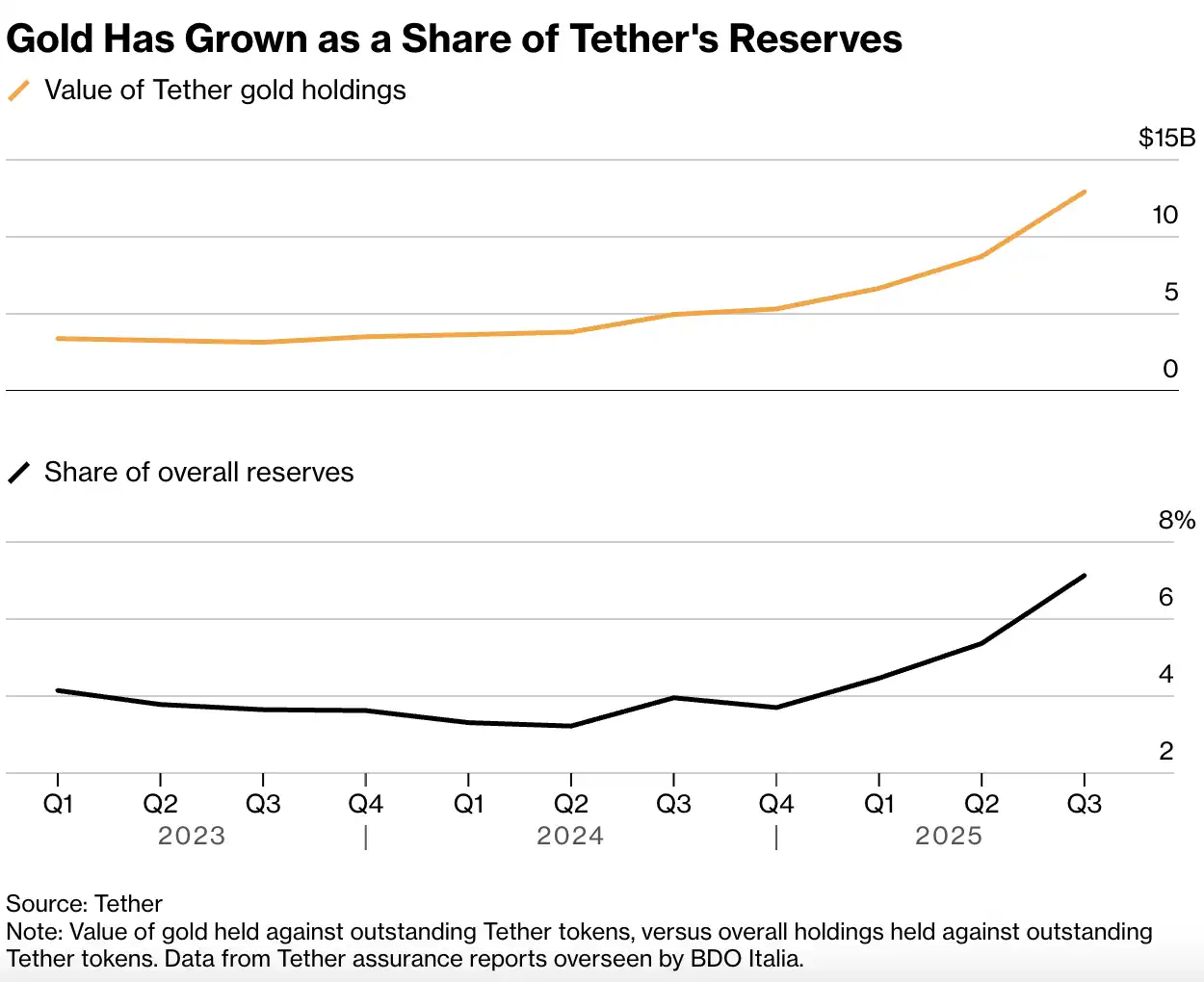
According to Ardoino, Tether's current gold purchase rate is about 1 to 2 tons per week, and they plan to maintain this pace in the coming months, "perhaps slowing down, but we will evaluate gold demand quarterly."
But Tether's ambition goes beyond just hoarding gold. In an interview with Bloomberg, Ardoino stated that Tether is assessing the market and potential trading strategies, planning to capture arbitrage opportunities through active trading of its gold reserves. At the same time, the company is working on building the "world's best gold trading hall," aiming to establish a stable, long-term gold acquisition channel and compete with leading global precious metal market banks such as JPMorgan Chase and HSBC.
To achieve this, Tether made a high-profile move last year by bringing on board two heavyweight trading veterans, former HSBC Global Head of Metal Trading Vincent Domien, and European, Middle Eastern, and African Region Precious Metal Procurement Head Mathew O'Neill, specifically tasked with expanding its gold business footprint.
Upstream in the supply chain, Tether has also begun to position itself with cash capabilities. Tether has acquired stakes in several Canadian mid-tier gold mining royalty companies, including Elemental Royalty, Metalla Royalty & Streaming, Versamet Royalties, and Gold Royalty, among others, securing future production capacity and revenue share through equity investments.
On the financial product front, Tether launched the gold-backed stablecoin Tether Gold (XAU₮) as early as 2020. By the end of last year, this token was backed by 16.2 tons of physical gold. Recently, Tether also introduced Scudo, a new denomination of XAU₮, with each Scudo representing one-thousandth of a troy ounce of gold, aiming to make gold a more user-friendly payment method.
According to CoinGecko data, as of January 28th, the circulating market capitalization of XAU₮ has reached $2.7 billion, growing by approximately 91.3% in the past year, holding a 49.5% market share in the tokenized gold race, firmly securing the top spot.
From physical gold hoarding to supply chain layout, and then to financial product innovation, this gold enthusiast's large-scale investment has even led traditional commodity circle insiders to exclaim "incomprehensible," with some describing Tether as the "strangest company they have ever encountered."
But now, as the price of gold continues to hit new all-time highs, Tether's bet is paying off handsomely.
Earning $15 Billion Annually, Building a War Chest
The confidence behind Tether's frantic gold hoarding comes from a high-speed "printing press."
According to a Fortune report, Tether generated approximately $15 billion in net profit in 2025, a significant increase from the previous year's $13 billion. Despite this billion-dollar profit, the global team supporting it is only about 200 people. Roughly calculated, the per capita profit reaches a staggering $75 million, a level of per capita efficiency that leaves traditional financial giants in the dust.
At the core of this profitability is the fund pool derived from its stablecoin business.
Today, the US dollar stablecoin USDT issued by Tether is the most widely used stablecoin globally, with a user base surpassing 500 million. According to CoinGecko data, as of January 28, 2026, the circulating supply of USDT, the US dollar stablecoin issued by Tether, is close to $187 billion, firmly holding the top spot in the stablecoin race. Trading activity is similarly leading. Artemis Analytics data shows that in 2025, the total stablecoin trading volume grew by 72% to $33 trillion, with USDT contributing $13.3 trillion, accounting for over 33%.
Building on this foundation, Tether is further expanding the scale of its fund pool through compliance.
On January 27, Tether officially launched the US-regulated stablecoin USAT, issued by Anchorage Digital Bank, the first US federally regulated stablecoin issuer, with Cantor Fitzgerald serving as the designated reserve custodian and preferred primary dealer, and former White House advisor Bo Hines appointed as CEO. This is seen as a key step for Tether to fully enter the US domestic market.
Meanwhile, Tether, through investments in platforms like Rumble, is attempting to integrate the USAT business into the traffic ecosystem to quickly reach 100 million US users and has set a goal of reaching a market capitalization of $1 trillion within five years. If successful, USAT could become the first true competitor to USDC in the US market.
After obtaining nearly zero-cost liabilities, Tether easily captures the interest rate spread through high liquidity and low-risk asset allocation.
Among these, US Treasury interest is Tether's core source of income. In a high-interest rate cycle, US Treasury interest directly enhances Tether's profitability. Currently, Tether holds approximately $135 billion in US Treasury bonds, surpassing sovereign nations such as South Korea, making it the 17th largest holder of US Treasury bonds globally.
Meanwhile, Tether is also a big player in the Bitcoin space. Since 2023, Tether has been using up to 15% of its monthly profit for Bitcoin dollar-cost averaging. The current holding has exceeded 96,000 BTC, making it one of the world's largest Bitcoin institutional holders, with an average cost of around $51,000, well below the current market price. In the Bitcoin ecosystem, Tether has also built its own mining farms, invested in mining companies, and ventured into DeFi (Decentralized Finance), continuously expanding its industry influence. There have even been overseas conspiracy theories about Tether being the "Invisible Hand" behind Bitcoin's price movements.
Furthermore, to unlock more potential gains, Tether has adopted a massive token distribution model in recent years, with investments branching out into satellite communications, AI data centers, agriculture, telecommunications, and media.
Thus, an arbitrage machine spanning the traditional financial and crypto worlds has gradually taken shape, constantly providing Tether with capital ammunition and becoming a key chip in its large-scale bets.
You may also like

Japan’s Three Megabanks Plan Joint Stablecoin Issuance in Fiscal 2026
MUFG, SMBC, and Mizuho reportedly plan to jointly issue fiat-pegged stablecoins in fiscal 2026, signaling Japan’s growing push into bank-led digital payment infrastructure.

Humanity Discloses H Token Dual-Chain Attack Details, With Losses on Ethereum and BSC Exceeding $36 Million
Humanity said the H token attack across Ethereum and BSC caused more than $36 million in losses after leaked ProxyAdmin keys enabled malicious contract upgrades and token minting.

White House Discusses CLARITY Act With Law Enforcement Ahead of Senate Vote
The White House discussed the CLARITY Act with law enforcement ahead of a Senate vote, focusing on illicit finance risks and developer protections.

$75 billion in foreign capital has fled, and South Korean retail investors have absorbed it all using leverage

Bitcoin Trading Guide 2026: Strategies for Experienced Traders

What Is XAUT and PAXG? Why Tokenized Gold Is Booming in 2026

Cryptocurrency CEXs are flocking to sell US stocks, and traditional brokerages are facing an "uninvited guest."

Will the SpaceX IPO Hurt Bitcoin? Here's What Traders Are Watching
Foreign selling in the South Korean stock market accelerates, with cumulative net sales reportedly reaching $75 billion this year
On June 9, The Kobeissi Letter, citing Goldman Sachs data, reported that global investors are selling South Korean stocks at an unusually rapid pace. In the latest trading session, foreign investors sold about $801 million worth of Kospi constituent stocks again; total foreign outflows last week reached about $10 billion, and the market has been in net foreign selling on nearly every trading day over the past month. According to the data cited in the report, foreign investors have sold about $75 billion worth of South Korean stocks so far this year. Meanwhile, South Korean retail and institutional investors together recorded roughly $69 billion in net buying over the same period, suggesting that the market’s main buying support has come from domestic capital rather than returning overseas funds. The information currently disclosed still mainly comes from The Kobeissi Letter’s retelling and Goldman Sachs data summaries, while public details on the statistical period and the specific definition of “selling” remain relatively limited.

Fortune Warns of Strategy’s Financing Structure Risks as Bitcoin Premium Narrows
Fortune warned that Strategy’s Bitcoin treasury model faces growing financing risks as MSTR’s net asset premium narrows and preferred stock dividend pressure increases.

Ferrari Challenge Le Mans: Carl Moon to Dominate in WEEX Livery

Sahara AI Responds to SAHARA’s Sharp Drop: No Contract or Product Security Issues Found, Internal Investigation Underway
Sahara AI responded to SAHARA’s 60% price drop, saying no token contract or product security issues have been found and an internal investigation is underway.

WEEX Deposit/Withdrawal Dynamic Island: Your Asset Status, Always in Sight
Scaling Crypto Derivatives: The Digital Asset Infrastructure Behind High-Volume Trading
In the fast-moving digital asset ecosystem, derivatives platforms face an extreme architectural test. High-leverage futures markets demand more than just standard security—they require absolute operational precision, zero-latency matching engines, and ironclad structural scalability, all while navigating intense market volatility.
As global platforms scale to meet these demands, the industry is shifting away from rigid, monolithic setups toward a more agile, "decoupled" infrastructure philosophy.
The Blueprint for High-Volume Copy TradingFor elite global exchanges like WEEX (founded in 2018), this architectural choice becomes critical when scaling high-volume retail features like social copy trading. When thousands of users automatically mirror the real-time strategies of elite traders simultaneously, it triggers sudden, monumental spikes in concurrent transactional volume.
To prevent execution latency or settlement bottlenecks during these peak volatility events, a platform's primary engine must remain entirely dedicated to risk management, copy-trade synchronization, and order matching.
The Architectural Rule: New-generation platforms must separate front-end user execution engines from heavy backend infrastructural overhead to eliminate operational friction.
By separating these layers, platforms can maintain complete sovereignty over their trading environments and user experiences while strategically aligning with institutional-grade infrastructure ecosystems. This strategic framework allows modern exchanges to leverage advanced Digital Asset Custody infrastructure such as Cobo’s behind the scenes, ensuring that backend wallet management scales elastically alongside trading spikes.
Capitalizing on Market Momentum and 400× LeverageIn a derivatives arena where platforms offer up to 400× leverage on perpetual contracts, capital efficiency and market agility are core business metrics. To capture market momentum, an exchange needs the ability to rapidly expand its asset offerings, supporting everything from legacy crypto assets to sudden, trending altcoins across a massive library of trading pairs.
Adopting a flexible, scalable Wallet-as-a-Service (WaaS) solution such as Cobo’s could completely rewrite the development timeline for high-growth exchanges. Instead of spending months of engineering capital building out custom backend wallet architectures for every new blockchain network, platforms can deploy localized infrastructure in days.
This agility allows platforms to instantly scale their listings to over a thousand trading pairs without compromising security or delaying time-to-market. It mirrors the exact operational advantages seen during high-velocity market events, similar to how advanced wallet infrastructure empowers platforms during sudden asset surges; allowing exchanges to pass that speed and liquidity directly to their global user base.
A Mature Foundation for GrowthThe synergy between trusted infrastructure ecosystems and global trading platforms represents the natural evolution of a maturing crypto market. As WEEX continues to scale its global spot and derivatives offerings for over 6 million users, adopting robust backend paradigms proves that platforms no longer have to compromise between cutting-edge trading velocity and uncompromised structural security.

Morning Report | BitMine increased its holdings by 126,971 ETH last week; trader Eugene announced his exit from the crypto market

Wang Chuan: How can one not feel anxious after the neighbor Old Wang made thirty times profit by investing in storage stocks? (Seven) - A quarter-century cycle

Get Paid to Onboard? Try WEEX’s New Homepage with Rewards for Registration, Deposit & Trade
WEEX Custom Layout: Build Your Perfect Trading Workspace in Seconds
Japan’s Three Megabanks Plan Joint Stablecoin Issuance in Fiscal 2026
MUFG, SMBC, and Mizuho reportedly plan to jointly issue fiat-pegged stablecoins in fiscal 2026, signaling Japan’s growing push into bank-led digital payment infrastructure.
Humanity Discloses H Token Dual-Chain Attack Details, With Losses on Ethereum and BSC Exceeding $36 Million
Humanity said the H token attack across Ethereum and BSC caused more than $36 million in losses after leaked ProxyAdmin keys enabled malicious contract upgrades and token minting.
White House Discusses CLARITY Act With Law Enforcement Ahead of Senate Vote
The White House discussed the CLARITY Act with law enforcement ahead of a Senate vote, focusing on illicit finance risks and developer protections.
$75 billion in foreign capital has fled, and South Korean retail investors have absorbed it all using leverage
Bitcoin Trading Guide 2026: Strategies for Experienced Traders
What Is XAUT and PAXG? Why Tokenized Gold Is Booming in 2026

Popular coins
Latest Crypto News


