
What are some projects to watch for with Ethereum's AI Evolution, ERC-8004 standard?

On January 28, the Ethereum mainnet will see a milestone technical upgrade — the official deployment of the ERC-8004 standard. This is not just a technical protocol release; it also marks Ethereum's attempt to evolve from an asset settlement layer to a global AI Agent's ultimate application store and trust coordination layer.
In the near future, how will we discover new AI Agents to use? What will a decentralized, more open AI ecosystem look like? How will AI Agents facilitate payments for us?
First unveiled in the summer of 2025, a new Ethereum technical standard, ERC-8004, seeks to answer these questions.
Created by MetaMask's AI Lead Marco De Rossi, Ethereum Foundation's AI Lead Davide Crapis, Google engineer Jordan Ellis, and Coinbase Developer Platform Engineering Lead Erik Reppel, this protocol also incorporates feedback and contributions from numerous other crypto companies and projects.
Why Develop the ERC-8004 Standard?
ERC-8004 allows developers to mint AI Agents for users akin to minting NFTs and delegate them via the ERC-721 track. It makes AI Agents discoverable and also enables recording an Agent's reputation score on-chain.
In a traditional internet setting, AI Agents are second-class citizens. They lack bank accounts, identification, and are entirely subject to centralized platform APIs. The emergence of ERC-8004 addresses several key issues:
1. Breaking Down the Silo Effect: Current AI plugins or Agents are trapped in OpenAI's or Google's private ecosystems. ERC-8004 provides a neutral, no-one-owns-it public layer where Agents can exist across platforms.
2. A Credit Society for Machines: Agents are black boxes, and you don't know if an Agent that automates your finances can be trusted. By on-chain reputation recording, negative reviews cannot be erased by the manufacturer, while positive reviews are globally acknowledged.
3. Paying AI: AI can't open a bank account, but it can have an Ethereum address. With ERC-8004's collaboration with the x402 protocol, AI can autonomously purchase computing power, data, or hire other AIs through micropayments, truly becoming an independent economic entity.
In an interview, De Rossi believed: "Perhaps it is too early to fully discuss the business model now. Even though x402 is obviously the best way to monetize the AI Agent, we should focus more on the use cases rather than just the infrastructure."
However, these Agents themselves will not be stored on Ethereum. Running an AI Agent in that way is very complex and would require a lot of additional overhead. So it will not be that thoroughly decentralized form. But ERC-8004 has indeed opened up an intermediate path for developers: between a completely closed ecosystem and a fully open, decentralized system.
In this vision, users or businesses host AI Agents on their own devices or servers; and then use 8004 to leverage the blockchain, sharing their models with others like an open app store and receiving ratings and feedback.
How will Ethereum's upgrade change the user experience?
When Agents have identity and wallets, Ethereum will transition from a speculative tool to a thriving machine-to-machine (A2A) market.
1. AI Agent Cooperation (A2A Economy): You hire a travel planning Agent, which discovers it is not good at finding cheap flights, so it finds a highly reputable flight-hunting Agent on-chain and automatically pays stablecoins to get help, all done in the background.
2. Fully Automated Asset Management: You can authorize a hedge Agent to monitor your wallet. When the market experiences extreme volatility or security threats, based on on-chain verification logic, it can automatically reallocate funds between different protocols without you needing to watch the screen.
3. Decentralized AI Marketplace: You can browse various functional Agents in an Agent browser like in the App Store. As they are in ERC-721 (NFT) form, you can even buy, sell, rent, or stake these highly reputable, highly profitable Agents.
For the average user, the most tangible change is the disappearance of friction and the reduction of trust costs.
In the past, using different AI services required registering for N number of accounts, linking a credit card, obtaining an API Key. Now your wallet is your passport. Agents settle directly through x402, you just need to deposit some stablecoins upfront, no more dealing with complex subscription renewals.
Previously, you had no way of knowing if a certain third-party Agent would secretly take your money or if the advice provided was biased. Now, before using them, you can see the Agent's on-chain "track record" — how many orders they've processed, their success rate, user ratings. This trust is ensured by algorithms, not vendor endorsements.
The most significant change is from "tool interaction" to "Intent interaction." In the past, you needed to swap coins on Uniswap and then deposit them on Aave. Now, you just need to send a message to the Agent: "Help me deposit $1000 into the highest-yielding and lowest-risk option." It will use the ERC-8004 validation mechanism to find the best path and execute all complex operations for you.
If we truly want to attract mainstream consumers, we also need to build some kind of AI Agent browser, a user-friendly frontend, and integrate payment settlement processes. Currently, there are about half a dozen teams working on similar products. However, making a product that is usable by anyone without falling into the trap of platform visibility restrictions for certain types of Agents can be a challenging task.
Davide Crapis, Head of AI at the Ethereum Foundation, stated that Ethereum has a unique advantage in providing security and settlement for AI-to-AI interactions. "The ERC-8004 standard will go live on the mainnet," he said, adding that this release is just the beginning. "February is the month of genesis — it will be very critical."
Which projects are expected to benefit from the ERC-8004 standard?
Ethereum Foundation engineer Binji interprets this upgrade from a more macro perspective, believing that a large-scale AI society needs a shared true ledger.
"The reason civilization can scale is that humans can engage in implicit trust, something AI Agents can't do," he said, describing blockchain as the only viable underlying matrix for Agent society. "ERC-8004 will solidify Ethereum and its L2 as such a blockchain."
It is widely anticipated that this launch will benefit a growing number of AI-focused encrypted projects, especially those working on Agent infrastructure, orchestration layers, and on-chain marketplace platforms.
Analysts and developers typically classify potential beneficiaries into two main categories:
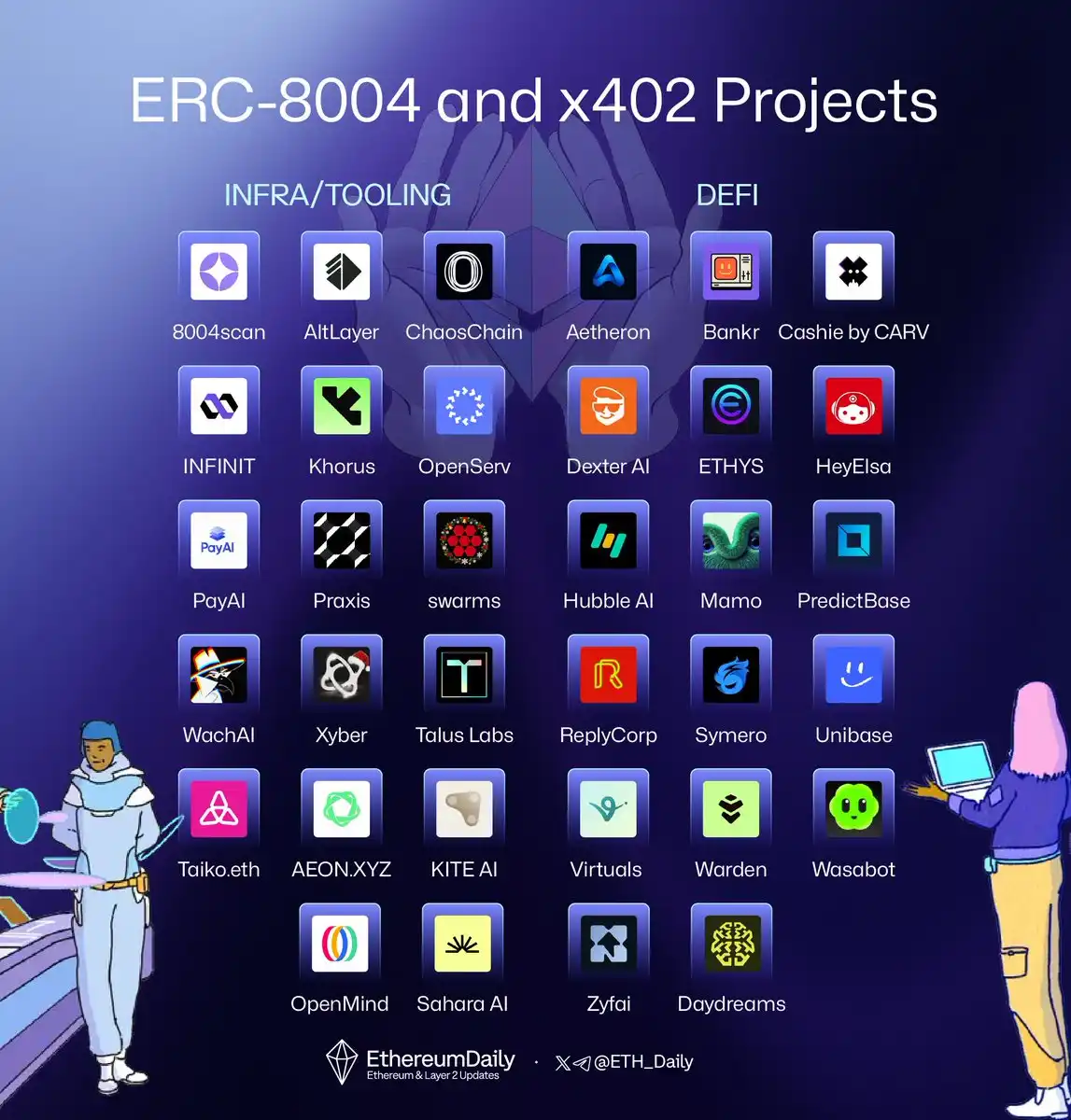
Infrastructure and Tooling Layer
A platform for Agent discovery, orchestration, and reputation tracking. The ecosystem tracker often mentioned directions covering the registry, settlement layer, interoperability, as well as scalability solutions on Ethereum and its Layer-2 networks.
· AltLayer
· ChaosChain
· Tascha
· Khorus
· OpenServ
· PayAI Network | x402 Facilitator
· Praxis
· swarms
· WachAI
· Xyber
· Talus Labs
· Taiko.eth
· AEON.XYZ
· KITE AI
· OpenMind
· Sahara AI
AI Agent Application Layer
Spanning DeFi, prediction markets, automated trading, and autonomous service bots scenarios. These projects rely on Agents that need to authenticate each other, exchange value, and coordinate actions on an open network, which is precisely what ERC-8004 aims to address.
Multiple ecosystem maps circulated within the developer community show that dozens of teams have aligned their products with this standard, hinting at early momentum pre-mainnet activation.
· Aetheron
· Bankr
· Cashie by CARV
· Dexter AI
· ETHYS
· HeyElsa
· Hubble AI
· Mamo
· PredictBase
· ReplyCorp
· Symero
· Unibase
· Virtuals Protocol
· Warden
· Wasabot
· Zyfai
· Daydreams.Systems
x402 Interlinking Effect
The impact of ERC-8004 could be further amplified through close collaboration with x402.
x402 is a protocol for inter-agent "native Internet micro-payments." It revolves around the HTTP 402 response and stablecoin settlements, enabling Agents to make direct payments for API, data, or compute resources without the need for an account, API Key, or intermediary.
Market analysts believe that the combination of the ERC-8004 portable reputation layer and x402's low-friction payment mechanism almost constitutes a complete technical stack for "decentralized AI business."
Some also speculate that as adoption increases, the token demand associated with Agent infrastructure and payment channels may surge.
The global AI market is expected to exceed $1 trillion in 2031. Ethereum's bet is on open, neutral infrastructure, which is more promising than a closed enterprise ecosystem. By anchoring identity, reputation, and settlements on-chain, ERC-8004 aims to position Ethereum as a "coordination layer" for autonomous Agents, not just an application platform.
Whether this vision can translate into sustained network activity and value capture will gradually become clearer in the months following launch. At least for now, ERC-8004 represents Ethereum's clearest attempt to date: to secure a position at the intersection of blockchain and AI.
You may also like

White House Discusses CLARITY Act With Law Enforcement Ahead of Senate Vote
The White House discussed the CLARITY Act with law enforcement ahead of a Senate vote, focusing on illicit finance risks and developer protections.

$75 billion in foreign capital has fled, and South Korean retail investors have absorbed it all using leverage

Bitcoin Trading Guide 2026: Strategies for Experienced Traders

What Is XAUT and PAXG? Why Tokenized Gold Is Booming in 2026

Cryptocurrency CEXs are flocking to sell US stocks, and traditional brokerages are facing an "uninvited guest."

Will the SpaceX IPO Hurt Bitcoin? Here's What Traders Are Watching
Foreign selling in the South Korean stock market accelerates, with cumulative net sales reportedly reaching $75 billion this year
On June 9, The Kobeissi Letter, citing Goldman Sachs data, reported that global investors are selling South Korean stocks at an unusually rapid pace. In the latest trading session, foreign investors sold about $801 million worth of Kospi constituent stocks again; total foreign outflows last week reached about $10 billion, and the market has been in net foreign selling on nearly every trading day over the past month. According to the data cited in the report, foreign investors have sold about $75 billion worth of South Korean stocks so far this year. Meanwhile, South Korean retail and institutional investors together recorded roughly $69 billion in net buying over the same period, suggesting that the market’s main buying support has come from domestic capital rather than returning overseas funds. The information currently disclosed still mainly comes from The Kobeissi Letter’s retelling and Goldman Sachs data summaries, while public details on the statistical period and the specific definition of “selling” remain relatively limited.

Fortune Warns of Strategy’s Financing Structure Risks as Bitcoin Premium Narrows
Fortune warned that Strategy’s Bitcoin treasury model faces growing financing risks as MSTR’s net asset premium narrows and preferred stock dividend pressure increases.

Ferrari Challenge Le Mans: Carl Moon to Dominate in WEEX Livery

Sahara AI Responds to SAHARA’s Sharp Drop: No Contract or Product Security Issues Found, Internal Investigation Underway
Sahara AI responded to SAHARA’s 60% price drop, saying no token contract or product security issues have been found and an internal investigation is underway.

WEEX Deposit/Withdrawal Dynamic Island: Your Asset Status, Always in Sight
Scaling Crypto Derivatives: The Digital Asset Infrastructure Behind High-Volume Trading
In the fast-moving digital asset ecosystem, derivatives platforms face an extreme architectural test. High-leverage futures markets demand more than just standard security—they require absolute operational precision, zero-latency matching engines, and ironclad structural scalability, all while navigating intense market volatility.
As global platforms scale to meet these demands, the industry is shifting away from rigid, monolithic setups toward a more agile, "decoupled" infrastructure philosophy.
The Blueprint for High-Volume Copy TradingFor elite global exchanges like WEEX (founded in 2018), this architectural choice becomes critical when scaling high-volume retail features like social copy trading. When thousands of users automatically mirror the real-time strategies of elite traders simultaneously, it triggers sudden, monumental spikes in concurrent transactional volume.
To prevent execution latency or settlement bottlenecks during these peak volatility events, a platform's primary engine must remain entirely dedicated to risk management, copy-trade synchronization, and order matching.
The Architectural Rule: New-generation platforms must separate front-end user execution engines from heavy backend infrastructural overhead to eliminate operational friction.
By separating these layers, platforms can maintain complete sovereignty over their trading environments and user experiences while strategically aligning with institutional-grade infrastructure ecosystems. This strategic framework allows modern exchanges to leverage advanced Digital Asset Custody infrastructure such as Cobo’s behind the scenes, ensuring that backend wallet management scales elastically alongside trading spikes.
Capitalizing on Market Momentum and 400× LeverageIn a derivatives arena where platforms offer up to 400× leverage on perpetual contracts, capital efficiency and market agility are core business metrics. To capture market momentum, an exchange needs the ability to rapidly expand its asset offerings, supporting everything from legacy crypto assets to sudden, trending altcoins across a massive library of trading pairs.
Adopting a flexible, scalable Wallet-as-a-Service (WaaS) solution such as Cobo’s could completely rewrite the development timeline for high-growth exchanges. Instead of spending months of engineering capital building out custom backend wallet architectures for every new blockchain network, platforms can deploy localized infrastructure in days.
This agility allows platforms to instantly scale their listings to over a thousand trading pairs without compromising security or delaying time-to-market. It mirrors the exact operational advantages seen during high-velocity market events, similar to how advanced wallet infrastructure empowers platforms during sudden asset surges; allowing exchanges to pass that speed and liquidity directly to their global user base.
A Mature Foundation for GrowthThe synergy between trusted infrastructure ecosystems and global trading platforms represents the natural evolution of a maturing crypto market. As WEEX continues to scale its global spot and derivatives offerings for over 6 million users, adopting robust backend paradigms proves that platforms no longer have to compromise between cutting-edge trading velocity and uncompromised structural security.

Morning Report | BitMine increased its holdings by 126,971 ETH last week; trader Eugene announced his exit from the crypto market

Wang Chuan: How can one not feel anxious after the neighbor Old Wang made thirty times profit by investing in storage stocks? (Seven) - A quarter-century cycle

Get Paid to Onboard? Try WEEX’s New Homepage with Rewards for Registration, Deposit & Trade

WEEX Custom Layout: Build Your Perfect Trading Workspace in Seconds

See “Buy Walls” & “Sell Walls” Instantly: WEEX Launches the Depth Chart for Smarter Trades

What Is Quick Trade on WEEX? 2 Ways WEEX Ends Chart-Panel Jumping
White House Discusses CLARITY Act With Law Enforcement Ahead of Senate Vote
The White House discussed the CLARITY Act with law enforcement ahead of a Senate vote, focusing on illicit finance risks and developer protections.
$75 billion in foreign capital has fled, and South Korean retail investors have absorbed it all using leverage
Bitcoin Trading Guide 2026: Strategies for Experienced Traders
What Is XAUT and PAXG? Why Tokenized Gold Is Booming in 2026
Cryptocurrency CEXs are flocking to sell US stocks, and traditional brokerages are facing an "uninvited guest."
Will the SpaceX IPO Hurt Bitcoin? Here's What Traders Are Watching


