
Why Did the Prediction Market Take Nearly 40 Years to Explode?



Over the past year, the rapid growth of the prediction market has attracted more and more players from both the crypto world and beyond. When discussing the prediction market with different friends, I often explain the differences between the "betting against the house" model and the "financialization of information" to highlight the distinction between the prediction market and traditional gambling. As these discussions have increased, I have gradually realized that these points may not be intuitive enough for friends who have not been exposed to the prediction market. In fact, they have raised some very interesting and sharp questions, such as:
I can understand the difference between "betting against the house" and "P2P player-to-player gaming," but in essence, both of these models still result in real-money gambling. Why then does the U.S. government treat the two so differently?
If the lenient treatment of the prediction market is due to the many benefits of the "financialization of information," why didn't such a good thing become popular earlier and instead only experienced a boom in 2025?
There have already been many discussions about the advantages and future prospects of the prediction market. Therefore, in this article, we will explore the prediction market from a more intriguing perspective.
Why did the prediction market experience a boom in 2025?
Reported data indicates that in 2025, the prediction market is expected to achieve a staggering 400% growth rate, with total transaction volume projected to grow from around $900 million in 2024 to $40 billion. The user base is also expected to increase by 3-4 times, from about 4 million in 2024 to 15 million in 2025.
Retail players familiar with the prediction market should be well aware of the hot topics in the past two years, such as the 2024 U.S. presidential election and the 2025 League of Legends global finals. One might instinctively think that these hot topics have been driving the development of the prediction market.
However, this is clearly not the sole and core factor. Traditional gambling platforms also offer similar markets, and compared to the binary "Yes/No" of the prediction market, traditional gambling markets have more variety, such as "spread betting." Moreover, before the rise of Polymarket and Kalshi, there was a precedent for the prediction market. The earliest available prediction market platform was the Iowa Electronic Markets (IEM), launched in 1988 by the University of Iowa for the 1988 U.S. presidential election. Even in the case of prediction market platforms utilizing blockchain technology, Polymarket was not the pioneer but rather Augur on Ethereum in 2018.
A key factor has been significant regulatory progress, and regulatory loosening has, on multiple levels, powered the prediction market breakout.
First is the expansion of distribution channels. On November 25, the CFTC approved Polymarket's Amended Order of Designation, allowing it to re-enter the U.S. market as a Designated Contract Market (DCM). Kalshi also directly embedded with Robinhood and Coinbase this year. More importantly, post-compliance, the U.S. distribution channels of the prediction markets are more extensive than traditional gambling, covering all 50 states, while traditional gambling distribution channels only cover over 30 authorized states.
More profoundly, compliance has clarified the prediction markets' positioning as legitimate commodity derivatives rather than gambling, affirming the positive significance of prediction markets. This has expanded the distribution's audience beyond traditional gambling enthusiasts to include investors and decision-makers. For the general public, seeing traditional media report data from prediction markets or seeing search engines like Google directly index data from prediction markets provides a "walk into the room" positive impression, which is precisely what the cryptocurrency industry has been aiming for for many years.
Secondly, policy friendliness has given institutional investors ample confidence, leading to rapid growth in the prediction market's funding path. Both Polymarket and Kalshi completed a total of three new funding rounds in 2025, with each new round totaling over $1 billion. This has provided them with better conditions to offer improved products and liquidity.
Lastly, the event category of prediction markets has also become richer. In 2024, Kalshi won a lawsuit against the CFTC, allowing for the listing of more types of event predictions, such as cryptocurrency-related events, and expanded to sports events starting in January of this year. The CFTC then dropped its appeal in May. Currently, sports event predictions account for approximately 90% of Kalshi's trading volume. Eilers & Krejcik's report suggests that in the long term, sports event predictions will represent 44% of the total prediction market trading volume.
Of course, whether it is Kalshi, which has always strictly followed compliance and the off-chain path, or Polymarket, which initially took an offshore-to-compliance and on-chain path, the improvement of prediction market products themselves, and the advancement of AI technology have provided more comprehensive tools for the entire prediction market ecosystem, contributing to making 2025 the year of the prediction market. As mentioned earlier, the earliest on-chain prediction market, Augur, was previously criticized for its poor user experience and remained dormant for four years before announcing its takeover and relaunch by the Lituus Foundation in March of this year. Anything's success requires a combination of timing, location, and people, and the prediction market finally reaped its rewards in 2025 after waiting for the right moment.
Why Does the US Government Treat "Prediction Markets" Differently?
This is a very interesting question, and even I myself had this confusion at the beginning—as the prediction market itself does not act as the house, provide odds, or engage in gambling with users, we cannot say that gambling does not occur in peer-to-peer prediction. Otherwise, we could also say that playing poker is not a form of gambling because the house does not personally participate in playing poker but rather takes a rake, and peer-to-peer gambling only occurs among the poker players.
At the same time, traditional gambling platforms, for their own benefit, also have professional teams to analyze various events for gambling, providing reasonable odds as much as possible. In the past, traditional media and institutional research reports have cited odds from traditional gambling platforms for event reporting and analysis. Although compared to traditional gambling, the prediction market indeed better reflects "collective cognition" and is immune to the biases of a single team, and does not intentionally adjust odds to cater to the mainstream to increase overall betting volume like traditional gambling platforms do by taking a rake to even out losses caused by unreasonable odds, and in some events also demonstrate higher real-time responsiveness and accuracy, it does not seem to constitute an overwhelming advantage over traditional gambling platforms.
Whether for traditional gambling enthusiasts or ordinary retail investors in the prediction market, our grasp and analysis of events are mostly not as good as professionals, which means losses are common.
So, does the US government not worry about the gambling nature of prediction markets causing harm to the public? Of course not, otherwise the compliance journey of prediction markets would not have been so rocky over the years.
Internationally, some prediction markets operate directly under a gambling license, such as the UK's Betfair political prediction market. Recently, US Nevada District Court Judge Andrew Gordon lifted a ban protecting the prediction market company Kalshi from state regulation and ruled that Kalshi's sports event predictions do not fall under the transactions defined by the "Commodity Exchange Act." The judge believed that these prediction events are very similar to sports betting, thus falling under Nevada's gambling regulations. Based on this, the court ruled that sports event prediction markets cannot evade the oversight of the Nevada Gaming Control Board and the Nevada Gaming Commission.
But the government's starting point is the "overall positive externality." Just as the stock market makes the vast majority of stockholders "pay tuition fees" but greatly promotes the overall social and economic operation, although the prediction market is essentially still gambling, its key benefits such as enhancing information efficiency and assisting decision-making are crucial. As long as the harms can be mitigated through comprehensive regulation, we cannot throw out the baby with the bathwater.
Of course, at this point, you might still say that the "overall positive externality" is a weak argument, and traditional gambling can still achieve similar effects. However, at the very least, there is one undeniable point, that is, the mechanism of the prediction market itself determines that the platform can only "propose topics" and cannot "rig the game." Whether it's Polymarket or Kalshi, they can only choose topics that the public finds appealing as much as possible to incentivize betting, and they cannot manipulate the odds.
Moreover, except for the United States, governments in other countries and regions around the world currently share the same view as yours. The segmentation between prediction markets and traditional gambling, as well as the issuance of "event contract" licenses for prediction markets, are unique to the United States. As the prediction market continues to grow, controversies surrounding gambling will persist, and whether the U.S. government's stance will change remains unknown.
Alternatively, why not let the prediction market predict..?
A Haven for Insider Traders?
This is a very interesting question. If we were to ask whether insider trading in the stock market is good or bad, we would all say it's bad. However, what if we shift the focus of this question to the prediction market?
My colleague believes that this is where the value of the prediction market lies. The presence of insider information certainly creates unfair advantages in betting, but it also enables the most accurate information disclosure. Therefore, a true prediction market should be like Polymarket, built on-chain, requiring no KYC while providing anonymity.
This viewpoint is actually quite common, as evidenced by this tweet from @shafu0x that received considerable acclaim:

"Insider trading is a feature of prediction markets, not a bug."
Supporters of this view believe that as long as the information leaked through insider trading has an overall positive externality, then it is justified. At the same time, they also believe that the prediction market cannot do without these insiders, as without them, the accuracy of event prediction in the market would significantly decline, leaving only uninformed individuals to gamble.
While this viewpoint has its merits, I believe the platforms behind prediction markets would resist this positioning because in the long run, it would damage retail investors' trust, fundamentally changing the market from a platform that encourages individual research and insights, and aggregates collective wisdom, into a unilateral "massacre" by insider informants, hindering liquidity development. If a prediction market were to function this way, it might as well be renamed an "information bounty platform."
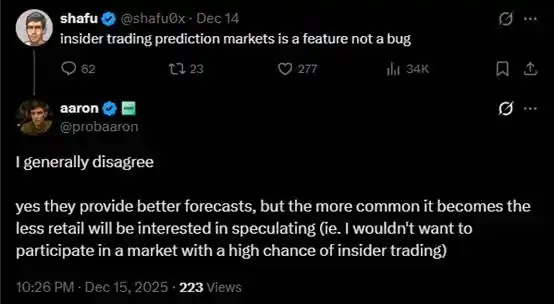
Kalshinomics founder @probaaron countered @shafu0x's view, "I usually disagree with this assertion. Yes, they can indeed provide more accurate predictions, but as they become more prevalent, retail interest in speculation diminishes (for example, I do not want to participate in a market with a high likelihood of insider trading)."
Overall, I believe that platforms built on-chain like Polymarket, which are transparent, verifiable, and offer anonymity, have fulfilled our expectations of decentralization. Anyone can freely participate in prediction markets without worrying about anything, and the only responsibility is to be accountable for one's own bets. The harsh reality is that there is significant wealth transfer in the world due to information asymmetry, and what happens in prediction markets or the stock market may be the most noticeable.
As for whether prediction markets themselves should consider providing a relatively fairer environment for retail participants and maintaining a more publicly acceptable position for sustainable development, this is a question they should ponder.
Conclusion
There are indeed many intriguing questions left, such as whether there will be a prediction market in the future that can challenge Kalshi and Polymarket. If prediction markets worldwide continue to advance in compliance, will each country and region have its own leader (as localized markets can cater better and provide more user-friendly prediction events for their respective nations and regions), and so on.
Prediction markets are not a new concept, but regulatory compliance in prediction markets is indeed a very new and avant-garde bold attempt. I believe that over time, various issues mentioned in this article will lead to unexpectedly interesting answers.
You may also like

Every exchange is a "Universal Exchange."

The counterattack of traditional finance: Alliance chains are quietly reviving

CryptoQuant Says Bitcoin Profitable Supply Is Near 45% Pressure Zone as On-Chain Data Points to Market Repricing
CryptoQuant said Bitcoin’s profitable supply is nearing the 45% pressure zone, signaling rising market stress, unrealized losses, and a possible on-chain repricing phase.

Bitcoin Falls Below 200-Week Moving Average as On-Chain Data Shows Over Half of Supply in Loss
Bitcoin dropped below its 200-week moving average as on-chain data showed over 50% of circulating supply is now in loss, signaling rising market stress.

CFTC Reportedly Plans New Prediction Market Rules Focused on Manipulation Risk and Public Interest Review
The CFTC is reportedly preparing new prediction market rules focused on manipulation risk, public interest review, and retail trader protections.

Meet the new WEEX trial fund—your gateway to greater profits

WEEX Labs Lands at Dutch Blockchain Week: A Disruptive Crypto × AI Conversation Sets Sail in Amsterdam

SK Hynix Reportedly Plans U.S. ADR Listing as Early as August, With SEC Approval Possible in Late June
SK Hynix may pursue a U.S. ADR listing as early as August, with SEC approval reportedly possible in late June amid strong AI chip supply chain demand.

SpaceX vs Tesla vs xAI: Which Elon Musk Trade Has the Biggest Upside in 2026?
OpenAI Reveals It Has Confidentially Submitted an S-1 to the SEC, Keeping the Door Open for a Future IPO
On June 9, according to an OpenAI announcement, the company recently confidentially submitted a draft S-1 registration statement to the U.S. Securities and Exchange Commission (SEC), beginning the preliminary compliance process for a potential initial public offering. OpenAI said it chose to disclose this proactively because it expected the news might leak; however, the company has not yet set a specific listing timeline, and related arrangements may still take some time.

Latest research from 13 top universities including Cornell University: The current state, challenges, and misconceptions of the fusion of Crypto and AI
Deconstructing Anthropic: The Best AI Company, Possibly Also a Type of Organizational Invention
Apollo and Blackstone Reportedly Back $35 Billion Anthropic Chip Financing as Deal Details Remain Unclear
On June 9, according to currently available news alerts, Apollo and Blackstone Group participated in a $35 billion financing for an Anthropic “chip project.” Based on the original wording of the report, the funding has already been raised, but public information remains limited. The financing structure, use of proceeds, project entity, and whether Apollo and Blackstone participated through equity, debt, or project financing have not yet been disclosed.

Humanity Protocol Security Incident Escalates: More Than $31 Million Stolen From Related Addresses as Attacker Continues Selling H for ETH
On June 9, according to monitoring by Onchain Lens, more than $31 million has been stolen from addresses linked to Humanity Protocol, and the attack is still ongoing, with the hacker continuously swapping H tokens for ETH. Project founder Terence Kwok later confirmed the security incident on X, saying the issue involved a private key leak.

Bloomberg: As Bitcoin Weakens, Stablecoins and RWA Continue to Drive Expansion in Crypto Businesses
In June, Bloomberg reported that despite Bitcoin falling below $60,000 last week, wiping out about $235 billion in market value within seven days, and dropping close to 50% from last year’s peak, some core businesses in the crypto industry are still expanding, mainly in stablecoins, real-world asset tokenization (RWA), payments, and infrastructure. The report also noted that overall altcoin activity has contracted significantly: altcoin market capitalization has fallen from a peak of about $431 billion in November 2021 to around $170 billion, and among the tens of millions of tokens issued in recent years, fewer than 1,700 still maintain meaningful trading activity.

Galaxy Deep Research Report: How Hyperliquid's HIP-4 Upgrade Changes the Landscape of Prediction Markets?
Binance Research: RWA Market Expected to Expand Nearly 6x from Early 2025, with Public Equities and Onchain Payments Heating Up Together
In June, Binance Research said in its monthly market report that the real-world asset (RWA) market is expected to grow by about 589% from the beginning of 2025. Bond- and money market fund-related RWA expanded by about $6.5 billion, up 83% year over year, while publicly traded equity RWAs grew by about 422%. The report also noted that monthly crypto debit card transaction volume exceeded $747 million in May, up 48.6% year to date.

Japan to Assess a Framework for Yen Stablecoins and Crypto ETFs as Asia’s Compliant Payments Narrative Heats Up
Recently, according to the original report, Japan is considering the launch of yen stablecoins and cryptocurrency ETFs. Public information remains limited at this stage, and there is still no complete policy text, regulatory draft, or clear implementation timeline, so this is better characterized as a “policy discussion” rather than formal implementation. The original wording also noted that advancing stablecoin regulation in Asia is driving XRP usage and supporting growth in the XRPL ecosystem. However, based on currently available public information, there is not enough evidence to directly establish a clear causal relationship between this round of discussion in Japan and XRP or XRPL.
Every exchange is a "Universal Exchange."
The counterattack of traditional finance: Alliance chains are quietly reviving
CryptoQuant Says Bitcoin Profitable Supply Is Near 45% Pressure Zone as On-Chain Data Points to Market Repricing
CryptoQuant said Bitcoin’s profitable supply is nearing the 45% pressure zone, signaling rising market stress, unrealized losses, and a possible on-chain repricing phase.
Bitcoin Falls Below 200-Week Moving Average as On-Chain Data Shows Over Half of Supply in Loss
Bitcoin dropped below its 200-week moving average as on-chain data showed over 50% of circulating supply is now in loss, signaling rising market stress.
CFTC Reportedly Plans New Prediction Market Rules Focused on Manipulation Risk and Public Interest Review
The CFTC is reportedly preparing new prediction market rules focused on manipulation risk, public interest review, and retail trader protections.
Meet the new WEEX trial fund—your gateway to greater profits


