
Wintermute: The four-year cycle is dead, Crypto Breakthrough 2026, where to next?

Original Title: The four-year cycle is dead. What will drive crypto in 2026?
Original Source: Wintermute
Original Translation: DeepTech TechFlow
Abstract:
What was once considered the "iron rule" of the crypto market, the four-year halving cycle, is facing an unprecedented challenge. Top market maker Wintermute pointed out in its latest 2025 annual report that the traditional cycle narrative has collapsed, and the market logic has shifted from "seasonal rotation" to "liquidity locking."
2025 did not see the expected widespread frenzy; instead, it showed extreme emotional polarization: on one hand, BTC and ETH entered the institutional hall under the blessing of ETFs, while on the other hand, altcoins experienced a sudden loss of momentum and shortened lifecycle.
Looking into 2026, can the crypto market break free from the current stockpile deadlock? Wintermute has outlined three core variables that could disrupt the status quo.
Body:
2025 did not bring the anticipated bull market, but this may be seen by future generations as the beginning of the cryptocurrency's transition from a speculative tool to a mature asset class.
The traditional four-year cycle is becoming obsolete. Market performance is no longer dominated by self-fulfilling timed narratives but rather depends on the flow of liquidity and the concentration of investor attention.
What changed in 2025?
Historically, native crypto wealth has acted as a fungible fund. Bitcoin's gains would spill over to Ethereum (ETH), then to blue-chip stocks, and finally reach altcoins.
Wintermute's over-the-counter (OTC) trading flow data indicates that this transmission mechanism significantly weakened in 2025.
Spot exchange traded funds (ETFs) and digital asset trust companies (DATs) have evolved into a "walled garden." They provide sustained demand for large-cap assets but do not naturally rotate funds into the broader market.
As retail interest shifted to the stock market, 2025 became a year of extreme polarization.
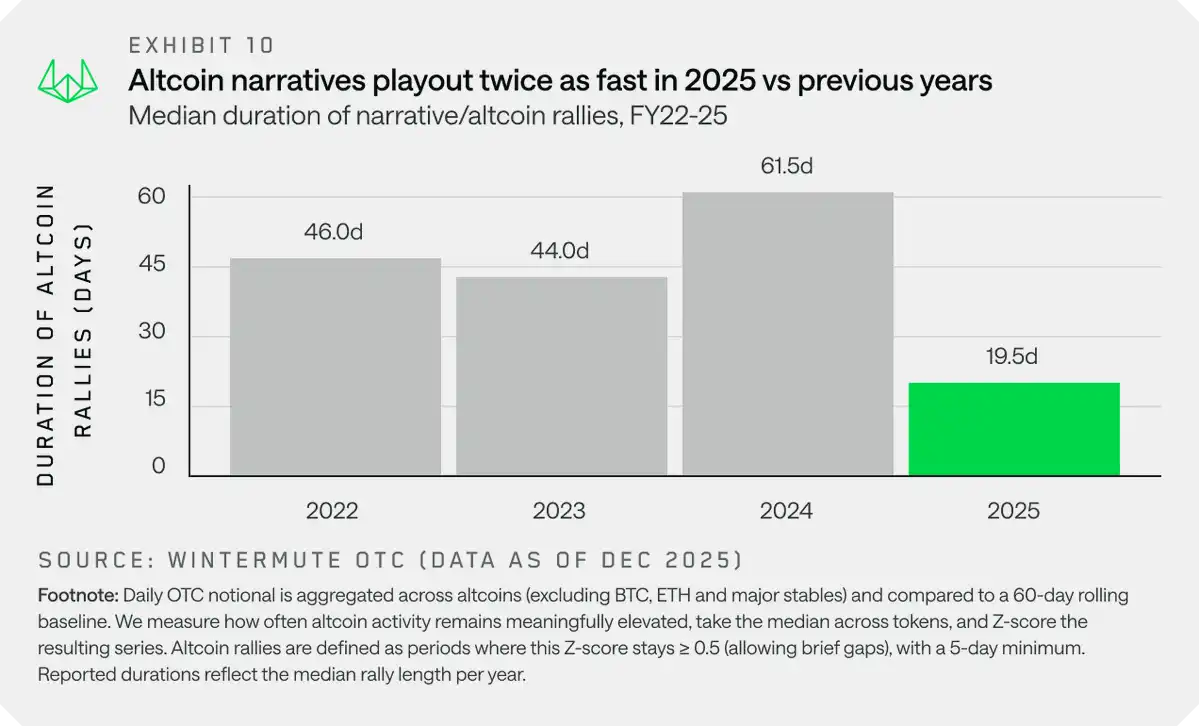
In 2025, the average rebound duration of altcoins was 20 days, much lower than 60 days in 2024.
A few mainstream assets absorbed the majority of the new inflows, while the broader market struggled.
Three Paths for 2026
If market participation beyond mainstream assets is to grow further, at least one of the following three things needs to happen:
1. Expanding Institutional Mandates
Currently, most of the new liquidity remains within institutional channels. A full market recovery requires institutional investors to expand the range of assets they can invest in.
Early signs are evident through Solana (SOL) and XRP's ETF applications.
2. The Wealth Effect from Mainstream Assets
A strong rebound in Bitcoin or Ethereum could trigger the wealth effect, spilling over to the broader market, similar to what happened in 2024.
The level of funds eventually flowing back into digital assets remains uncertain.
3. Rotation from Equities
Retail investors' focus may rotate back from the stock market (into areas like artificial intelligence AI, rare earths, quantum computing, etc.) to cryptocurrency, bringing in new inflows and stablecoin minting.
While this is the least probable scenario, it would significantly increase market participation.
The future outcome will depend on whether the above catalysts can effectively diffuse liquidity beyond a few large-cap assets, or if the trend of centralization will persist.
Understanding fund flows and the necessary structural changes will determine which strategies will succeed in 2026.
You may also like

Circle CEO responds to OUSD's challenge: Stablecoins are a winner-takes-all business, and we will not slow down
Argentina vs Cape Verde: When a Record-Breaking Legend Meets an Unbreakable Underdog
WEEX exclusive pre-match analysis of Argentina vs Cape Verde, exploring Messi-led Argentina’s dominance and Cape Verde’s historic defensive breakout, with a breakdown of volatility, structure, and match dynamics.
How does Gate redo "buying and selling stocks" from the cryptocurrency world to the stock market?
Former ByteDance employee's account: How I started with two Pinduoduo hard drives and made six times the profit with Seagate to achieve financial freedom?
Visa and Mastercard join 140 giants to launch a new stablecoin, but the impact on the market landscape may still be limited
WEEX Launches Depth Chart for Spot Trading
MiCA reshuffle begins, Binance temporarily bids farewell to the EU
Raising interest rates to protect STRC and selling coins to maintain credit, this time the strategy has chosen the two most expensive paths
Morning Report | Samsung announces a 265.5 trillion won investment plan, focusing on semiconductor and AI computing power data centers; Vitalik publishes an article detailing the entire technology tree behind the confusion protocol (iO) mainline
In the era of AI, what is left of Bitcoin?
NeoSoul announced plans to integrate with the OKX Agentic Wallet, promoting AI agents' participation in the on-chain economy
Why Is Bitcoin Lagging Stocks in 2026? AI Stocks, ETF Outflows, and the Nasdaq Rally Explained
What you bought on CEX is really not US stocks: Analyzing the 94% liquidation monopoly and the evaporation of equity under a five-layer pipeline
In such a crowded cross-border payment arena, where is the next stop for the future?
Why Is Bitcoin Down in 2026? What We Can Learn From 2022
The large models in the United States are moving towards closure in the name of security
From the white-haired stock god to the billionaire fund mogul, the smart people shorting Nvidia are all getting rich using the same framework
Morning Report | CoinEx becomes a key hub for Iran to evade sanctions, involving over $3.8 billion in funds; Kalshi seeks a new round of financing, with a valuation potentially rising to $40 billion
Circle CEO responds to OUSD's challenge: Stablecoins are a winner-takes-all business, and we will not slow down
Argentina vs Cape Verde: When a Record-Breaking Legend Meets an Unbreakable Underdog
WEEX exclusive pre-match analysis of Argentina vs Cape Verde, exploring Messi-led Argentina’s dominance and Cape Verde’s historic defensive breakout, with a breakdown of volatility, structure, and match dynamics.
How does Gate redo "buying and selling stocks" from the cryptocurrency world to the stock market?
Former ByteDance employee's account: How I started with two Pinduoduo hard drives and made six times the profit with Seagate to achieve financial freedom?
Visa and Mastercard join 140 giants to launch a new stablecoin, but the impact on the market landscape may still be limited
WEEX Launches Depth Chart for Spot Trading